Physical Description
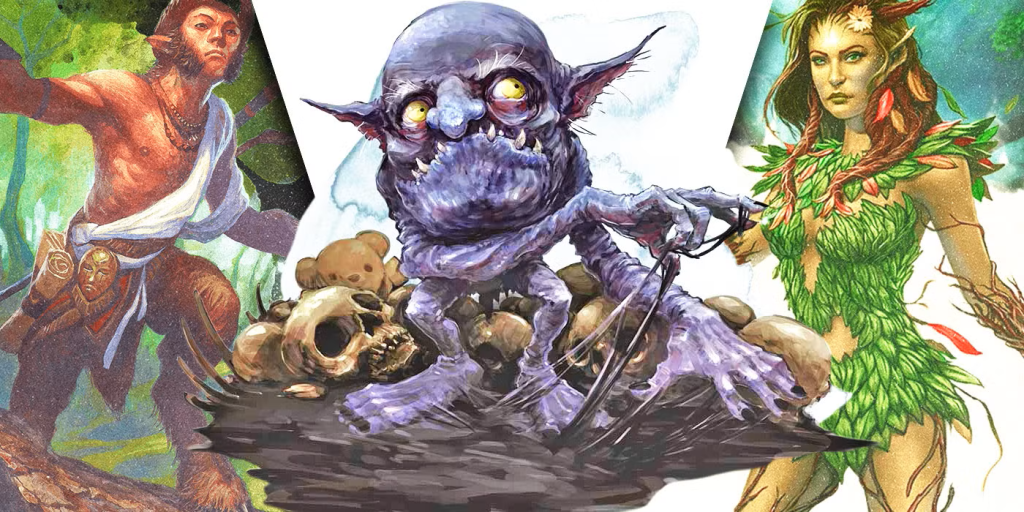
Fey have no unifying physical appearance across the different subraces. All of them are vaguely humanoid. The different subraces have some part of the natural world joined with part of their humanoid form. Leafy dryads, water naiads, horse hybrid centaurs, or goat hybrid satyrs are all examples of the natural world fusing with the humanoid form. Along with these fusions fey are frequently on the smaller side for height and weight. Larger fey are typically as tall as dwarves or elves while smaller ones are only a few inches. No matter the fey, they are gifted with immortal bodies that do not age or age at a minuscule pace.
Fey are gifted with magical powers. These powers allow the fey to blend in with the natural environments they call home. Additionally, they often provide a peaceful method to defend themselves from intruders. Misdirection and enchantment are a fey’s primary weapons against the clumsy followers of civilization that enter their realm. Some fey creatively use their magic to harm and abuse others, but such incidents are rare.
Culture
Fey have a unique culture among the creatures of Cimmeria. Fey have little or no need to eat to sustain themselves. The natural magic of the realm provides them with sustenance. Without a need for food, fey only gather together for entertainment instead of necessity. With few practical needs a fey is far more likely to destroy a social relationship in exchange for a few laughs. After all, in a fey’s mindset a social relationship exists only for laughs. Thus practical jokes and insult comedy are popular among the fey.
Fey commonly act independently, but they unite together in defense of their homelands. As the natural world provides them sustenance, if the natural world is destroyed the fey suffer. The ever increasing spread of civilization threatens the homes and lives of fey creatures. When humanoids despoil the forests and waterways of Cimmeria the fey respond with violence and intimidation. Humanoid communities have learned to respect the fey or risk their wrath.
Fey are roughly split into two camps in how they deal with other humanoids. These camps are referred to as the Seelie Court and the Unseelie Court. The court title implies a level of organization and respect that does not exist within fey culture. The fey simply enjoy playing dress up and using the same titles of nobility that other races do.
The Seelie Court want to coexist with the other races of Cimmeria. They feel that humanoids can be trained with education and communication to respect the fey world.
The Unseelie Court sees no long-term path for coexistence with the civilized races of Cimmeria. With an “us or them” mentality, Unseelie fey violently protect their homelands from any incursion by civilizing humanoids. The two Courts rarely agree on how to approach foreign affairs and often fight and argue amongst themselves.
History
Fey existed long before the Olympians came to Cimmeria. Many species of fey came into being during the Golden Age of Cronus. Their position was closer to divinity than humans thus their disdain for mortals has existed for centuries. Fey in ancient times were often antagonistic towards humans with a few exceptions such as Chiron, mentor of heroes.
Fey attitudes towards mortals stayed much the same after the Olympians conquered Cimmeria. The Unseelie fey were led by Davonisi to fight on the dragons‘ side during the Dragon War. These Unseelie committed some of the worst atrocities of the war. Their depravity is what drove Eathirilu to abandon the Dragon Hegemony and join the mortals’ side during the war.
Fey have a habit opposed to their typical animosity towards humans. They frequently participate in the founding of human royal lines. After the Dragon War the fey began engaging in this behavior once more. The Oceanides helped found Mars’ Oasis by creating the Dythalid Pool and birthing the first generation of Mars’ Oasis citizens. The nymph Chaktal married Gollard to become the first Queen of Aractrash. Prometheus created the washernia fey species as a force of chaos to protect King Aeëtes of Colchis from the lawful maruts of Hades. These peaceful interactions were common during the Early Kingdoms period of history, but have decreased in frequency as the years passed by.
Fey have always lived in the hidden natural places of Cimmeria, but they can be seen commonly in Dionysus’s city of Satronwook. The fey have always had a strong connection to Dionysus and Pan. When the gods’ parade around the Caspian started many fey joined their entourage. The final stop for the parade was at the village of Satronwook. After a raucous party, Dionysus created the alcohol fountain and the Baradera competition. The fey that traveled in the parade settled in Satronwook or nearby the city. It remains a place where fey interact frequently with the civilized world.
Subraces
There are dozens of subraces of fey, far too many to describe them all. The most prominent fey are described here, with many less common subraces living in the woods and wilds of Cimmeria. Centaurs are one of the largest fey subraces as a horse-human hybrid. Satyrs are a frequent trickster with a goat-human hybrid body. Nymphs are the beautiful daughters of gods and the spirits of nature. Pixies are tiny winged faeries gifted with powerful magical ability. Harpies are horrid winged humanoids with enchanting voices that lure people to their deaths.
Centaurs: Centaurs are half-human half-horse hybrids. They have the body of a horse, but where the horse’s head and neck would be there is a human torso instead, complete with arms and a head. Centaurs are one of the faster races of Cimmeria due to their horse body. They are incredible shots with bows as well.
Centaurs live in hilly areas of Cimmeria. Every few years a group of centaurs descends from the hills into the civilized lands. These groups are ravaging plunderers. They rape and pillage every settlement they come across. Their primary goal is alcohol. Any food or drink they can find is consumed immediately before the centaurs move on to the next town or village. Villagers in centaur areas often build basements to take shelter in during these raids. As they are horse-people, centaurs don’t understand basements and leave them untouched during their assaults.
Satyrs: Satyrs are half-human half-goat hybrids. They have two hairy goats legs attached to the upper body of a human. Goat horns grown from their head. Satyrs are shorter than humans, standing about four and a half feet tall and they are always male. Satyrs are frequently bearded with goatees.
Satyrs are famous partiers. They’re always drunk, hungover, or on the hunt for more alcohol. Hundreds of satyrs follow Dionysus around in service to him and his gifts. Satyrs are also famously horny, desiring to fuck practically anything that moves. Women must be careful around satyrs. Fortunately satyrs can be easily fooled or overpowered when their arousal is peaked.
Nymphs: Nymphs are beautiful nature spirits. Each nymph is female and each nymph is bound to a natural feature of some kind. This binding occurs when the nymph is created through some magical or divine process. Nymphs draw their strength from their bound natural feature. If separated, the nymph will sicken. If the natural feature is destroyed, the attached nymph suffers an agonizing death.
The particular natural feature defines the specific variety of nymph. Dryads are bound to plants, usually trees. Naiads are bound to rivers, streams, lakes, and ponds. Oreads are bound to mountains and prominent rock formations. Oceanids are an exception. While they naturally live in salt water bodies, they are not bound to those areas in the same way other nymphs are. Oceanids can wander freely across the world with no restrictions on land or water.
Nymphs’ main motivation is to protect their bound object. Their main weapons are their profound beauty and magical power over nature. Trespassers in a nymph’s domain risk being led astray by an enticing woman. Once distracted, poisonous thorns, rockslides, and drowning are common occurrences for those that don’t respect the power of a nymph.
Pixies: Pixies are the smallest of the fey, standing between one inch and one foot tall. Their skin, hair, and eyes can be any color of the rainbow, but tend towards muted pastels. Pixies have rail thin humanoid shaped bodies. Out of their backs grow gossamer wings that allow them to fly in calm weather.
Pixies possess the most powerful magic of the fey. A young pixie’s spellcasting abilities rival those of experienced wizards. Their expertise lies in illusion and enchantment magic. Most pixies are able to turn invisible. Older pixies develop magical powers related to music and nature. All of them use their skills to play tricks of the mind on other races.
Pixies are unusual among the fey and other races of Cimmeria as they are functionally immortal. Pixies are born from nature in their fully matured form. They are able to walk, talk, and fly from their origin. Pixies live forever without aging. When they die due to accident or design their spirit rejoins the flow of nature and is reborn the next spring in a new body. Pixies recall pieces of their previous life, but their magical powers regress to their beginning with every reincarnation. A pixie that suffers a true death release a powerful magical aura. Some nefarious wizards seek out ways to truly kill pixies in order to harvest this aura for magical experimentation.
Harpies: Harpies are female human-bird hybrids. Their lower bodies are the feathery legs and talons of a large bird of prey. They have wings instead of arms, but with crude hands at the ends for grabbing objects. The rest of their features are human. Harpies favor straight hair with brown coloration for their eyes, hair, and feathers. The combination of features gives harpies a universally grotesque appearance.
Harpies use their many gifts to aid their favorite pursuit, luring mortals to their deaths. Harpies typically make their homes on mountain cliffs or sea bluffs. They hunt surrounding fish or wildlife for food just like animal birds of prey. They also possess beautiful, melodious voices that are spiked with enchanting magic. Any mortal that hears the sound becomes enraptured and must follow the music to its source. Harpies position themselves such that their victims walk on a path that leads towards a deadly fall or drowning.
Harpies hate interruptions in their favorite activity of leading people to their doom. When prevented they grab the offender with their talons. Next they fly to a great height to drop their victim upon a rock or in the deep ocean. If this secondary activity is halted, harpies become sullen and hateful. They land and sulk until they can resume their murderous tendencies unimpeded.
Location
Most fey live in the forests, jungles, and waters of Cimmeria. Wherever they are, they live far away from the cities and towns of the civilized races. Fey thrive in the natural world far away from agriculture and industry. Fey rarely leave their realm as spending long lengths of time in civilized areas sickens them. The one exception to this is the city of Satronwook. The city was blessed by Dionysus and Pan making it hospitable to fey despite its settled nature.
Some specific species of fey live in different areas of the world instead of forests, jungles, and waterways. Those associated with ice and frost live in the mountains or north of Cimmeria in the Dark Reaches. Centaurs live on Apollo’s Plains. Washernias live in Colchis. Some twisted Unseelie live in the Underdark. While most fey can be found far from civilization a few find places for themselves in cities despite the sickening feeling.
Relations with Other Races
Fey have a tense to hostile relationship with most other races. They like living with their own kin. Satyrs, centaurs, and maenads enjoy journeying into civilization to drink and break things, but coexistence is out of the question.
There are a few exceptions to the hostility shown to other races. Elves famously live in peace alongside both Seelie and Unseelie fey. Halflings and dragons are also shown a friendly face even if they don’t typically live in the same communities as fey. Fey can become friends with individuals of other races that show them proper respect, but those people are a rare breed.
Common Deities
Fey worship a variety of deities with different subraces favoring some over others. Pan, Artemis, and Gaia are loved by all fey as symbols of the wild places of the world. Satyrs and oreads worship Pan and Dionysus. Dryads are particularly devoted to Gaia. Oceanides and naiads worship Oceanus and Tethys. Centaurs worship Dionysus and Ares. Pixies pay fealty to Hermes for his love of tricks and practical jokes. Harpies serve Zeus as part of his punishment against those that violate the laws of hospitality. Numerous less populous subraces have their own favorites beyond those listed here.
Place in Adventuring
The fey’s place in adventuring depends on whether their sentiments fall more in line with the Seelie or Unseelie Courts. Seelie fey are a force that must be respected by adventurers. Fortunately Seelie can often be bargained and reasoned with. Compromise is always possible with Seelie fey and they be forgiving of mortals that don’t understand any arcane fairy taboos they may be violating. Unseelie fey are another matter entirely.
Unseelie fey interactions with adventurers are almost universally violent. Any interaction with adventurers is likely to make an Unseelie feel insulted. They may accept appeasement, but their desires are often associated with human sacrifice or debasement so embarrassing the victim will never recover from it. Worse, a straight fight with an Unseelie Court is doomed to fail without a titanic force behind the adventurers. Fortunately, a rogue Unseelie can be defeated but only by an experienced adventuring party.
Fey make poor adventurers themselves. Their connection to the natural world makes leaving their wild abodes particularly unpleasant. Some fey actually cannot leave due to magical connections to the trees or a river that prevents them from wandering too far. Half-fey children can become adventurers. Their ancestral ties to nature draw them to the druid and ranger classes.



 GoCorral