Subraces
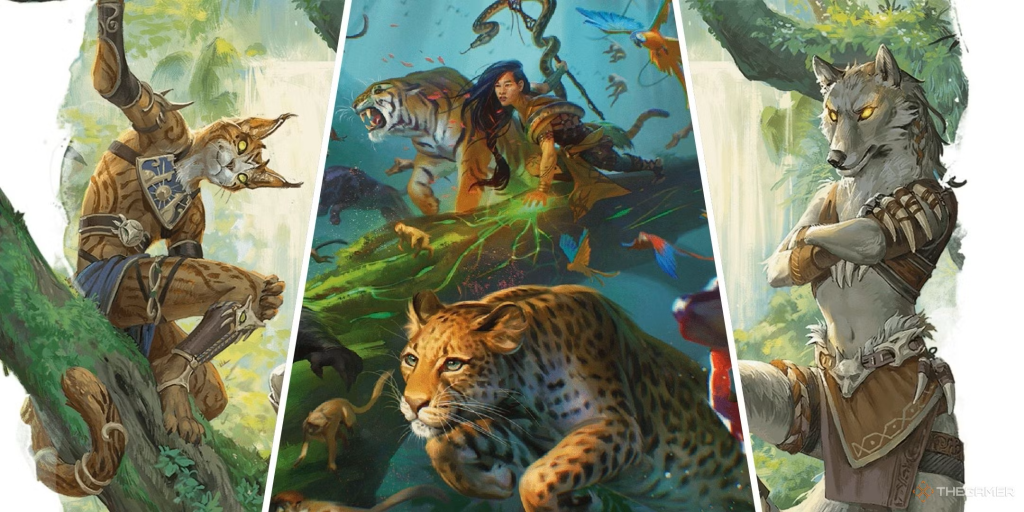
There are numerous types of lycanthropes when they are defined by their animal form. Despite that, it is more helpful to separate lycanthropes by how they acquired their condition. Natural lycanthropes were born that way due to their lineage. Infected lycanthropes became that way due to a bite from another lycanthrope. Additionally, there is a subrace called shifters. Shifters are the children of a lycanthrope, but due to dilution of the transformation gene, they cannot transform.
Natural Lycanthropes: Natural lycanthropes are born that way due to having one or more lycanthrope parents. They do not possess complete control over their transformations at birth, but quickly develop over time. Just as a baby learns to walk, a lycanthrope child learns to choose when they transform into their animal or hybrid forms. Caretakers for natural lycanthrope babies must be careful. The bite of a lycanthrope transmits the disease, and babies bite frequently.
Natural lycanthrope children do not necessarily match the animal type of their parents. While having the same animal form for family members is common, many lycanthrope babies have a different transformation than their parents. They are raised to always hide their true nature. A visible lycanthrope is often a dead lycanthrope in Cimmerian society. Natural lycanthrope children are still able to revel in their strength, speed, and agility as the animal powers are slightly transferred into their humanoid bodies. Thus, lycanthrope children often stand out from the crowd.
Infected Lycanthropes: Infected lycanthropes acquire their condition through the bite of another lycanthrope. An infected lycanthrope will always share the animal form of the lycanthrope that bit them. Sometimes, a victim is unaware of their condition after the bite. A werewolf in animal form can appear to be just a wolf. If someone is bitten but escapes, they may assume it was just a normal animal. The infected person continues going about their daily life until the next full moon triggers a transformation and they attack anyone in their vicinity.
Infected lycanthropes are often desperate to cure their condition. While powerful magic can cure the disease, that is usually inaccessible to the average person. Most infected people seek a wolfsbane potion. The freshly picked flower is brewed to provide a cure for someone afflicted with lycanthropy, provided that the potion is consumed before the end of the first full moon after someone was bitten. Thus, a bite victim must act rapidly to find wolfsbane and an apothecary capable of mixing the potion, and that’s if the flower is even in bloom.
Infected lycanthropes that do not find a cure have less control over their transformations than natural lycanthropes. An infected can take years to learn how to transform at will. Often even longer to maintain control of themselves while in animal form. With effort, they can eventually master their disease and comport themselves as natural lycanthropes do. Unfortunately, most infected lycanthropes are discovered and slain by adventurers before they reach that point.
Shifters: Shifters are the children of lycanthropes that don’t fully inherit the transformation gene. They appear as their humanoid race, but with more wild and hairy features. Shifters cannot transform, but they do possess a strong adrenaline rush. In dangerous situations, they take on some of the characteristics of animals. Thicker skin, faster reflexes, and stronger muscles, sometimes even natural weapons such as sharp fangs or claws. Despite these traits, shifters still possess only one humanoid form. The bite of a shifter does not pass lycanthropy. Children of shifters can be shifters themselves or solely their humanoid race if the transformation gene is fully lost.





Leave a Reply