Physical Description
The water races of Cimmeria live within the Caspian and Aral Seas. They are generally humanoid in shape with most subraces having a head, torso, two arms, and two legs. Their bodies are adapted to the water, sporting gills, webbed toes and webbed hands for improved swimming. Many water races have dorsal fins and tails to assist with movement through the water. While some water races have lungs for breathing above water, many do not. Those without are able to hold their watery breath for several minutes on land.
Some water races live in the deep waters of the Caspian far below where the sun penetrates. The deep waters are a dark place, thus the water races have developed darkvision to see at those depths. Additionally, water races that live on the sea floor of the Caspian have thick skins to resist the increased water pressure at that depth.
Culture
Despite being wildly different in form and temperament, the water races share a cultural foundation shaped by life beneath the sea. Their societies are adapted to the dangers and bounties of the ocean. Vicious sea monsters still lurk in the depths and the water races look to the gods for protection. All water races pay homage to the many gods of the sea whose space they occupy. Rituals revolve around tides, storms, and migrations.
Water race culture revolves around interdependence with the ocean’s resources. Hunting, gathering, and crafting are shaped by the availability of coral, kelp, cavern stone, and the many creatures they coexist with or prey upon. Tools and ornamentation often incorporate shells, bone, and bioluminescent materials, giving water race craftsmanship a distinctive glow in the dark waters. Some societies, like the merfolk, maintain trade and diplomacy with surface dwellers. More insular or aggressive groups rely on raiding, territorial control, or survivalist nomadism.
Social structure among the water races is varied but linked by a shared understanding of power as fluid and situational. Leadership may be based on age, wisdom, ferocity, or mystical insight, but it must always respond to the shifting demands of the ocean environment. The stoic councils of triton cities, the egalitarian bands of merfolk, the predatory hierarchies of sahuagin war-clans, and the chaotic priesthoods of locathah all reflect ways of adapting to the pressures of the deep. Even scrags follow an order of strength, however brutal. Despite differing values, water race cultures respect strength of purpose whether expressed as martial skill, survival insight, or mystical fervor.
Perhaps the greatest unifying feature of water race culture is their relationship with stories. Oral tradition dominates underwater life as writing with ink and parchment is impossible underwater. Tales are told through song, dance, or ritualistic reenactments. Legends speak of lost cities claimed by the deep, heroic defenders of the trenches, monstrous beings from the abyss, and the delicate balance between the surface world and the ocean below. These stories bind the different water races together, reminding them that while their forms and values differ, they all belong to the vast, living world beneath the waves.
History
The water races were originally native to the Mediterranean Sea and the outer ocean that encircles the earth. When the Olympians came to Cimmeria they did not bring the water races at first. Only after winning the Goblin War did they open a whirlpool in the Caspian Sea. This whirlpool links with Charybdis, the whirlpool in the Strait of Messina between Italy and Sicily. Anything that goes into one whirlpool will be spit out the other side, if its not destroyed during the process.
The water races were led in droves through Charybdis and exited into new territory in the Caspian. They didn’t have long before the gods introduced monsters to the region. The sea was not spared this event. Sea serpents , chuuls, krakens, and other monsters of the deep terrorized the water races. They lived in fear for decades, forming communities as best they could to evade the monsters that preyed upon them.
The sea monster plague was lifted by the Heroes of the Dragon War. Jovy, Cecilia, and Amalgami cleared the Caspian of the more dangerous monsters. The safer territory allowed the water races to rally and defend themselves from the lesser threats. Amalgami and Toffoun cleared monsters from the Aral Sea as well. Water races were able to settle that sea in small numbers after it was made safe.
All four of the heroes, Jovy, Cecilia, Amalgami, and Toffoun are honored by the water races but Cecilia is at the top. The others largely stayed out of the water when fighting sea monsters, using boats, islands, or magical flight to fight back. Cecilia actually entered the water and spoke with the water races to coordinate with them as needed. Rituals of thanks are performed by each water race at the town of Cecilia every year.
After the actions of the Dragon War Heroes the society of the water races advanced along separate lines from that of the rest of Cimmeria. Only in recent years did the water races cross paths with surface dwellers once more. During the Second Alliance War Poseidon led his followers in an attack on Phoenix. The sahuagin defected due to the control of Kharad-khor and struck at Bradel Fields. The Bradel Fields attack failed, while the Phoenix attack succeeded. Phoenix is now flooded and largely abandoned by surface dwellers. The water races have settled in the water logged buildings below the surface of a large lake that now surrounds the city.
Subraces
The water races are varied in visual appearance, but all are able to swim and live anywhere within the waters of Gaia. The different subraces do not typically live in the same communities besides those around Cecilia.
Locathah: Locathah have humanoid bodies with webbed limbs and the head of a fish. They live in the deeper areas of the Caspian, far from the sun’s light. In the deep waters they practice dark rituals to ancient gods. It is no secret that some locathah seek the return of the Titans. Mortals are offered in sacrifice to give power to the Titans so that they can break their bonds in Tartarus. The locathah raid the surface, capturing mortals to sacrifice and to find locations to perform their rituals while their victims are still alive.
Merfolk: Merfolk have the upper body of a human and the lower body of a fish. Their great fish tails allow them to swim quickly while their upper body allows merfolk to have more peaceful relations with the surface world. A familiar appearance breeds familiar attitudes. Merfolk live on the edges of the Caspian, particularly around port cities. They act as merchants for the rest of the water races, exporting the sea’s bounty to the surface world while importing commodities from above to help the rest of the Caspian’s people.
Sahuagin: Sahuagin are a hybrid version of a shark and a humanoid. They have claws, a vicious bite, and a strong sense of smell in the water. Their affinity for sharks extends to husbandry as well. Sharks are kept as pets and mounts by sahuagin. Sahuagin also adapt the shark mindset to the rest of the world. They are the most violent of the water races. If a ship is attacked in the open water, its likely a sahuagin raid.
Some sahuagin are born with four arms. These mutants are amazingly strong. Sahuagin society is organized around a hierarchy of physical might. That organization allows sahuagin mutants to rise to positions of political power. The leaders of sahuagin tribes are mutants more often than not.
Scrags: Scrags are the underwater version of trolls. The aquatic environment provides a notable benefit to scrags as fire is an impossibility below the water’s surface. Without fire their regenerative capabilities are unrestrained. Scrags raid the surface world for food and valuables before retreating into the water to heal their injuries. Once they’ve collected enough food for a year, a community of scrags will descend into the deep waters of the Caspian until the next year.
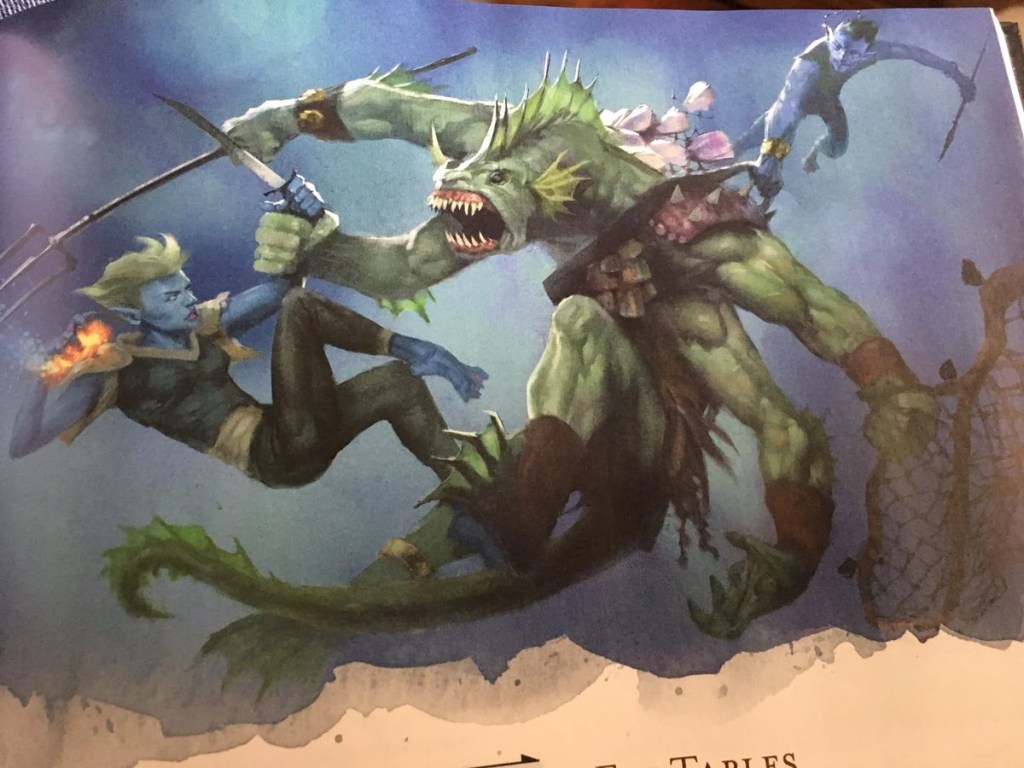
Tritons: Tritons look like elves with blue skin. They’re able to breath water and air. They have no webbing between their digits or fins of any kind. Regardless, tritons are able to move through the water easily due to their magic. They push water through their feet and hands to propel themselves through the sea. Tritons are also one of the few water races to wear clothes.
Tritons were the favored people of Poseidon while he was the god of the sea. Poseidon’s first son is named Triton and his descendants inherited his name for their race. Along with the divine name came divine powers. Tritons have power over the water and can also magically command fish and other animals that live within the sea. Their magical power and ancestry gives tritons a feeling of superiority over the rest of the water races. While Poseidon reigned, this feeling was reinforced with a superior position within the sea’s hierarchy. This arrangement is set to be disrupted with Zelus as the new god of the sea. He does not favor the tritons in the same way that Poseidon did, partially due to his distaste for shirts.
Location
The water races live within the Caspian and Aral Seas of Cimmeria. Many of them live around the edges of the water near the land and islands. The deeper areas belong to locathah and scrags that can survive at those depths. A few of the water races live in the ruins of Phoenix after the Second Alliance War. The Delain River leading to the city from the Caspian Sea is also occupied by a few water race villages.
Relations with Other Races
Many water races wish to be left alone by the other races of Cimmeria. The top of the seas is shared, but below the surface belongs to the water races. As long as that territory is respected, the water races have no issues. Some of the subraces have different views on this matter. Famine can strike below the sea as well, causing sahuagin to attack ships for food. Locathah and scrags have also been known to kidnap surface dwellers to sacrifice in rituals to revive banished gods. Merfolk and tritons rarely cause issues to surface dwellers.
Common Deities
As the new god of the sea, Zelus is first and foremost for the water races, especially sahuagin and merfolk. However, many are still loyal to Poseidon and Amphitrite even after their lord was cast down. Cults have formed seeking the return of their lost lord, particularly among the tritons who lost their position of power in Poseidon’s court. These groups mix with even older cults still loyal to Oceanus and Tethys who rule the ocean outside of Cimmeria.
Place in Adventuring
The water races live separate from the rest of Cimmeria. Water race adventurers on the surface are rare, but they do exist below the water’s surface. These adventurers face the threats of the deep to keep their underwater settlements safe from sea monsters.
Each water subrace favors different classes. Tritons are typically paladins or clerics due to their closer connection to the gods of the sea. Merfolk are typically sorcerers or fighters. Locathah are typically rogues or druids. Scrags and sahuagin both favor the barbarian class but sahuagin also occasionally train in the druid way. Water races are rarely rangers or wizards. The fighting style of a ranger doesn’t work below the waves and the writing required for wizards is difficult underwater as well.
The water races occasionally feature as threats for the surface world of Cimmeria. When surface dwellers violate convoluted peace treaties the water races strike back. It falls to adventurers to reestablish peace. Bands of sahuagin, scrags, and locathah also occasionally fall into more violent habits that result in conflict between the surface world and the underwater world. The aquatic environment requires that more experienced adventurers take on these challenges, simply because more powerful magic is required just to breath, move, and survive for long periods underwater.