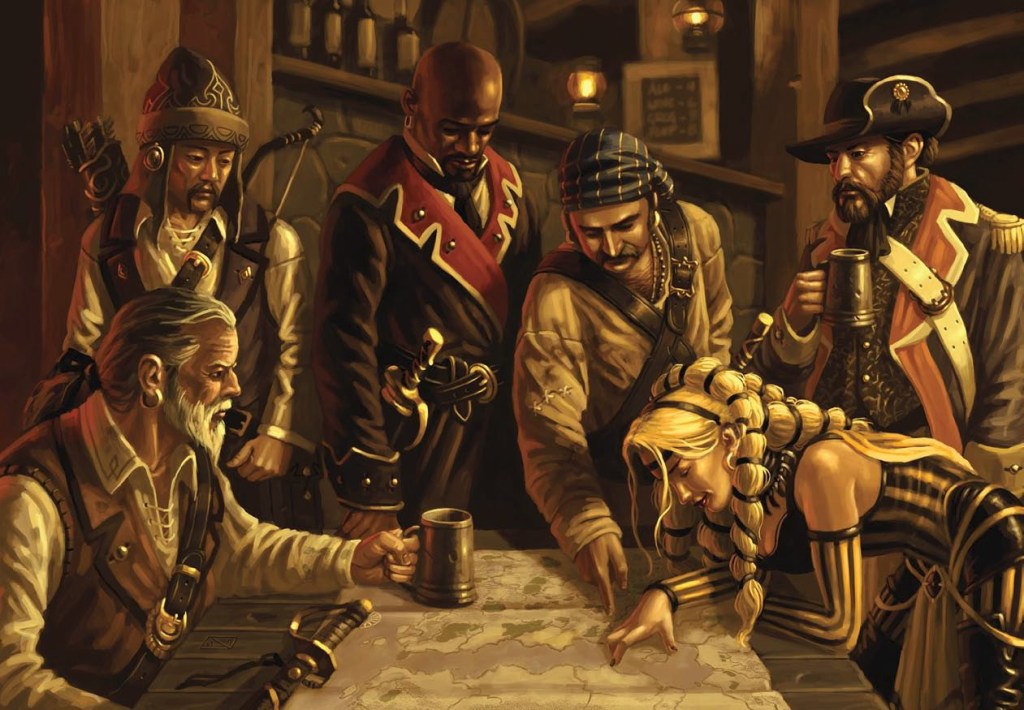
Physical Description
Humans are physically on the larger end of humanoids in Cimmeria, but with far more variance in their cosmetic features. Humans stand five to six and a half feet tall and weigh 100 to 300 pounds. Their hair color varies from blonde, red, brown, or black, but with black being the most common. Skin color can be beige, pink, ivory, olive, brown, or ebony. Olive is the most common color in Cimmeria. Eye color can be grey, blue, green, hazel, or brown. Human males have beards, but variations in style and genetics dictate their presentation.
Humans are the most populous race in Cimmeria. They have a higher fecundity rate than most, but their true strength comes from cooperation. When threatened, humans always stick together for the good of the community. Through this, they’ve managed to weather the many storms and tragedies that devastated other races of Cimmeria.
Culture
While humans work together in times of adversity, their natural state is more of greed and selfishness. A group of humans is kind and protective. A solitary human is dishonest and conniving. Humans are intelligent and have a community focused culture, but they lack the lifespan of the longer lived races. Humans act with no thought to long-term consequences, often with disastrous results.
From a broader view, humans have many different cultures. Their dissemination across Cimmeria allowed humans to develop into a variety of different cultures that are quite distinct from each other. Customs in Aractrash are different than those in Xoria, Gazeara, Dalleer, and so on. The unifying factors, as stated, are individual greed and communal guardianship.
History
Humans are involved in nearly every piece of Cimmeria’s history. They participated in the Goblin War alongside the other Conclave races. As the dominant force in the Conclave, humans slowly drove the other races out of the organization. Dwarves left, then elves and orcs. Halflings lingered within the Conclave far longer than the other races, but they also abandoned the aggressive humans in time.
After the halflings left, the Conclave dissolved. Humans split apart to form independent communities. Unfortunately, this only made them easier to conquer when the dragons attacked. Humans weathered the storm under the Dragon Hegemony. Working together, they fought alongside the other Conclave races once more to secure their freedom. Four of the ten Dragon War heroes were human.
It becomes difficult to track human history in Cimmeria after the Dragon War. The different settlements of humans encountered problems relative to their own area. They rarely worked together again. The githyanki invasion might’ve coerced a united reaction, but unfortunately, there was no broad response to the outsiders. This was largely due to githyanki assassination of human leadership prior to the invasion.
Over time, humans formed into three main blocks within Cimmeria. These were the Xorian Kingdom, the Aractrashan Kingdom, and the city-states of Northeastern Cimmeria that were free from the influence of both kingdoms. The city-states kept to themselves and the Aractrashan Kingdom stayed within the natural borders of the Aractrashan Jungle. The Xorian Kingdom’s expansionist policies drove much of human Cimmerian history over recent years.
The Xorian Kingdom relentlessly conquered other realms for many years. They took over the surrounding city-states and incorporated them into their realm early on. Xoria then looked outside Cimmeria to expand into the provinces of the Assyrian Empire. These invasions were repulsed over time and the Xorian Kingdom entered a decline. It was only through the union of the Xorian King Jevaninada I and the Amazon Queen Anajakaze that Xoria became ascendant once more. The two armies together were able to conquer half of Cimmeria.
Xorian expansion was undone in recently. The dragon god, Blendegad the Reaper, turned Jevaninada II into a dragovinian. This initiated the spread of a new religion, Dragovinysm, and a new age of expansion for the Xorian Kingdom. Jevaninada II led an invasion of Eastern Cimmeria. The city-states of the East rallied along with the Dwarven Kingdom to form the Second Alliance. They resisted and defeated the dragovinians. Eathirilu used Pan‘s Touch of Nature to purify all dragovinians back to their mortal forms. The sudden reversion resulted in the collapse of the Xorian Kingdom. Humans rebelled across the nation and killed their previous oppressors.
Human society entered a decline after the Second Alliance War. Many cities and towns were destroyed or depopulated. Thousands of humans left the supposed safety of civilization to form roving bands of robbers and thieves. Queen Tarigananata of Xoria is trying to hold her kingdom together while the remnants of the Second Alliance look to preserve themselves over the welfare of the whole human race.
Subraces
Humans have numerous subraces across the world. There are slight physical differences between the subraces, but they are separated by appearance and culture rather than ability. Only a few subraces are relevant in Cimmeria. The Cimmerians have the most population in the region, obviously. The Cimmerians are followed by the Aractrashans and Xorians who split off from the main group of humans to form larger kingdoms. Amazons come from outside of Cimmeria, but have gone native within the region. The only outsider subrace that frequently contacts people in Cimmeria are the Persians. Finally, Greeks do occasionally have contact with Cimmeria due to their shared deities.
Cimmerians: Cimmerians are the most numerous subrace of humans in Cimmeria. They have red, brown, or black hair and olive colored skin. They have eye colors of all kinds with darker eyes being slightly more common.
Cimmerians have no unified culture beyond their respect for the Olympians. With dozens of independent city-states and towns, each has its own traditions, rituals, and way of dressing. The people of Jipangu are absolutely foreign to those of Gazeara, who are foreign to those of Restnor’s Point. Cimmerians have a common language, and the food they cook is often similar, but little else is shared between this subrace.
Aractrashans: Aractrashans live in and around the Aractrashan Jungle of Cimmeria. With few variations, they have fair skin, blonde hair, blue eyes, and sharp facial features. Aractrash’s location on the Southeastern edge of Cimmeria puts them in a prime spot for trade with Eastern Persia. Numerous goods pass through Aractrashan hands as they move between Cimmeria and Persia. Aractrash also hosts a large slave market of sentient workers that are bought and sold alongside less sentient beasts of burden.
The people of Aractrash are inwardly focused. While they are happy to enrich themselves through trade with the outer world, they would rather stay in their jungle than develop real relationships with other people of Cimmeria. Within the Aractrash Jungle, Aractrashans are the civilizing force. The jungle was savage and unsettled even by the goblins before the Goblin War. The Aractrashan humans are consistently pushing deeper in the jungle to secure more land and resources for themselves.
Xorians: Xorians live in Western Cimmeria south of the Rarventataa River. They have short black hair and dark almond-shaped eyes. Their skin is yellow-gold in tone. Xorians have prominent cheek bones and the males have thin facial hair.
Until recently, Xorian culture was hierarchical. The Xorian King gave commands to the lords who gave commands to the burghers on down to the peasants and tradesmen. Each citizen knew their place and did what was required of them by their superiors. Decades of true tyranny under the dragovinians spoiled any hope of that continuing. The end of the Second Alliance War saw a series of riots and rebellions that targeted anyone possessing political power in the previous regime. In the aftermath Xorian society is stood on its head with new forms of government rising and falling constantly.
Xorians have a habit of expanding outwards. The Kingdom showcased this best with their conquests, but individual citizens have smaller habits that match the same trend. Xorians frequently look for ways to expand and improve their businesses. Whether in agriculture, industry, trade, or service, they always look forward instead of being satisfied with what they have.
Amazons: Amazons came to Cimmeria from Scythia, the region north of the Black Sea. Amazons stand a few inches taller than most other humans with a corresponding increase in weight as well. They typically have blond, black, or red curly hair. Their skin is a deep olive color and their eyes are brown, green, or hazel. Amazon facial features create a countenance that is either beautiful or terrifying.
Amazons are a matriarchal subrace with the Queen as the head of state and the mother as the head of household. Their society prizes martial prowess above all else, so much so that their ruler is chosen through a fighting tournament. Whenever the Amazon Queen dies a tournament is held to choose the next ruler, with the best combatant taking the crown.
The Amazons are a fierce and war-like race, always looking for another conflict to prove their valor in. They fought alongside the Xorians during the Second Alliance War, but with the structures of order breaking down in Western Cimmeria the Amazons are free to act on their own. They have begun pillaging and raiding towns and villages across the defunct Xorian Empire, as they did when they first came to the region centuries ago.
Persians: The great Empire of Persia lies to the south of Cimmeria. The people of Persia are varied in ethnicity themselves as the Empire spans across dozens of different tribes and cultures. The Persians themselves are taller than the average human with slight builds. They have dark eyes and hair. They have fair to light olive colored skin. Persian faces are typically dominated by large noses.
The current King of Kings of Persia is Artaxerxes II. His rule was challenged from the start by his brother’s claim to the throne and a number of revolts. His brother was slain in civil war and many of the revolts have been put down. Unfortunately, it seems that a new revolt occurs every time Artaxerxes defeats the previous one. Fortunately, trade has always remained strong throughout the Persian Empire. Goods from Cimmeria and India pass through Persia on their way west and goods from Africa and Europe pass through Persia on their way east. Either way, Persia profits on the trade, making it a wealthy empire and a wealthy populace as well. It’s no wonder that many of the richest merchants in Cimmeria are Persian or descended from Persians.
Greeks: Greeks are the original people of the Olympian gods. While the Olympians moved their mortal escapades to Cimmeria, the Greeks still hold a special place in the pantheon’s collective heart. Greeks have curly hair of red, brown, or black color. They have light olive skin and green or blue eyes. They have great constitution compared to other human subraces and can run for longer distances.
Greeks aren’t a common sight in Cimmeria. Even Grecian merchants rarely travel further east than Lydia. Those who go beyond the Anatolian Peninsula are typically official representatives from a city-state or noble. The occasional exiled Greek can also make their way to Cimmeria.
Location
Humans live across the plains, hills, and valleys of Cimmeria. Few are found in the forests and mountains. The exceptions are the people of Aractrash that have learned to live with the jungle and the people of Mars’ Oasis who subsist on the magic of the Dythalid Pool. Throughout Cimmeria humans gather in the cities of the region, with dispersed towns, villages, and farms around the major population centers.
Relations with Other Races
Other races are wary of humans. The other long-lived races see humans as babies that need instructing or out of control teenagers to be avoided. Humans have tense but stable relationships with dwarves, elves, and halflings. A dominant relationship exists between with orcs and goblins. Humans captured so many orcs and goblins during the Time of the Conclave and the Age of Monsters that a significant slave population exists within Cimmerian human settlements. Orcs have a tendency to resist their servile position while goblins accept their enslaved status.
Humans are largely hostile to other races besides the ones described above.
Common Deities
Humans worship the twelve gods of the Olympian pantheon. Zeus gets special attention as the king of the gods. The agriculture required for human civilization also places Demeter as a central figure. Ingenuity and invention to support that same civilization brings Athena and Hephaestus into the mix. Human men often choose Apollo as a favored deity while women gravitate towards Hestia or Hera depending on their personalities.
Place in Adventuring
After the Second Alliance War human civilization entered a decline. With so many of their cities ravaged and destroyed by the conflict, many humans were left homeless and jobless. To support themselves, humans have turned to banditry in great numbers. Adventurers are commonly called to a community to kill or drive off human raiders. Additionally, human selfishness is often exemplified in the callous magical research of human wizards. Higher level adventurers encounter human wizards who have committed unthought of travesties to reach unseen magical heights.
As adventurers humans are extremely versatile. They regularly fill any of the standard adventuring roles of fighter, wizard, rogue, and cleric. There are perhaps a higher number of human paladins than other races and a lower number of druids. This seems to stem from humans’ love for the comforts of civilization over the wilds of nature. Humans do still make fine rangers, but with the mindset of conquering nature rather than protecting it.

 GoCorral