The elves of Gurutama live in the Lower Maw.

Previous: An Overview of Gurutama Part 6

Last time I mentioned that the elves allied with the dwarves against the human Najar Empire.

Elves are typically enemies of dwarves in high fantasy. Which is strange because they are both “good” races in D&D.

Tolkein started this trend by making dwarves and elves good, but having them disagree on nearly everything.

Tolkein’s dwarves and elves disagree on how to wage war, on how to act socially, on what professions are honorable, etc.

I controlled the elves and the dwarves in our Dawn of Worlds game, so I decided to change that rivalry into a partnership.

But first! Where did the elves come from?

Our first four races were based around the four elements. Water for merfolk, air for avians, fire for humans, and earth for dwarves.

The second set of races only had three positions in it. One of my friends became too busy to keep playing the game and dropped out (resulting in his race, the avians, becoming a subject population).

The new set of three was based off of the Hindu Trimurti, Brahma the Creator, Vishnu the Preserver, and Shiva the Destroyer.

The elves represent creation. Everytime I had the elves do something I always tried to tie it into creation.

The elves built many of the wonders of the world that exist in Gurutama.

This also allowed me to stay within normal elf stereotypes. They live in the forest, are good with magic and bows, and they make beautiful things.

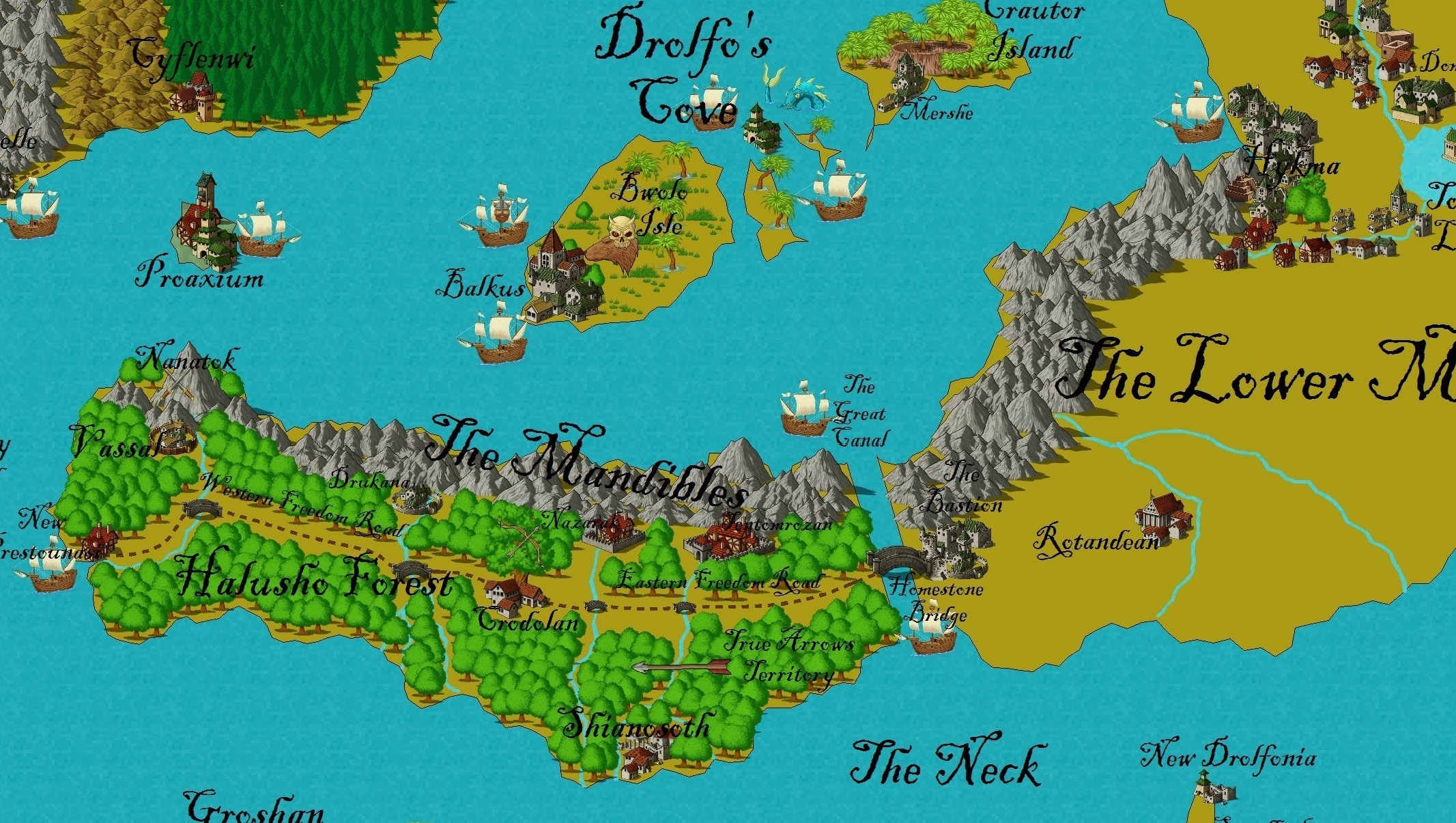
In our Dawn of Worlds game, the elves showed up and began expanding through the Halusho Forest, seen above.

The elves joined the dwarves against the Najar humans because they also thought it was the right thing to do. Demons should be sent back to Hell after all!

The elves created the port city of Cyflenwi at the upper left of the posted image. This city supplied the dwarven invasion of Najar.

The city was subsequently taken over by the merfolk and handed back to the Najar humans under some treaty or another. The details on it are a little hazy, just like everything else when you look too closely at the Dawn of Worlds game.

After Cyflenwi was taken over the elves became more independent from the dwarves. I’ll talk more about the rest of the elves history in my next blog post on Gurutama.

-Mister Ed

Next: An Overview of Gurutama Part 8

2 responses to “An Overview of Gurutama Part 7”

  1. An Overview of Gurutama Part 6 | GoCorral Avatar

    […] An Overview of Gurutama Part 7 […]

  2. An Overview of Gurutama Part 8 | GoCorral Avatar

    […] An Overview of Gurutama Part 7 […]

Leave a comment

I’m Isaac

Welcome to the GoCorral website! I’m Isaac Shaker and this is a place for me to write about D&D and occasionally other topics. I host a podcast called Setting the Stage that interviews different DMs about their campaigns. I’m currently focused on completing the Cimmeria campaign setting and turning it into a book.

Setting the Stage Podcast

86 – Wuxia Adventures in RPGS (Daniel and Metanoia/Ithasen) Setting the Stage, Campaigns for D&D and Other RPGs

I interviewed Daniel, my cohost of the Tabletop Community Spotlight! Daniel created his own setting called Ithasen with an in-progress wuxia TTRPG system called Metanoia to go along with it. Ithasen has a spiritual force known as Ren that pervades the world. Ren is a magical manifestation of the user's, or Rennim's, will upon the universe. Rennim that cultivate their will grow stronger and capable of more amazing feats as the concentrate their power and force of personality.Within Ithasen there are seven lineages of people that decide what type of Ren they can use. Anamor use conversion Ren. Elkyr use flux Ren. Janim use elasticity Ren. Nyl use influence Ren. Okoi use recurrence Ren. Haqol use harmony Ren. Finally, Daruner use use coalescent ren. The two races lineages that drive unique politics in Ithasen are the Daruner and the Haqol.Daruner children absorb the Ren talents of both their parents, becoming a perfect blend of Daruner and another lineage parent. Through this mixing, a Daruner family could potentially include all other lineages within itself. This power has placed Daruner as the nobility of Ithasen.Haqol's power of harmony allows them to amplify the Ren powers of others. This puts Haqol in a vulnerable position as unscrupulous people will do anything to incorporate Haqol lineage into their bloodline. Haqol have experienced something akin to a genocide as their lineage has been consistently absorbed by other lineages and diluted over the centuries.There's a whole lot more than that so strap in!Daniel has a fully setup GitHub Wiki for information on Metanoia and Ithasen that you can explore.There's a Metanoid Discord server you can join to discuss the rules and setting with other fans.The occasional musing on TTRPGs can be found on Daniel's blog, Tabletop Discourse.GoCorral YouTube Channel for watching the Tabletop Community Spotlight.Vote in the CRIT Awards! Voting is open until August 23rd.Check out the Setting the Stage website!Want to be on the show? Fill out this survey.Join our Discord!Support Setting the Stage on Patreon! Hosted on Acast. See acast.com/privacy for more information.
  1. 86 – Wuxia Adventures in RPGS (Daniel and Metanoia/Ithasen)
  2. 85 – Medical Doctor D&D (Justin and Oops! All Healers!)
  3. 84 – Horseback Riding D&D Camp (Michael and SaddleSnaps)
  4. 83 – Call of Cthulhu's Garden (Hem and The Sprouting)
  5. 82 – Tarot Ghosts (George and Fears & Fortunes)