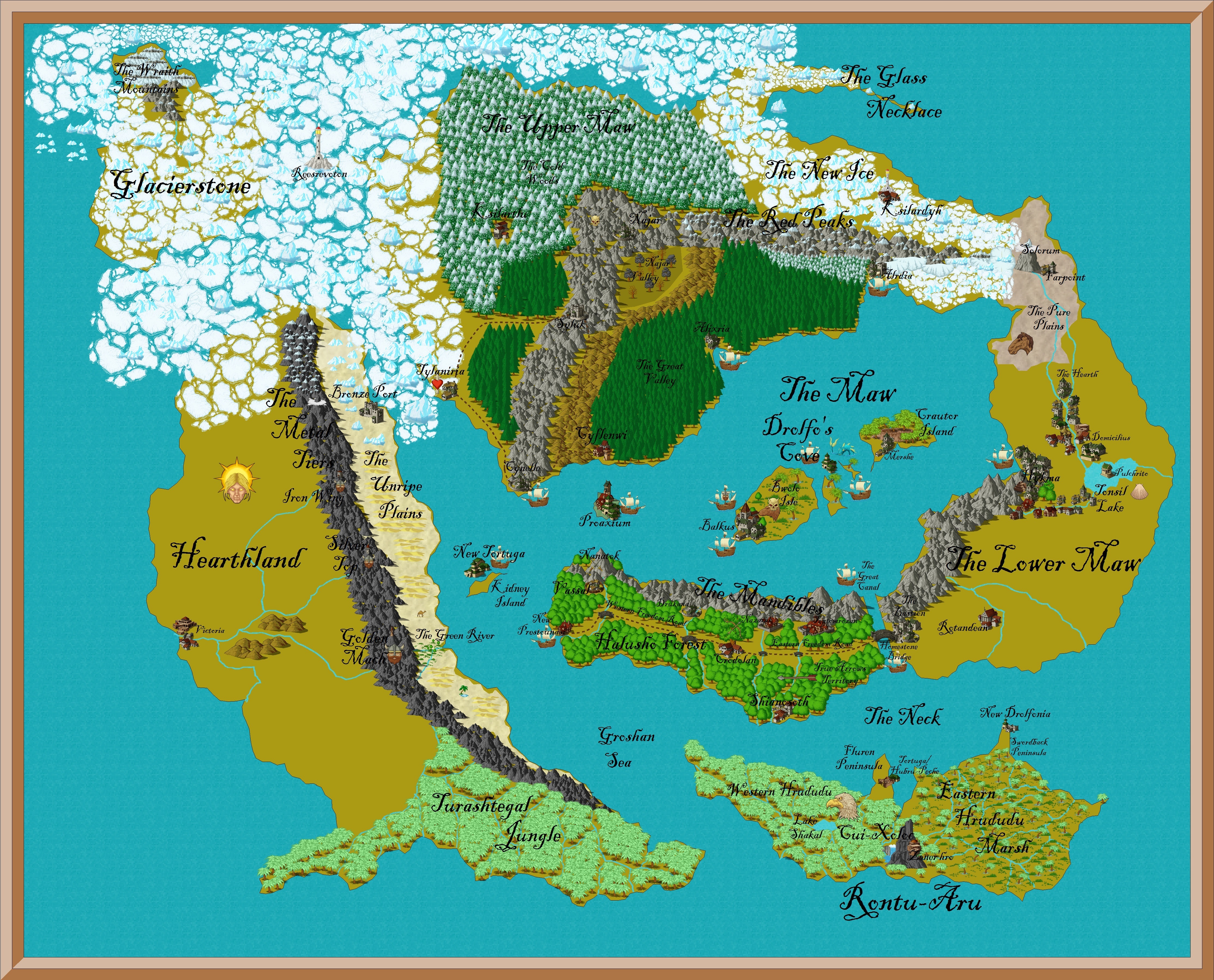
The map I made of Gurutama using Campaign Cartographer.

Starting off the posts on Gurutama will contain information my D&D group has already written.

After we’ve covered that background information I plan to post more indepth descriptions of places or cultural aspects. Religion, art, holidays, monuments, military, civil administration, all these things were touched on but not explicitly described in our Dawn of Worlds game. I’ll do what I can to get those ideas fleshed out here.

So first up, what are these continents we’re looking at on the map? There are four continents on Gurutama, Glacierstone, Hearthland, Rontu-Aru, and the Maw.

The Maw is split up into four sub continents, the Upper Maw, the Eastern Maw, the Lower Maw, and the central islands (islands aren’t really a continent, but inner oceans are still defined by tectonic plates).

Rontu-Aru, the southern continent, is inhabited mostly by bird people called avians.

Avian culture is loosely based off of Aztec, Mayan, and Inca cultures. Avians build ziggurats like the Aztecs and Mayans did. They live high in the mountains like the Inca did. They sacrifice intelligent beings like the Aztecs and Mayans did. I avoided the term human sacrifice, because in there are more races than humans in our fantasy world.

The avians came into contact with the merfolk early in our world’s history. The merfolk are fish people that live around the islands in the central sea of the Maw.

This map shows the Avian continent of Rontu-Aru and the central islands of the Merfolk.
This map shows the avian continent of Rontu-Aru and the central islands of the merfolk.

The merfolk wished to make trade easier with the southern sea, The Neck. They prayed to their god, Drolfo, to open up a quick path to the Neck.

Drolfo summoned a giant octopus named Selcatnet which dug a trench through the mountain range on the northern edge of the Lower Maw. This trench became the Great Canal that separates the Lower Maw from the Eastern Maw.

The merfolk came down to Rontu-Aru and set up trading outposts with the avians.

The avians were resistant to the outsiders. Eventually a prophet rose up and formed an army to attack the merfolk.

War raged for many years and eventually the merfolk won. The fish people enslaved the bird people. Now intelligent beings are exported along with goods from the jungles and marshes of Rontu-Aru.

The merfolk are in an excellent position for trade at the physical center of Gurutama. They trade with all the civilized races of our world, humans, dwarves, elves, gnomes, halflings, and the rana. Rana are frog people that live in the Eastern Maw.

There’s more to get into, but that feels like enough for one blog post. That’s all for now!

-Mister Ed

Next: An Overview of Gurutama Part 2

One response to “An Overview of Gurutama Part 1”

  1. An Overview of Gurutama Part 2 | GoCorral Avatar

    […] An Overview of Gurutama Part 1 […]

Leave a comment

I’m Isaac

Welcome to the GoCorral website! I’m Isaac Shaker and this is a place for me to write about D&D and occasionally other topics. I host a podcast called Setting the Stage that interviews different DMs about their campaigns. I’m currently focused on completing the Cimmeria campaign setting and turning it into a book.

Setting the Stage Podcast

86 – Wuxia Adventures in RPGS (Daniel and Metanoia/Ithasen) Setting the Stage, Campaigns for D&D and Other RPGs

I interviewed Daniel, my cohost of the Tabletop Community Spotlight! Daniel created his own setting called Ithasen with an in-progress wuxia TTRPG system called Metanoia to go along with it. Ithasen has a spiritual force known as Ren that pervades the world. Ren is a magical manifestation of the user's, or Rennim's, will upon the universe. Rennim that cultivate their will grow stronger and capable of more amazing feats as the concentrate their power and force of personality.Within Ithasen there are seven lineages of people that decide what type of Ren they can use. Anamor use conversion Ren. Elkyr use flux Ren. Janim use elasticity Ren. Nyl use influence Ren. Okoi use recurrence Ren. Haqol use harmony Ren. Finally, Daruner use use coalescent ren. The two races lineages that drive unique politics in Ithasen are the Daruner and the Haqol.Daruner children absorb the Ren talents of both their parents, becoming a perfect blend of Daruner and another lineage parent. Through this mixing, a Daruner family could potentially include all other lineages within itself. This power has placed Daruner as the nobility of Ithasen.Haqol's power of harmony allows them to amplify the Ren powers of others. This puts Haqol in a vulnerable position as unscrupulous people will do anything to incorporate Haqol lineage into their bloodline. Haqol have experienced something akin to a genocide as their lineage has been consistently absorbed by other lineages and diluted over the centuries.There's a whole lot more than that so strap in!Daniel has a fully setup GitHub Wiki for information on Metanoia and Ithasen that you can explore.There's a Metanoid Discord server you can join to discuss the rules and setting with other fans.The occasional musing on TTRPGs can be found on Daniel's blog, Tabletop Discourse.GoCorral YouTube Channel for watching the Tabletop Community Spotlight.Vote in the CRIT Awards! Voting is open until August 23rd.Check out the Setting the Stage website!Want to be on the show? Fill out this survey.Join our Discord!Support Setting the Stage on Patreon! Hosted on Acast. See acast.com/privacy for more information.
  1. 86 – Wuxia Adventures in RPGS (Daniel and Metanoia/Ithasen)
  2. 85 – Medical Doctor D&D (Justin and Oops! All Healers!)
  3. 84 – Horseback Riding D&D Camp (Michael and SaddleSnaps)
  4. 83 – Call of Cthulhu's Garden (Hem and The Sprouting)
  5. 82 – Tarot Ghosts (George and Fears & Fortunes)