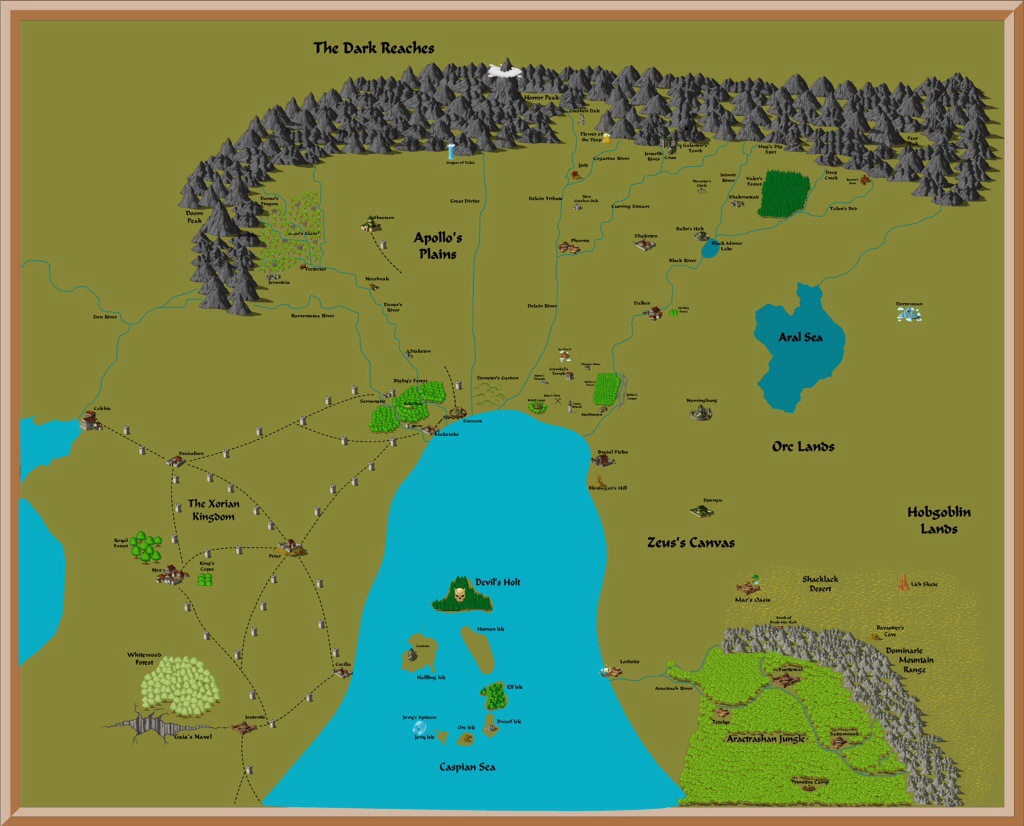
That’s a map of my campaign world which is physically based in a completely altered landscape north of the Caspian Sea.
Keeping with the theme of D&D Mondays, here is an introduction into the decisions I made while designing the campaign world that my players currently use.
The initial impetus for creating my campaign world came from the gods that are present in the D&D manuals. D&D has a few of its own pantheons and none of them make a great deal of sense to me when compared to real polytheistic religions.
Real religions have gods with relationships between each other. They are often members of the same family with a well known family tree. Stories and personalities exist for each of the gods.
D&D has no such relationships. Each god appears to be its own religion, making the pantheon of gods somewhat irrelevant. There is no well established mythology, and the bare facts that do exist will change based on which edition of D&D is played.
I much prefer the Greek pantheon. They were all related. They had stories about them. I understood why they did things. Best of all, everyone already knows about them! It’s actually required in USA schools to learn about them.
The problem with using the Greek gods in a D&D campaign is all the stuff associated with Greece in the myths. I didn’t want to switch to a real setting, only more realistic gods. So I changed the location of the gods.
Within my world, after the Trojan War, the gods realized that the Greeks couldn’t really handle the gods fighting over them. The gods moved west to the area around the Northern Caspian Sea and created new races to play with.
Elves, dwarves, halflings, and orcs were made for the gods to mess around with along with monsters and more humans. The new races were given far more magical power, so they could survive the gods’ attentions.
I significantly changed the geography around the North Caspian. I didn’t have any reason to do this beyond creative freedom. The name of my campaign world and the area north of the Caspian is called Cimmeria. This is actually what the ancient Greeks called it, so why not keep the name?
The current year in my campaign world is 396BC. The characters wouldn’t actually call it that, but for the sake of unambiguity, we’re using the Christian year system.
I simplified the month system. Every year lasts 360 days and every month lasts 30 days. The full moon is always on the 30th and the 1st of every month and the new moon is always on the 15th and 16th of every month. There are no weeks, instead there are “tendays.” This is just to make it simpler for me, so I don’t have to keep track of months, weeks, and moons. Also, yes, this is the way the world actually works in my campaign. The year is literally 360 days instead of just being measured that way.
Other pantheons do exist in my campaign (Persian, Egyptian, Indian, Norse), but don’t appear very often. Other cultures also exist outside of the ones in Cimmeria, but these other cultures are rarely featured in the sessions of the campaign.
The world is flat and the sun god’s chariot goes around the Earth every day. The other side of the world is inhabited by scary monsters and Atlas, who holds up the world. The planes (those other dimension things) are laid like pancakes on or around the earth. The typical image of Hell below and Heaven above fits very well.
Most of the cities in Cimmeria are city-states, but there are two exceptions. the Xorian Empire and the Aractrash Kingdom. The Xorian Empire has been expanding over the last hundred years. The Aractrash Kingdom has several cities within the Aractrashan Jungle. The jungle was united under one king around one hundred years ago.
That’s all the basic information of my campaign world. More to come later!
-Mister Ed


 GoCorral
Leave a comment