Physical Description
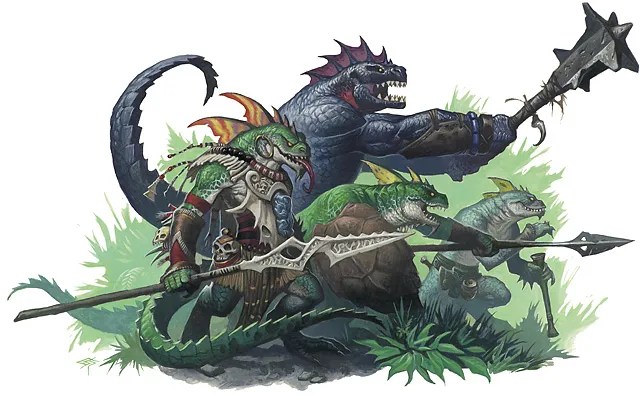
Lizardfolk are anthropomorphic lizard people. While they have lizard features, their internal metabolism is warm-blooded. Their size and weight vary between different subraces, but all lizardfolk have impressive muscularture. Similarly, the scale colors of lizardfolk vary between subraces. All lizardfolk have head crests that move according to their emotions. At their bottoms, lizardfolk have tails ranging from three to five feet long.
Lizardfolk have many natural advantages that compensate for their weaker minds compared to other races in Cimmeria. Without understanding of advanced technology, magic, or tactics, lizardfolk rely on their natural gifts. They have sharp fangs and claws that rival swords in lethality. Their tails allow lizardfolk to balance and maneuver faster in combat and swim faster in aquatic environments. An additional adaption for water is a large pair of lungs, allowing lizardfolk to hold their breath longer than other species. With these traits, lizardfolk are the natural predators of fresh water areas in Cimmeria.
Culture
Lizardfolk lead primitive lives in the wetlands of Cimmeria. They are hunter-gatherers and live in wood and skin huts. They use simple wooden and stone tools as they have no inclination for metalwork. The few metal tools that lizardfolk have are acquired in trade or by raiding. There are a few domesticated beasts in lizardfolk tribes. The most common beasts are reptiles, amphibians, or drakes. These animals are used as beasts of burden, guard dogs, or a food source, depending on their size and ferocity.
Lizardfolk are opportunistic cannibals. Everything edible is food to lizardfolk, fruits, roots, slugs, deer, halflings, humans, and even other lizardfolk. Most tribes don’t go out of their way to kill other intelligent beings for food, but they won’t turn down calories if available. Lizardfolk funerary traditions often involve the ritualistic butchering of the deceased, cooking them according to a tribal recipe, and eating them.
The chief of a lizardfolk tribe is always the strongest fighter of the tribe. This typically leads to a dumb brute of some sort in charge. Actual tribal decisions are usually made by the shaman, the smartest member of the tribe. The shaman advises the chief, manipulating them into making intelligent, informed decisions. Chiefs that disregard their shamans often end up raiding civilized areas, attracting the attention of adventurers, and spelling doom for their tribe.
Lizardfolk have tribal structures but do not have families. Long-term mating is rare, with most lizardfolk having sex with the closest willing partner when the mood strikes them. Eggs are laid in communal clutches. When they hatch, the young are raised by the tribe as a whole. Lizardfolk mature rapidly, reaching adulthood in three years. This utter absence of a family structure is the main reason for lizardfolk existing apart from the rest of Cimmerian society. So many cultural traditions based around the family are absent in lizardfolk tribal units.
History
Lizardfolk existed in Cimmeria long before the Conclave races arrived. Goblin oral histories make no mention of when lizardfolk arrived, indicating they were always present. Lizardfolk have no extant written records of their own to indicate their history. It seems as if they were always in Cimmeria since the creation of the Earth.
Lizardfolk rarely feature prominently in modern Cimmerian history. Their existence in marshes and swamps sets them apart from most civilized races. The limited wetland space in Eastern Cimmeria causes occasional problems. Lizardfolk live in the few swampy areas slowly increase in population over time. At increased population points, tribes split off from the swamp to become raiders instead of hunter-gatherers. These tribes experience friction with the towns and villages in Eastern Cimmeria. Inevitably, a band of heroes is called in who slay the lizardfolk, releasing the pressure of extra population on the swamp lands for the next generation.
The most notable example of these raids occurred at the start of the Early Kingdoms period. The lizardfolk’s population pressure focused inward initially, resulting in a temporary unification of the lizardfolk of Eastern Cimmeria under a single leader, King Blacktooth. The lizardfolk pillaged settlements across Eastern Cimmeria with impunity. Restnor the Second led the rangers trained by the Elves of Valor’s Forest to oppose the lizardfolk. The small-scale war ended with King Blacktooth’s death and the sundering of his large war band. No other lizardfolk raid has matched King Blacktooth’s in size.
Subraces
Lizardfolk have their subraces separated by size and scale color. While there are physical differences between the subraces, they are not strictly inherited by lizardfolk children. Newly hatched lizardfolk tend to be the same subraces as their parents, but regular exceptions occur. Some philosophers believe the subrace of an egg is decided by the surrounding conditions rather than the parentage.
Green Scale: Green scales are the most common variety of lizardfolk. They stand between six and seven feet tall and weigh between 200 and 300 pounds. Green scales love to hunt, no matter the prey. Animals, monsters, and humanoids are all viable options for green scale lizardfolk. They adorn their bodies with trophies taken from kills that were particularly challenging or kills that marked an important moment in their lives. Their tendency to display humanoid skulls contributes to the poor reputation that lizardfolk have among the Conclave races.
Black Scale: Black scales are the largest kind of lizardfolk. They stand between eight and ten feet tall and weigh at least 400 pounds. Their increased size is accompanied by even greater muscle mass than other lizardfolk. They wield entire trees as clubs, like ogres, but with the cunning intelligence of a predator. Black scales intimidating size leads them to be the chiefs of the tribes they are hatched into. They enjoy flaunting their position through displays of wealth on their body. Most commonly jewelry, but anything of value will do. Some black scales attach gold bars to ropes to create a crude but valuable necklace.
Blue Scale: Blue scales are the smallest and thinnest variety of lizardfolk. They stand between four and five feet tall and weigh between 100 and 160 pounds. While their natural color is blue, their skin can change coloration like a chameleon. This adaption allows blue scales to camouflage themselves while they wait to ambush their prey. Blue scales are equipped with webbed hands and feet for faster movement through water. Their yellow eyes have evolved to allow blue scales to see in extremely low light conditions.
Blue scales have a culture of modesty and shyness. While other colors of lizardfolk display trophies and wealth, blue scales do not. They prefer to wear almost nothing so they can use their camouflage to blend in with their surroundings. Blue scales also hunt with a different method. All lizardfolk embrace ambush tactics, but blue scales prefer to hit and run. They attack with poisoned arrows or darts and then flee to let the poison do its work. A few repetitions of this tactic and a single blue scale can claim a kill a whole tribe of green scales would find impossible to take down.
Troglodyte: Troglodytes, or white scales, are the Underdark variety of lizardfolk. They stand between six and seven feet tall, the same height as green scales but slightly thinner at 180 to 250 pounds in weight. Adapted for life in the Underdark, troglodytes can see in complete darkness. Additionally, their sweat glands have mutated to exude a stench so powerful that it makes other creatures sick. Their white scales, withered appearance, and noxious smell make troglodytes repulsive to all other creatures.
Living in the Underdark has made troglodytes hostile to intelligent life. The environment has few resources, forcing the inhabitants into vicious competition with each other. The first instinct of a troglodyte that encounters another species is to kill and eat it. The result is that troglodytes have no peaceful relations with other races. The necessity of cannibalism has spoiled any chance at friendly connections.
Location
Lizardfolk live in and around the waterways of Cimmeria. The most popular locations are Danar’s Marsh, Demeter’s Garden, and the Aractrashan Jungle due to the high number of crisscrossing tributaries in those regions. Lizardfolk live around all of the many rivers in Cimmeria, but there are higher concentrations around the Black River and the Long River. Troglodyte populations roughly mirror their aboveground cousins with tribal communities located below these same spots in the Underdark.
Relations with Other Races
Lizardfolk don’t get along well with other races due to their alien family and tribal structures. They have an adamant hatred for elves and view most of the other Conclave races as tasty. Some halfling traders have managed to form amicable trade relationships with lizardfolk tribes. Unfortunately, these partnerships are often upset by the rise of a new tribal chieftain. Halfling traders must be careful lest their regular trading partner abandon the partnership to claim a short snack.
Outside of the Conclave races, lizardfolk get along decently with goblins and orcs. While they rarely cohabitate in the same locations, they can build trust over generations. Each group stays in their own space with trade unifying them and occasional aid offered as needed. Lizardfolk also have a tendency to attach their tribes to a dragon as a patron and leader. It is common for some ancient dragon blood to flow in the veins of a lizardfolk tribe.
Common Deities
Lizardfolk’s homes in areas with water and nature lead them to worship gods associated with those pieces. Their most frequent patrons are the river gods and naiads that rule the freshwater areas of Cimmeria. Lizardfolk shamans often align themselves with Pan due to his power over natural spaces. The lizardfolk of Demeter’s Garden worship her as that wetland is her domain in Cimmeria. Lizardfolk that abandon the race’s opportunistic cannibalism for a more proactive approach find themselves drawn to the monstrous gods of Typhon and Echidna. No matter the deity, lizardfolk religious rites are simple, offering a bit of food and drink to the gods by pouring into the waters before a meal.
Place in Adventuring
Lizardfolk are more often foes than allies for adventurers. Their strong physique and humanoid intellect make them more threatening than the average monster. Couple that with their command of watery terrain and lizardfolk are dangerous creatures when encountered in their own element. Beginning adventurers should steer clear of lizardfolk territory if they don’t want to be ambushed and eaten. Once an adventurer has a bit of experience under their belt, they can tackle the crafty challenge of lizardfolk predators.
Lizardfolk do occasionally break away from their tribes to become adventurers. They tend to venture out in small groups of clutchmates that hatched around the same time. These groups focus on the experience and novelty of adventuring over moral or extrinsic rewards. They adventure for the joy of discovering new places and finding new friends. Lizardfolk adventurers favor the barbarian, ranger, and druid classes. Barbarian and ranger due to the natural physical power and ranger and druid due to their affinity for the wild places of the world. A lizardfolk adventurer is a strong ally for an adventuring group, providing a tough front-line in combat and a fresh perspective on the social webs that are so often invisible to those caught within them.



 GoCorral