Physical Description
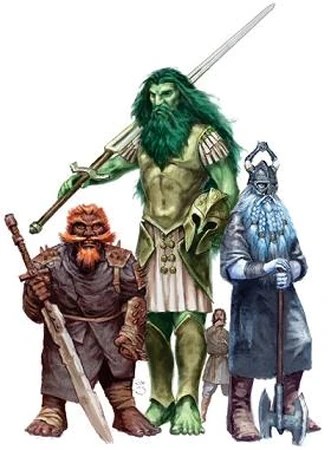
There are many kind of giants in Cimmeria but they are all huge, strong, and ferocious. The smallest giants stand at about eight feet tall while the largest are more than twenty feet tall. Weights are similarly variable with giants often being heavy for their relative height due to increased fat and muscle mass. The might of giants is legendary. Commonly giants will wield boulders as ranged weapons, throwing the large rocks accurately at targets several hundred feet away. Many giants are also blessed with minor supernatural powers. These powers vary between the different subraces of giant with no unifying factor across the whole race.
Culture
Giants use their increased size as their main weapon in life. Problems are always dealt with by force first and negotiation last. The strongest giants rule their tribes and villages. Intelligence is hated in giant families, where book reading and cleverness are punished rather than encouraged. Giant culture has advanced at a glacial pace over the centuries due to this practice. Many giantkin still use only stone tools as forging metal is too advanced. They can occasionally repurpose tools made by smaller races, but the difference in size makes this difficult.
While giants are violent as individuals, larger communities favor peaceful relationships with neighboring races. This behavior has been reinforced over many years. Giants are larger and stronger than other races, but their disdain for finer crafts puts them at a disadvantage in extended conflicts. A tribe of giants can often do little against a single flying mage raining fireballs down upon them. Thus, giant villages keep to themselves. The few giants that commit crimes are often exiled from these communities. These exiles are like natural disasters to the small villages they can find. A testament to the power of giantkin, even one rogue giant is sufficient to ruin any farming hamlet.
History
The giants came into being long ago during the Silver Age after the Olympians overthrew and imprisoned the Titans. Gaia was upset that her children were treated so poorly by her grandchildren. She gathered the spilled blood of Uranos and used it to form a new race, the giants. Their destiny would be to enact vengeance upon the Olympians for the barbaric punishments inflicted upon the Titans in Tartaros. These first giants fought a war known as the Gigantomachy against the Olympians. They were defeated by Zeus‘s thunderbolts and exiled to the edges of the world.
Before even the giants, there were the Cyclopes. They are three brothers, Brontes, Steropes, and Arges, who were born to Gaia and Uranos before the Titans during the rule of Uranos. Their father imprisoned them for their ugliness, but Zeus freed them during the Titanomachy for their assistance in the war. The three brothers served Zeus as his forge masters until Hephaestus was born. These three saw a kinship with the giants after the Gigantomachy. They left the Olympian kingdom and became the rulers of the giants in exile.
From the union of the Cyclopes and the giants came the myriad of giant races across the world. Elemental giants, lesser cyclopes, two-headed ettins, brutish ogres, and savage trolls are all descendants of Brontes, Steropes, and Arges. These giantkin can be found in every corner of the Earth, not just in Cimmeria.
Within Cimmeria, the giantkin fought on the dragons‘ side during the Dragon War. They were a particular problem for the dwarven cities and the people of Greshendale due to their locations in the Terror Mountains. Giants continue to occasionally threaten those areas, but not on the scale of the Dragon War.
Some giants settled in the Dominarie Mountians and the Shacklack Desert. The sand giants in the desert also fought alongside the dragons. After the establishment of the Lich Shade, these sand giants antagonized the Bane. The powerfully evil undead enacted his vengeance. The sand giants were exterminated to the last one. Bavastatner withheld his support, favoring the fire giants of the mountains instead. These fire giants have interbred with blue dragons over the centuries. Many show draconic heritage and lightning powers in modern Cimmeria.
Subraces
Giantkin come in many varieties. All giants are descended from the first giants and cyclopes birthed from Gaia. While the different subraces have diverged over time, they all maintain the general humanoid shape, large size, and powerful musculature iconic of giants.
Elemental Giants: Elemental giants are the most pure connection to the first giants of Gaia. There are five sub varieties of elemental giants, each with a different connection to an elemental force. In order of size the five elemental giants are Hill, Stone, Fire, Frost, and Storm. Hill giants are about 9 feet tall while storm giants can be almost 30 feet tall. The size of an elemental giant dictates their hierarchy, with the tallest at the top of their leadership structure.
Each breed of elemental giant has a small magical power associated with their elemental. Hill giants are normal, possessing no special powers besides their strength. Stone giants can meld into the rocks and stone, becoming a part of the landscape around them. Fire giants can withstand any heat. They used this talent and their natural strength to develop unique smithing techniques. Frost giants can live outside in the cold with no maladies. Lastly, storm giants can fly and have control over the weather in their area.
Cyclopes: Cyclopes are the most similar to the ancient patrons of the giantkin. They stand about 15 feet tall, have a single eye, and often forego all luxuries except for the most simple clothes. Unfortunately, cyclopes have drifted far from their forefathers in morals. They still possess great skill at the forge, but modern cyclopes also enjoy the taste of humans. They must resist the temptation or a cyclops risks incurring the wrath of adventurers and human civilization. Those that indulge in human flesh forge terrifying weapons and armor to aid their hunger. Additionally, cyclopes have the power of the evil eye. Any who lock eyes with a cyclops in anger are cursed with misfortune.
Ettins: Ettins are two headed giants. They stand about 13 feet tall. Their two heads have independent personalities and often argue with each other. This constant unwanted social interaction makes ettins prefer solitude. They typically reside in caves and only emerge to acquire food. This love of solitude makes ettins a dying breed as they rarely encounter each other to procreate. Ettins’ hatred of social interaction extends to the briefest of meetings with other races. A simple greeting can engage an ettin and lead to violence.
Ogres: Ogres are the smallest and most common giantkin. They stand about 8 feet tall with heads that slope forwards on their broad shoulders. Ogres have long limbs that give them increased reach in combat. Ogre social groups are small as they are too stupid to sustain larger groups. Any large gathering of ogres inevitably leads to misunderstandings, disagreements, and violence.
Their stupidity also leads ogres into being the most frequently witnessed of the giantkin. They have no fear of adventurers and civilization. Ogres often raid villages with no foresight to the consequences. Their subrace would’ve been wiped out long ago if they didn’t mature so quickly. Most giants have gestation and maturation periods similar to humans. Ogres have a longer gestation period, but mature at a much greater pace, reaching full size in only four and a half years. This rapid growth rate allows for ogres to quickly replace their population numbers that eliminate themselves through ignorant actions.
Trolls: Trolls are the most savage of the giantkin. Standing at 8 feet tall they have long limbs similar to ogres. Trolls have long pointed ears and noses and green skin. Their injuries regenerate rapidly unless burned with fire or acid. Trolls can even regrow entire limbs if left alone for sufficient time. Their regeneration serves them well in combat as no injury lasts longer than a minute.
A troll’s diet is entirely carnivorous. They spend most of their waking time looking for meat to consume. Trolls care little where their sustenance comes from. Sheep, birds, or humanoids, all are prime material to feed a troll’s hunger. They are almost animal-like in their intelligence, being the only giantkin subrace to use no weapons and go without clothing. Trolls can speak, but typically give in to their battlelust whenever another living being is present.
Location
Giants live in the mountains, hills, and caves of Cimmeria. Their tendency towards violence makes them incompatible with the settled development of civilization. A giant is likely to accidentally destroy a building in anger, so the little folk have banded together to push giants away from buildings. There are slight variances between the different subraces in their home of choice. Fire giants enjoy volcanic calderas while storm and frost giants enjoy mountain peaks. Ettins and ogres like caves. Trolls are an outlier, with many trolls preferring to live in the Underdark. Ogres and trolls can also be found regularly in the wilds of the Aractrashan Jungle.
Relations with Other Races
Giants are dangerous and powerful. One giant is enough to kill dozens and ruin a neighborhood even in a well-defended town. This threatening power makes giants unwelcome in the civilized communities of Cimmeria. While most interactions with giantkin are violent, the Conclave races do have peaceful relationships with some elemental giants. Particularly fire giants due to their forging skill. The Mountain Dwarves have established trade between their cities and giant villages. These trade deals are delicate matters handled by dwarves that are trained in the particulars of giant etiquette.
Giants get along well with a few other races. They commonly ally with orcs and goblins for raids and military campaigns. These alliances are fragile and short-lived, often depending on the giant’s hunger being satisfied by means other than eating their allies. Giants also ally themselves with dragons with some frequency. Fully grown dragons often adopt a giantkin tribe as their personal servants. A giantkin tribe’s focus on tradition can lead to a stable relationship where the giants remain faithful to their dragon lord for generations.
Common Deities
Due to their ancestral connections, giants are some of the few beings of Cimmeria that openly worship the Titans. They were created to seek vengeance for the Titans and many still carry this torch long after the Gigantomachy has ended. Along with the Titans, giantkin worship other primordial deities such as Typhon, Echidna, Nyx, Uranos, Gaia, and Ourea. Darker minded giants still engage in mortal sacrifice to the ancient gods.
There are many giants that have abandoned the old gods in favor of the Olympians. These giants largely worship Zeus as their patron as thanks for his help in freeing Brontes, Steropes, and Arges.
Place in Adventuring
Giants are a powerful threat for adventurers to take on. Only the most experienced adventurers are able to taken on giantkin with a reliable chance at survival. The varied subraces of giantkin come into conflict with Cimmerian society at different frequencies, but all are fearsome challenges for adventurers. While rare peaceful encounters between adventurers and giants exist, the race largely exists as grist in the mill for stronger adventurers.
Giants heavily reinforced tradition makes their chances of becoming adventurers themselves a near impossibility. The sand giants once had a tradition of fighters and swordmages, but their elimination by the Bane ended that practice. The other giantkin learned their lesson from the sand giant example. Now, any giantkin adventurer could be a singular example for their entire subrace, if not the giant race as a whole.


 GoCorral