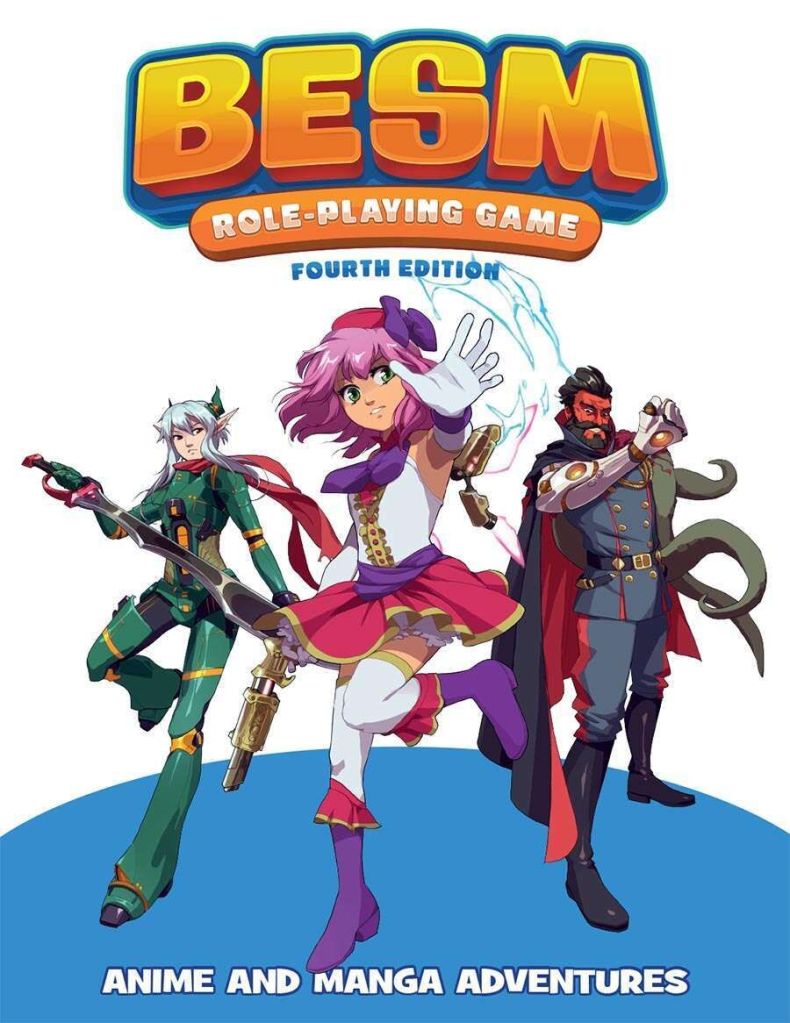
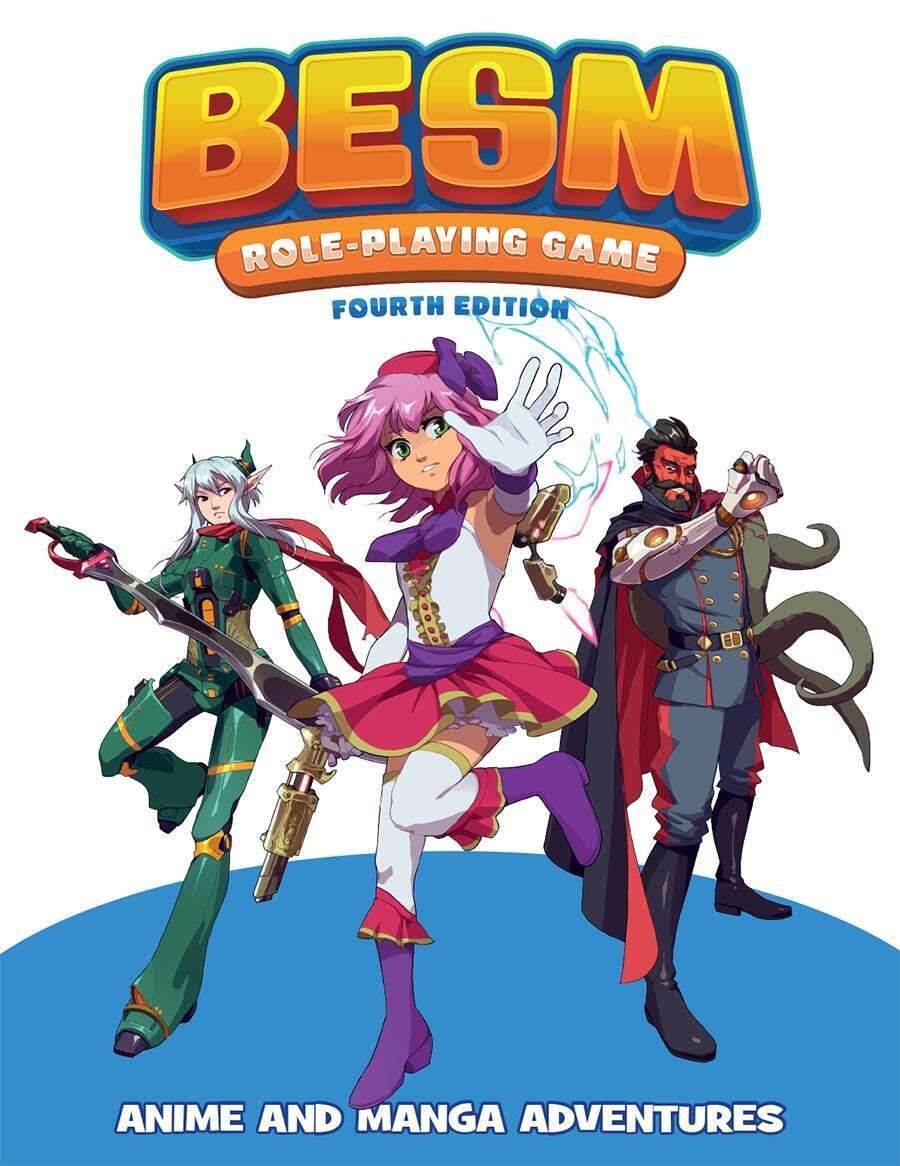
An RPG review that isn’t about a China focused game? Is this blog allowed to do that? YES! I’ve even done it before when I reviewed the Marvel Multiverse RPG at the start of 2024. I read BESM 4th Edition as part of my research for a Setting the Stage episode that ended up not panning out. But at least I can still get some ContentTM by reviewing the RPG system!
BESM stands for Big Eyes, Small Mouth, the name the system used to be under for its earlier editions. The name derives from the art style for anime where characters have big eyes and small mouths (usually). BESM is designed to help simulate all sorts of anime stories from slice of life school anime to shonen to mech battles. With a pretty broad focus, BESM is effectively a universal system even with its focus on anime. Anime is only a broad art style after all and not a fiction genre.
Character Creation
BESM uses building points for character creation with varying amounts of building points for different power scales. A normal human has 50 points while a superhero might have 150 or 200. That slice of life school anime might start with 30 point PCs because school-aged children are weaker and less experienced than adults. A shonen might start higher up at 50 or even 100. The average campaign rewards 2 additional points per session for advancement with more or less as the GM decides.
The main stats of BESM are Body, Mind, and Soul. Body is everything physical. Strength, reflexes, endurance, coordination, all are under the Body stat. Mind covers everything mental. Your basic intelligence, wisdom, and charisma from D&D. Soul is a “magic” stat as well as a “main character” or luck stat. It controls how powerful a character’s magic is, if they have any, and how special and cool they are. The world bends around characters with high Soul stat to make life easier for them. Stats usually cost 2 character points per Stat level.
All the fun things in BESM are loaded into Attributes. Attributes cover everything from having a cell-phone in your pocket to being able to turn into a robot fish. There’s tons of different abilities that have varying degrees of fantasy and usefulness for a particular type of campaign. The amount and breadth of options requires some guidance from the GM to ensure characters fit the campaign you’re trying to play. The slice of life school characters shouldn’t mix with the shonen characters. They have different point totals and different Attributes that are important to their goals. As long as the GM has a firm hand on the wheel and the players are aware of what type of campaign they’re playing, Attribute selection should go smoothly.
Attributes and Stats are also put into packages called Templates. Templates provide the beginning framework for a PC and can also be dropped in with little or no modification for an NPC. There are Templates for races and for classes. There isn’t some strict line between them though. Templates are just groups of Stat and Attribute purchases that are already added together. You can just as easily make an “orc paladin” on your own without taking the orc and paladin Templates.
Action Resolution
Action resolution in BESM is simple. When you encounter a challenge, roll 2d6. Add your relevant Stat + your level in any relevant Attributes. Usually only 1 or 2 Attributes are relevant to a particular challenge. The dice result + Stat + Attribute is your final result. The TN is 12 for an average difficulty task, but TNs can vary from 6 to 24.
BESM has an advantage and disadvantage system similar to D&D 5e. An action can have a minor or major edges and minor or major obstacles. These stack together, but never go beyond major. So two minor edges is counted as a major edge. A major edge and a minor obstacle is counted as a minor edge. A minor edge allows you to roll 3d6 and take the highest two as your result. A major edge allows you to roll 4d6 and take the highest two as your result. Obstacles work in the reverse with you rolling additional dice and taking the lowest two as your result. Simple and easy to remember!
Book Organization
BESM 4th Edition has some odd organizational and style choices but one really amazing one. For organization, placing Templates first before “how to play” or the Stats or Attributes is a mistake. The Templates are just collections of Stats and Attributes. How can I possibly understand Templates before reading what they’re made from? Next, the whole book has half the page with a purple background and half with white. Really weird to constantly and drastically change the background on the basic page layout.
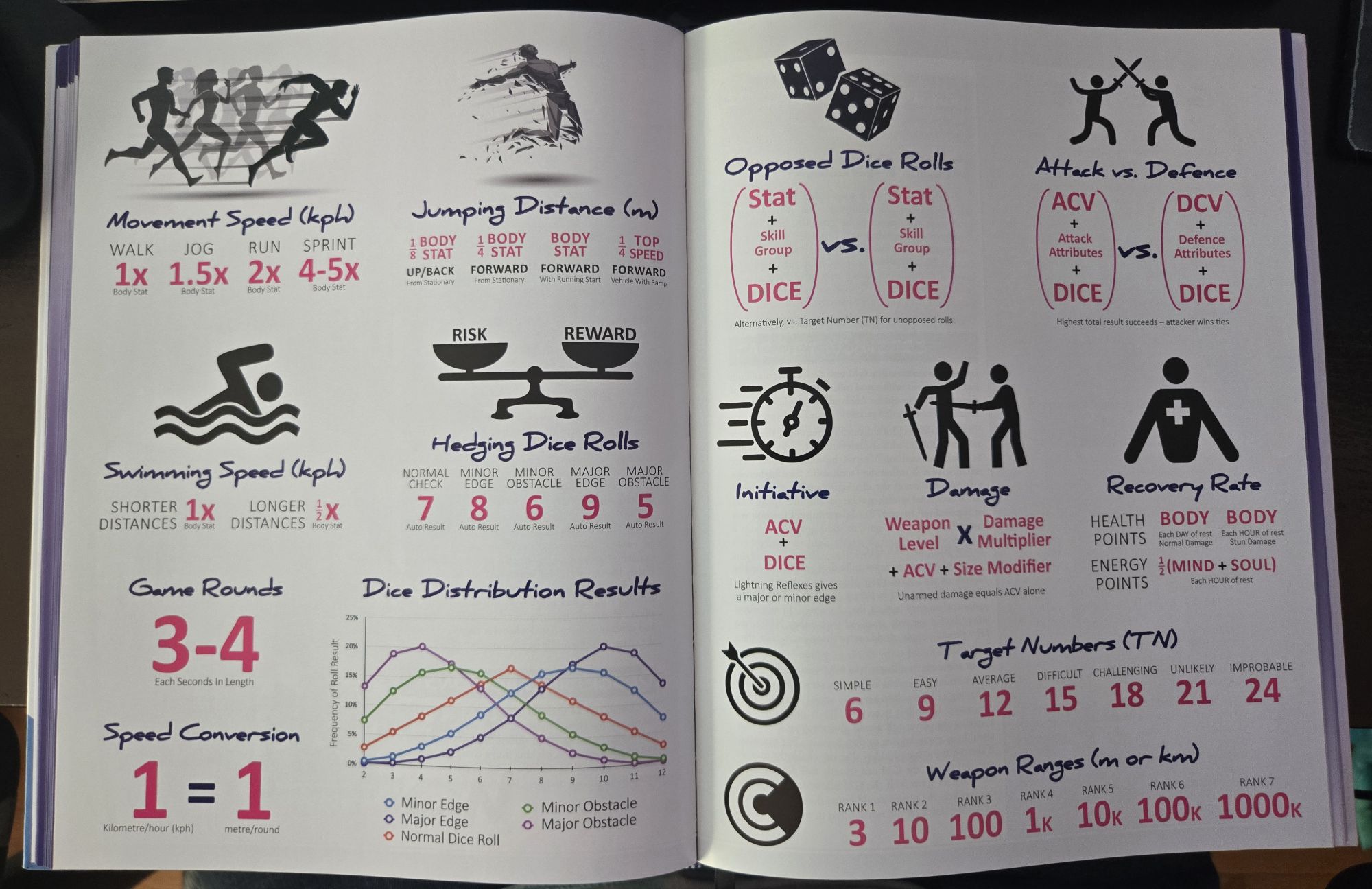
The one shining star of BESM‘s layout was on page 174 and 175. It’s a quick summary of all the rules you need for pretty much everything once you’ve made your character. All squished into one place. AND IT’S EASY TO UNDERSTAND! Amazing work. Just look at it.
GM Resources
The GM side of BESM has sufficient resources with some minor issues. The Templates come in handy for a GM, providing tons of ready to go NPCs. There’s additional ones later in the book for companions, animals, and other monsters. Those can always be modified a little bit to work as you need them as well. Or you can easily improv an NPC by assigning Body, Mind, and Soul stats and adding Attributes on as needed.
The actual GM advice is general. It boils down to respect the chosen genre. If you’re copying a show, make sure everyone knows what to expect from that show. Build the game with your players so you can ensure there’s no broken expectations. There is some quick guidance provided for more specific types of stories.
A full setting is provided for the “Anime Multiverse” which is a bunch of worlds connected by portals. Each world summarizes a particular type of anime story. Additional books are being released that provide more fleshed out guidance and options for a particular type of anime.
Conclusion
Ultimately BESM suffers from trying to accomplish an impossible goal. Anime is really an art style, not a story or genre. How can you have a functional rule set that works for Yugioh and Steins;Gate? You can’t. It’s almost guaranteed that whichever anime you are trying to emulate, there is a better choice for it. Or you just have to embrace how dumb the system is in parts. Maybe the system would work well for some fantasy shonen like Seven Deadly Sins where the characters are absolutely not balanced against each other. Rough to GM that type of game, but it might be fun as a player… Perhaps the extra setting books solve this problem. As it stands, I’d recommend alternatives that are more focused for the anime an RPG group is trying to emulate over BESM.
If you are interested in the book you can learn more at the publisher’s website: https://www.dyskami.ca/besm.html
Or check them out on DriveThruRPG: https://www.drivethrurpg.com/en/publisher/15393/dyskami-publishing-company/category/35602/besm-fourth-edition

 GoCorral
Leave a comment