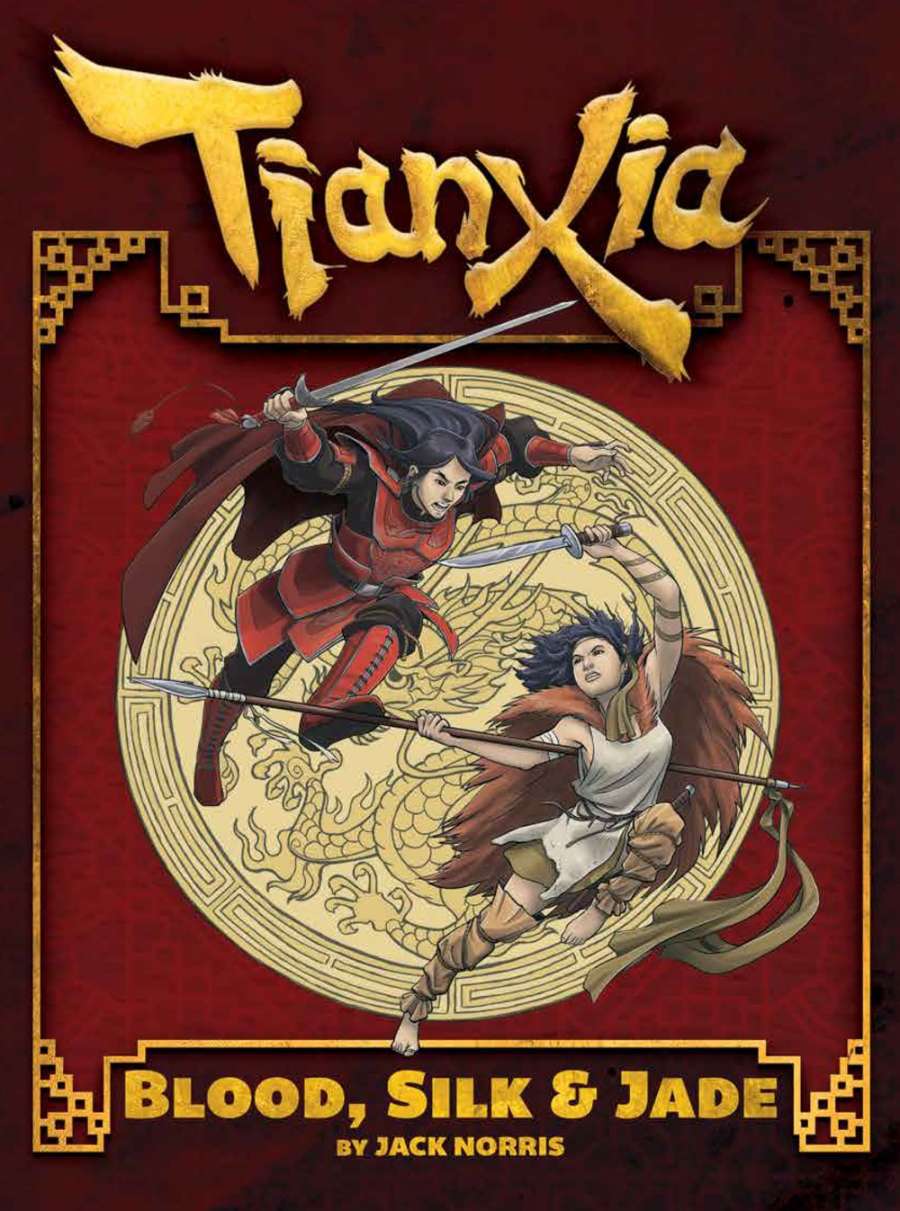
Tianxia had more going for it than I expected. It’s a FATE Core system similar to the FATE systems Do: Fate of the Flying Temple and Jadepunk which I’ve reviewed on here in the past. I wasn’t a fan of those presentations as they were too simplistic or too far from my own desires for a wuxia China game. Tianxia gets pretty close.
Background
The system has more support than I thought an Indie game would have. Blood, Silk & Jade is the main book, but it also requires the FATE Core rulebook for the full rules. FATE Core is free as well for the SRD or the PDF. In addition to the main Tianxia book, there’s a demo version. There’s also a sample adventure so you can get started without risking your wallet or your time setting up an adventure. If you end up liking the system a lot, there’s three additional splat books as of this writing and an additional adventure book. Tons of extra stuff!
The first two chapters of Blood, Silk & Jade detail background information for the setting. The chapters answer basic questions about China, wuxia, wuxing, and other aspects of Chinese culture. The game presents a fake setting called Shenzhou, which I believe translates as God’s Land. Blood, Silk & Jade focuses on the province of Jiangzhou (river land). Jiangzhou is a direct reference to Jianghu, the stereotypical “waterways” location of wuxia stories. The province is an amalgam of different dynasties and Chinese story tropes. Lots of different characters, places, and events to choose from.
And if you don’t like all that background? Throw it out and run a historical China campaign set during your favorite dynasty/period.
Rules
The basic gameplay for Tianxia uses the simple FATE Core system. The base system is a bit more complicated than Fate Accelerated which Do was based on. There’s a few additional stats and character generation is a tad more complicated. It seems like it all plays the same way though.
Obviously there are a few extra rules layered on top of FATE Core for the Tianxia game. There are a few bonuses for equipment that get more specific. The most notable new rule for me was fighting styles. Fighting styles are split into two halves. Each half has three techniques/stunts you can learn. The first half is chosen from Forest, Ghost, Iron, Lightning, Stone, and Storm. The second half is chosen from Crane, Dragon, Monkey, Phoenix, Serpent, and Tiger. After you’ve learned the six techniques for a fighting style combination there is an additional secret technique/stunt as a capstone for masters of that fighting style.
The fighting style rules are a clever system. They give lots of different options without analysis paralysis or cognitive overload for a simple system like FATE. It’s also easy to see how the different halves fit together. I’d like the system even more if it was more grounded in Chinese mythology. The two halves of the fighting style could’ve been the five elements and the twelve Zodiac animals. Or the eight trigrams and the five Heavenly Beasts. I’m certain fighting styles matching those combinations could be homebrewed, but I don’t understand FATE well enough to do that.
The Rest
The GM section of the book is well constructed. The setting material I already mentioned has lots of NPCs and adventure hooks for GMs to use. Blood, Silk & Jade has a quickstart adventure to get you going. There’s an additional quickstart adventure online. There’s an extensive play example in the book to show off the system. This is in addition to all the other stuff that’s been produced to support FATE Core and how to GM the base system. New GMs will have more tools than they could possibly use for learning how to run the game well.
The book has solid organization. The sections are clear and easy to follow. You can skip around as you like for learning the setting, system rules, character creation, or GMing side. The layout helps with well-placed sidebars for extra details. The art is nice, nothing great but nothing truly terrible either. My main complaint was the three column presentation for some of the sub-sections. My lazy butt has never found three column layouts to be worth it. Having only five words on a line feels like I’m moving my eyes too much to read.
Tianxia ultimately suffers from the same issues that Do did. The fighting style construction is the only rule that really evokes anything related to wuxia stories. Everything else is pretty much FATE rules with a Chinese paint job for the aesthetics. It’s a good paint job for sure! But the system could still just as easily be used for any other martial artist setting.
Tianxia isn’t the right system for me, but I think Tianxia is one of the best China-inspired TTRPGs on the market. If you’d like to give it a try you can find it on Vigilance Press’s website: https://www.vigilancepress.com/tianxia/



 GoCorral
Leave a comment