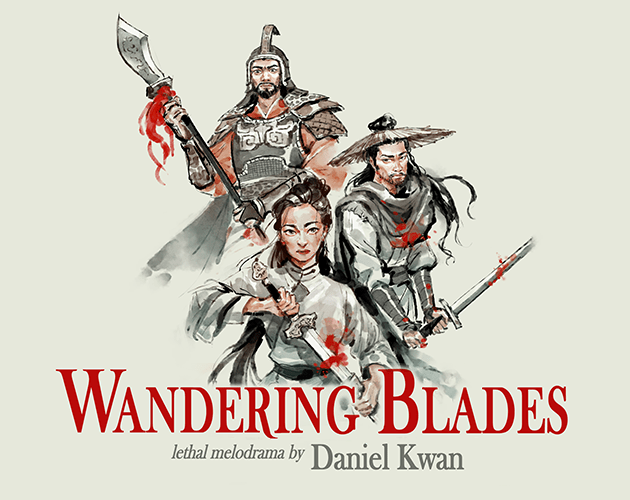
Wandering Blades is a Chinese themed RPG that’s in development right now. It had a successful Kickstarter in May 2025 that’s still accepting late pledges if you’d like to check it out. The game’s base rules are released for Kickstart backers, but I wrote this review before those came out. Thus my review is of the Quickstart demo rules, not the complete game. The completed version could be different and invalidate elements of this review.
Character Creation
The basic mechanic for Wandering Blades is a d20 + your attribute bonus against 10 + opponent’s attribute bonus. There are four attributes of Strength, Agility, Focus, and Intellect. Agility is just better than Strength as it provides both offensive and defensive bonuses. Intellect is used for only a few things at the moment, but might have more in the full rules. Focus adds to your special action pool of Qi. The attributes are decided by rolling a 4d6 and then assigning one of the dice to each stat.
Wandering Blades uses a class and level system. There are three planned classes, Youxia, Outlaw, and Scholar. Youxias are wandering warriors. Outlaws are sneaky bandits, kind of like a D&D rogue. Scholars are not in the Quickstart rules, but are presumably a smarty pants of some kind. Wandering Blades has a low fantasy focus, so it is unlikely that Scholars will be full-on wizards like D&D.
Leveling in Wandering Blades is fun. At the end of each session you ask yourself five questions.
- Did you participate in the session?
- Did your character accomplish a noteworthy deed?
- Did your character work to accomplish their goals?
- Did your character experience a setback or obstacle?
- Did your character have an impactful scene with their connections?
For each “yes” answer you gain 1 XP. 5 XP gives you a level up. Level ups are similar to D&D. You gain more HP, more special techniques, and higher bonuses on your rolls. Standard level ups max out at level 5, but you can continue to learn more techniques after that point.
The main focus of the game is on all the cool techniques. You start with s few techniques and gain more as you level up. Techniques are used by expending qi. Your qi is determined by your Focus attribute as well as your level in your class. Qi is recharged when you sleep. The techniques let you take special actions beyond the normal move and attack. Usually these are bonus attacks or moves that do a little extra, like imposing a condition upon your enemy in addition to dealing them damage. Fairly typical stuff for an RPG. There’s around 20 techniques for each class in the Quickstart rules with more on the way for the full game.
Bonus Rules
There are a few bonus rules based on character goals, morale, and reputation. Character goals are called their Drive which let them auto-succeed on a roll once per session. Morale and Reputation seem unnecessary for the kind of game this is trying to be in my opinion. So much of the game reminds me of OSR games. Wandering Blades has d20 rules, small bonuses, small HP totals, and significant equipment usage; all of which are common elements of OSR games. A mechanical representation of morale and social standing is not OSR. Those are the kind of things that other games similar to Wandering Blades would handle by whatever makes sense instead of something derived from a numerical formula. With that in mind, these rules are confusing to me. Not because they’re bad, but because they feel out of place in my interpretation of the game’s goals.
GM Resources
The GM side of Wandering Blades is what you’d expect from a Quickstart demo. There’s minimal advice for how to GM and there’s missing pieces of the rules that you might want for a more full campaign. There is a sample adventure to get you started on playing and designing your own stuff. I’d say Wandering Blades does pretty well in what it provides the GM from the perspective of a Quickstart. I’d want more if this was the full game.
My Thoughts
When you put it all together I don’t see Wandering Blades offering much that D&D 4th Edition doesn’t already have. Most of the game is a class-based power system very similar to D&D 4th Edition but on a smaller power scale. The Chinese elements of the system are mostly just names of the cool techniques you pick. Moonlit Swordplay is a cool name but it’s really just “Attack Two Targets Strike.” The reputation mechanics are probably the only thing that’s definitely Chinese, but those aren’t fully developed in the Quickstart rules.
The system that Wandering Blades is closest to is Righteous Blood, Ruthless Blades (RBRB) which also has a power-based level system. The main difference is RBRB doesn’t have classes so you can choose any techniques you want. RBRB also appealed more to me with its wuxing powers, even if they were minimal. Wandering Blades does suffer in this comparison as its a demo being put against a completed product. Ultimately, Wandering Blades will need to differentiate itself from RBRB and other wuxia OSR games like Flying Swordsmen and Legends of Wulin. The reputation system, morale, and qi mechanics might be the way to do that.
If you’d like to take a look at Wandering Blades for yourself you can find the Quickstart rules on the itch.io shop of the author, Daniel Kwan: https://danielhkwan.itch.io/wanderingblades
And if the Quickstart rules aren’t enough for you the Kickstarter is still accepting late pledges: https://www.kickstarter.com/projects/tonyatplusoneexp/wandering-blades



Leave a comment