I gave Descript a try for editing Setting the Stage. It worked well, but I think I’ll continue with Audacity for now.
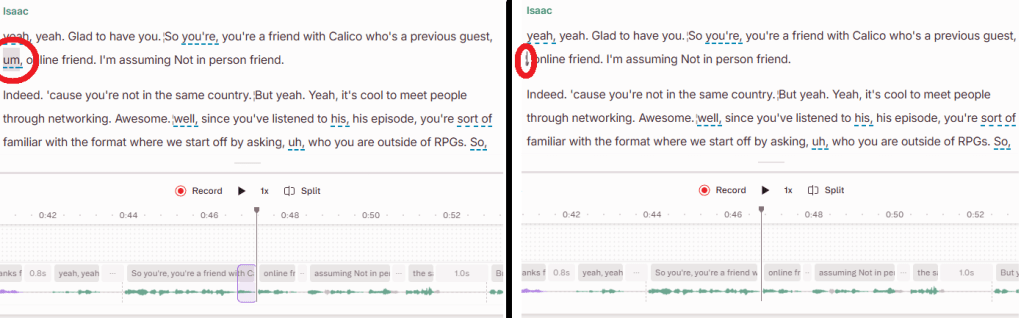
The main advantage of Descript for me is transcript editing. The program detects different speakers and what they’re saying with decent accuracy. It’s very easy to edit out all the filler words of “um, uh, like, kind of, basically, and chchch.” Just select the word in the transcript and press delete. This is a much faster workflow than selecting a sound in Audacity’s waveform.
I used the free trial version which allowed 1 hour of audio to be uploaded per month. That meant it took me 3 months to upload a recording that was slightly more than 2 hours (and then edit down to under 2 hours).
The editing of filler words worked really well. While there is a command to remove all filler words, I didn’t use it. Removing them all makes speech unnatural and can introduce errors. For example, people frequently use “uh” as the first syllable of a word that begins with “A.” Someone might say, “We want to hold him… uhhhh…-countable.” Removing the “uh” creates the malapropism of, “We want to hold him countable.”
I used my regular editing method of listening to the episode and pruning as I went. The transcript just made the process easier. Typically, a 2 hour episode takes me 6 hours to edit. I didn’t time myself on this one, but it was probably close to 4 hours. More importantly, transcript editing was a more enjoyable process. Fiddling with waveforms is fun when I’m trying to sync something with music. It’s not fun for me to do for an interview sound file.
Now for the problems. Problem #1 is obvious, Descript is a subscription product. I’d be willing to pay $100 or $200 to have the software. I’m less willing to pay that amount every year. If Setting the Stage was making enough money to cover that cost? Maybe.
Problem #2 is far more technical. It’s a problem that arises because I’m conducting interviews with online voice chat instead of using face-to-face conversations. When you can’t see someone there’s no way to visually indicate that you’d like to speak. It’s also harder to audibly indicate you want to speak because many of the smaller sounds that people use for that are removed by Discord if you don’t continue speaking. The person on the other end doesn’t hear your subtle noises so they keep talking unless you interrupt them.
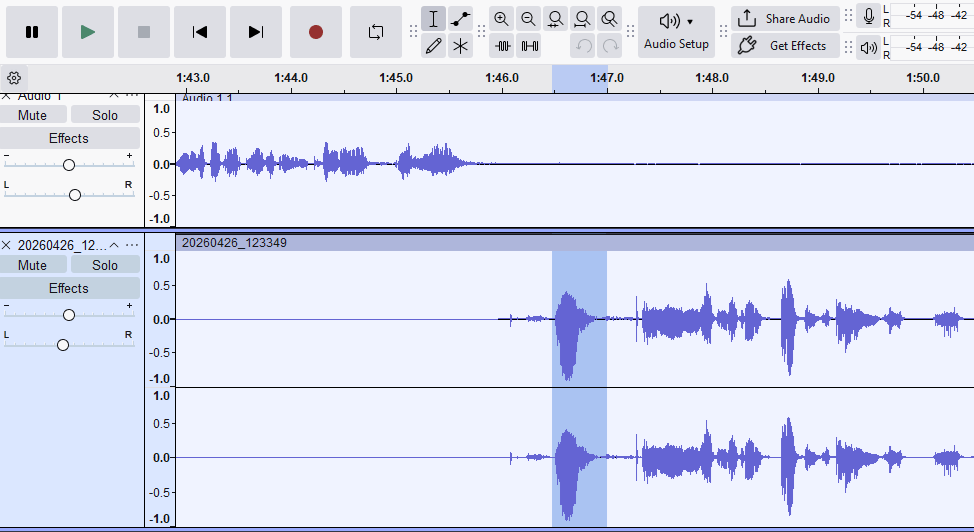
When I’m interviewing someone, I occasionally have to interrupt them. I don’t like interrupting people but sometimes I have to so that the interview stays on track. I also don’t like seeming rude in my recording. That means that a portion of my editing is removing the parts where I talk over someone. I pick a spot where my guest’s thought naturally ended, then lop off the bits where we were both talking. If necessary, that means I’ll silence my interruption noises and the short part where they kept speaking while I was beginning my next question. It’s not a straight edit where I’m just removing the audio from both speakers, I selectively remove and silence pieces from my audio track as well as my guest’s audio track.
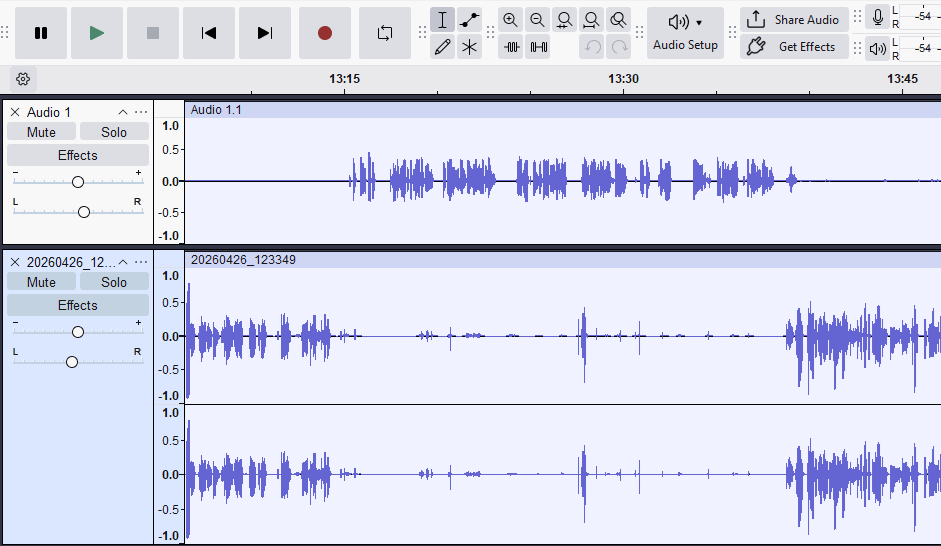
Descript doesn’t let you do that with transcript editing. Descript can only create a transcript off a single audio file. The programming is able to detect two different speakers. It can accurately assign different words to the two speakers when they talk at the same time. Unfortunately, your only options when editing are to remove or silence both speakers. That means I can’t easily edit/smooth out my interruptions.
You can load two tracks at the same time on Descript, but then only one of them gets the transcript. That could still be a solution. I’ve been doing this for years and recorded dozens of episodes, so my microphone discipline is better than most of my guests. I’m also talking a lot less than them. I could use their audio track as the transcript track that I edit with transcript editing. My track would be synced alongside theirs, but I would have to edit it with waveform editing, just like in Audacity. A marginal improvement, but probably still better!
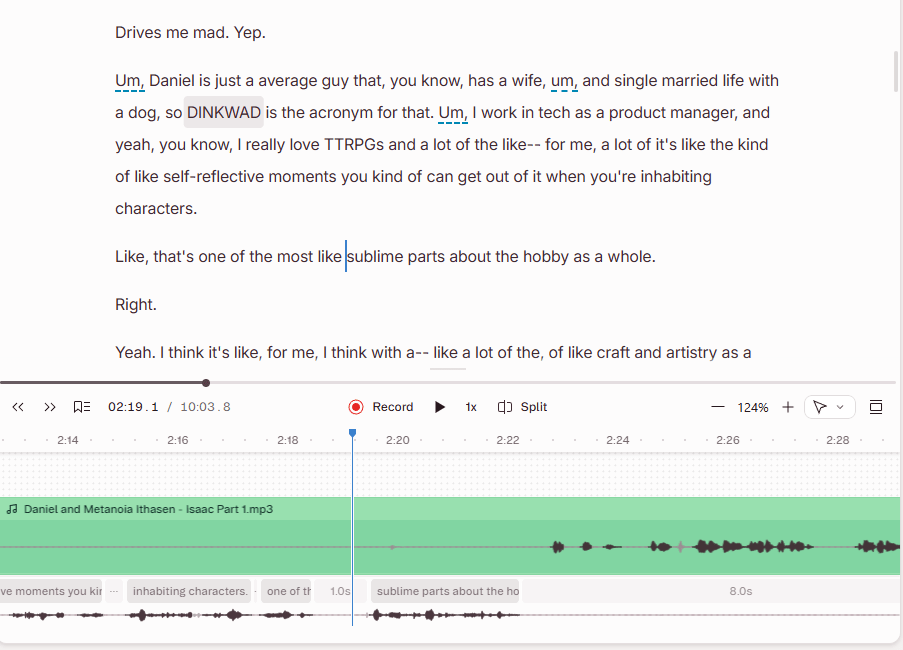
I’ll be giving that method a try for future episodes. Keeping the audio tracks separate for this kind of editing does introduce an additional hassle though. It means that my upload size to Descript is doubled, meaning a 1 hour episode becomes a 2 hour upload if I’m separating the two tracks out. Regrettable, but I don’t think I’d keep using Descript if that wasn’t an option.
Descript doesn’t quite replace Audacity, but it’s awfully close. I’ll see if I can recommend changes related to this in a feature request at a later date. I have a feeling they wouldn’t listen to a free tier user. At least I’ve got it all written up with pictures ahead of time!





Leave a Reply