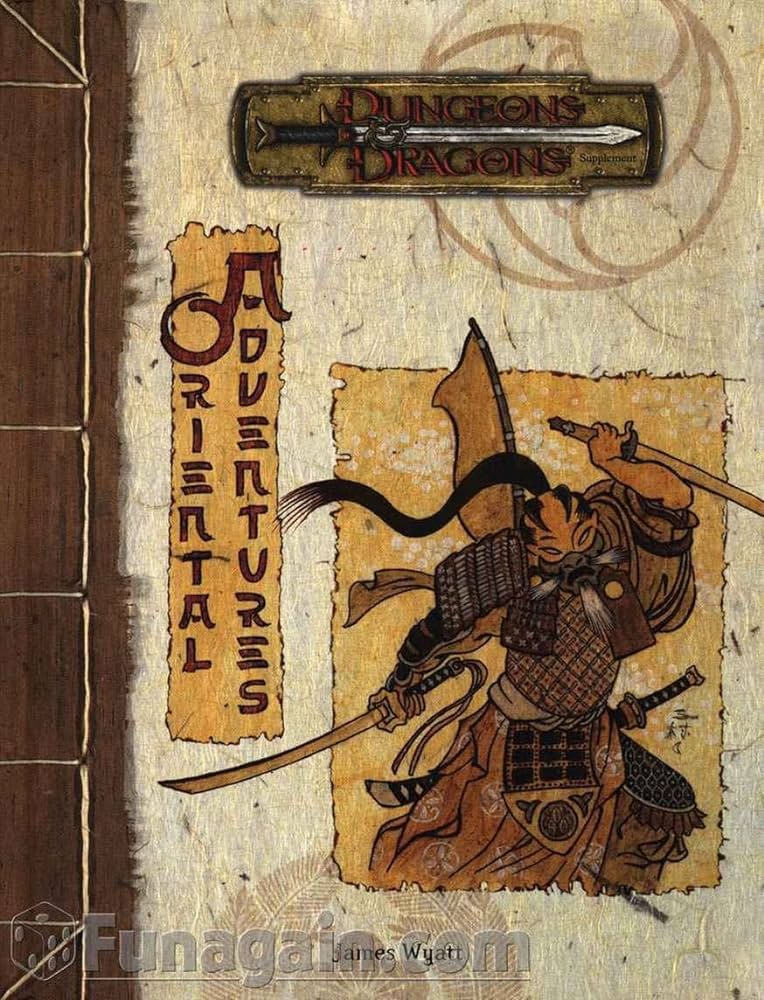
Oriental Adventures was a supplement for 3rd edition D&D. It still requires the base game to play, but the book is much bigger than the other 3rd edition supplements. It was one of the most popular supplements. It had tons of new content for DMs and players. A lot of that content carried over into the Complete supplement books for 3.5.
The 1st edition version of Oriental Adventures had a vague Eastern setting without much character to it. The 3rd edition version is a collaboration with the Legend of Five Rings (LFR) games using their setting of Rokugan. One wonders what the purpose of the collaboration is since LFR’s RPG and its card game are theoretically competitors to Wizards of the Coast’s D&D and Magic the Gathering games. Why play D&D’s version of LFR when you can just play the real thing? Well of course we know the answer… People don’t want to change the game system they’re using if they don’t have to.
Oriental Adventures offers a bunch of new classes, monsters, magic items, and spells for D&D. It’s all still the same basic frame, but with one new trait unique to Rokugan, Taint. Doing super evil things infects a character with Taint. If your Taint score goes too high, you become an evil demon-like character. Taint is usually a negative thing to have, but there are also a few cool classes that are only available to characters with maxed out Taint.
There were a few elements of the supplement that stood out to me. Monks got a lot of new feats and prestige classes to make them more powerful. Everything except a full basic attack bonus. There are a lot of great monsters. Evil fey that die when their trees are cut down. Hags that can kill people and then wear their skin to assume their identities. A few that are just piles of hit points with a costume too. The book also includes some very satisfying iaijutsu rules for samurai duels like this one.
Oriental Adventures uses the typical 3rd edition Vancian magic system, but with two different elemental systems for magic. The traditional four European elements of air, earth, fire, and water are used by the shugenja class (a sort of cleric analog). These four elements are joined by a fifth element of void. This comes from the original Book of Five Rings written by Miyamoto Musashi as a warrior-poet’s guide to combat, life, and philosophy. The void is meant to represent the Zen practice of remaining in the moment. Void elemental magic in Oriental Adventures is represented by scrying, astral projection, buffs, and debuffs.
The second elemental system for the wu jen class (wizard analog) uses the five elements of Chinese wuxing, earth, fire, metal, water, and wood. There is no special interaction between the elements or with the wu jen class, so it just comes down to the spell descriptions for each of the five elements. There is an attempt to give them each a theme. Earth is defensive buff spells. Fire is damage and speed. Metal is the art of magically hardening scarves and spanking people with them. Water is poison magic. Wood is druid utility spells. Metal feels like it missed the mark obviously, but my main complaint is that there’s no interaction between the elements. The wuxing system is based around elements strengthening and weakening each other. It really needed a class that was built for that system from the ground up instead of a wizard with face paint on it.
3rd edition Oriental Adventures could work decently for Chinese inspired gameplay. It is more Japanese than Chinese, but those lines get blurred more than I’d like in their representations in American culture. It certainly could work if one wanted to use 3rd edition as their vehicle for that type of game. I’ve had enough of 3rd edition D&D though. What Oriental Adventures offers simply isn’t enough to make me return to the edition I started with and already played in for fifteen years. On to something new!
If you are interested in buying the 3rd edition D&D Oriental Adventures book its still available on Amazon for its sticker price.





Leave a Reply