Last week the rice research lab I work in was all but abandoned due to a local conference on plant pathogens.
I didn’t go to the conference as I’ll soon be changing to working entirely on C. elegans.
Spending the lab’s money on me learning more about a topic that I probably won’t encounter again would’ve made me feel guilty.
I was left in the lab with a few people who stayed behind or came back early.
I finished all my usual duties in the lab like taking care of plants and setting up stuff for next week, but I still had a lot of extra time before the end of the day.
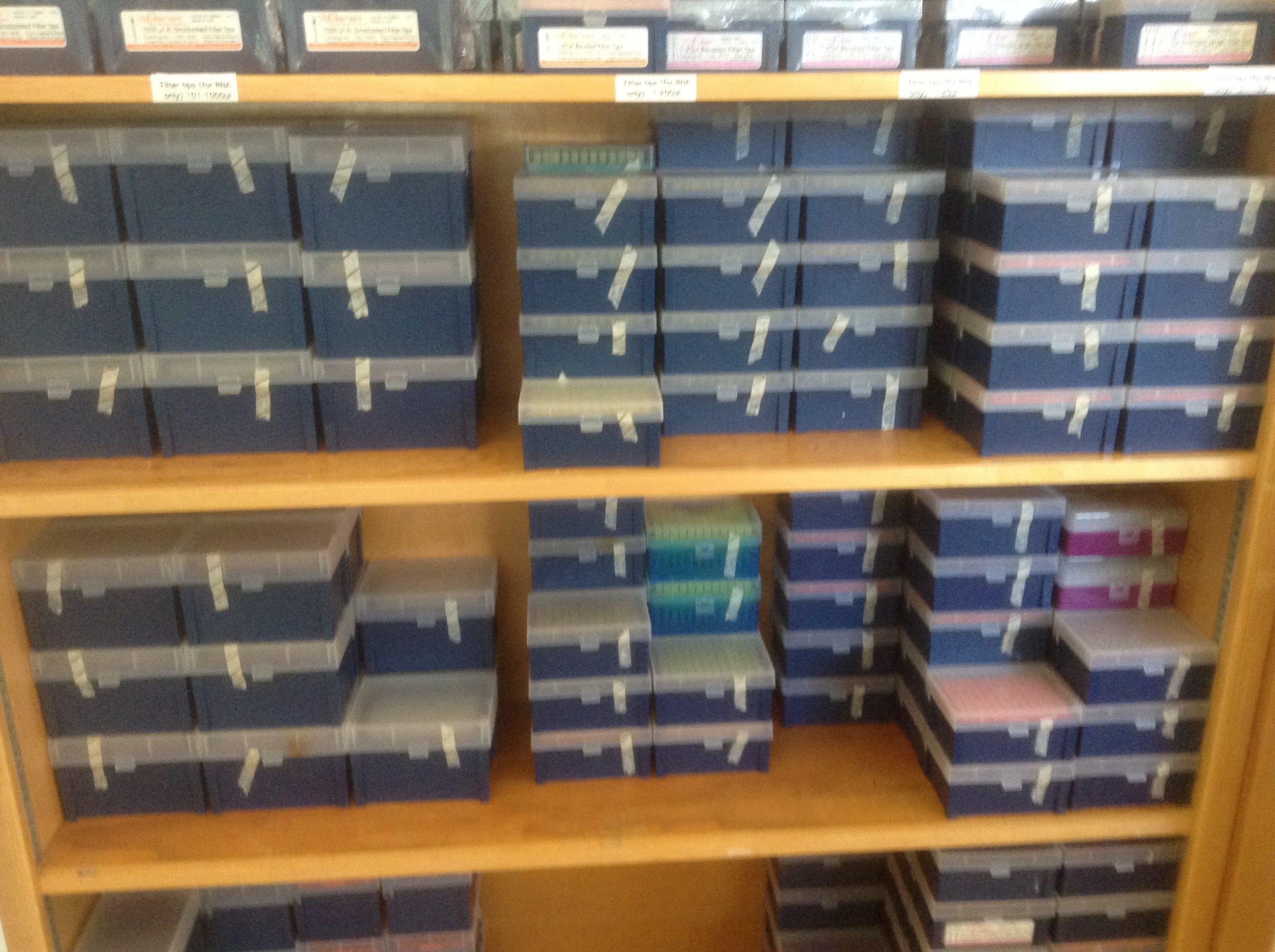
I cleaned up the lab a bit and… FILLED TIPS.
I filled two entire shelves with boxes of tips.
You might be wondering what are tips and what are they used for?
Biological research often requires very small amounts of liquid to be measured.
For comparison, in the science we usually measure volumes of liquids in liters.
Most people are familiar with liters in the form of those two liter soda bottles that are used for parties.

A milliliter is equal to one thousandth of a liter, or two thousandths of a soda bottle.
A milliliter is still rather big though. It’s about the size of the last joint on your pinky finger.
The research I perform measures liquids in microliters, which are one thousandth of a milliliter (or two millionths of a soda bottle).
A microliter is about as big as a period.
So how is something that small measured?
With a pipette!

A pipette is essentially a mechanical suction device, similar to a straw.
A pipette tip is added on to the sharp end of the device you see above.
The button on top is pressed down, expelling a specific volume of air from the pipette.
When the button is released the pipette sucks that volume back up into the pipette tip.
Pretty much the same principle as using a straw to drink a two-liter bottle of soda.
The amount of air expelled from a pipette allows researchers like me to work with extremely small volumes. Some pipettes can even measure volumes as small as a thousandth of a micoliter (Another name for that is a nanoliter).
When working with small volumes like this its even more important to be clean.
Any small contaminant on the pipette tip would be a large contaminant in a mixture of only a few microliters.
So the tips are put into those boxes in the first picture and then autoclaved to sterilize them.
Oh and here’s a closeup of a pipette tip!

-Mister Ed









Leave a comment