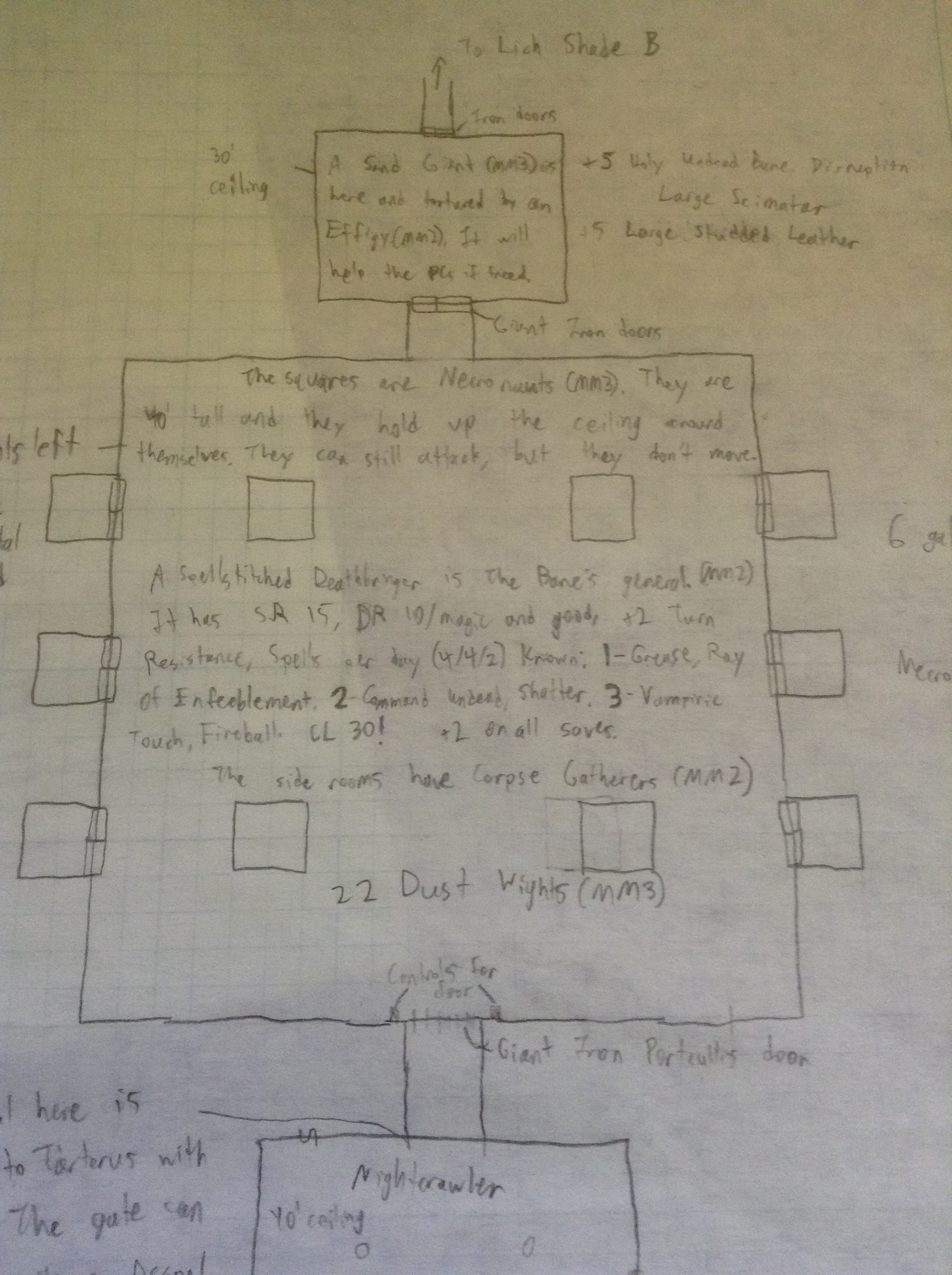
Room 2 of the Lich Shade dungeon drawn using graph paper with notes on it.

There a lot of different styles of DMing in D&D and other roleplaying games.

You can wing it and come to each session with very little prepared.

You can come up with the adventure for each session in the week before.

You can also do what I do, make up the entire campaign before starting it.

Between each session I have almost no creative work to do for D&D. My campaign has been running for close to three years now and I’ve only had to design one adventure out of about a dozen since then.

It’s nice. I don’t need to spend extra time on the game for me and my friends to have a lot of fun.

I have started to run into a few issues though.

When I wrote the campaign I imagined my group would still manage to meet in person.

That proved to be horribly wrong. We have in person sessions about once a year now.

When I drew all my maps they looked like the one pictured above. I’d make them on a piece of yellow-green graph paper.

When they reached a room I’d draw with a wet-erase marker on a battle mat I brought to each session.

When the players defeated the monsters in one room I’d erase and draw the next room.

Dry erasing was easy, but creating good maps in our current system is a little difficult.

My group now plays over the internet using an internet browser program called Roll20.

Roll20 is really great. It has everything a tabletop has. You can even turn on a feature to see your dice roll across the table.

However, I can’t just grab a pen and draw on my monitor as easily as I draw on the battle mat used previously.

I suppose I could do that if I was used to creating digital images, but I’m not.

Instead I’ve taken to making lame looking maps or using a cool mapping software piece called GridMapper.

The second room of the Lich Shade dungeon made using GridMapper.

GridMapper is extremely simple. You pretty much just click to change stuff.

I can easily build maps in GridMapper. They don’t look amazing because it doesn’t come with preset images like trees and stuff, but they’re functional just like my dry erase mat.

GridMapper has one issue, it has a maximum image size. Easy to get around though, I just make two images and glue them together for really big rooms.

I’m slowly converting all my old pencil maps into GridMapper maps for Roll20 now.

That’s it for now!

-Mister Ed

One response to “Mapping Methods”

  1. Roll20 and D&D | GoCorral Avatar

    […] mentioned Roll20 in past posts about how my group plays D&D, but I figure it deserves a post all its […]

Leave a comment

I’m Isaac

Welcome to the GoCorral website! I’m Isaac Shaker and this is a place for me to write about D&D and occasionally other topics. I host a podcast called Setting the Stage that interviews different DMs about their campaigns. I’m currently focused on completing the Cimmeria campaign setting and turning it into a book.

Setting the Stage Podcast

88 – DM & Roleplaying Tips with Balance of Aksio (Jay + Sandra! and 3RPG) Setting the Stage, Campaigns for D&D and Other RPGs

Our guests today are Jay and Sandra from the 3RPG podcast. Their podcast is a talk show, typically with three hosts. Unfortunately the third host Chris was unable to make it.Jay and Sandra are working on a RPG product dubbed The Balance of Aksio. It's a new narrative fantasy TTRPG system with point buy character creation. The world within Balance of Aksio grew out of games that Jay and Sandra have been playing together since high school. Lots of history from important characters over the in-game centuries they have been playing. Balance of Aksio comes with numerous storytelling aids to help with character decision making, generational play, and how to cover long gaps between adventures.Balance of Aksio also introduces a unique idea for running your NPCs. Rather than make all the decisions yourself, Jay and Sandra recommend outsourcing the NPC actions to people you know outside of the campaign. Give those people a profile of the NPC and the decision they are facing. Then let those people decide what the NPC would do without your own biases as a GM entering the equation. Quite a clever way to introduce new developments in your game that even you can't predict!There's a 3RPG Podcast website and the show itself is available on all major podcast platforms.I guested on the 3RPG podcast for episode 61. Check it out!Check out the Setting the Stage website!Want to be on the show? Fill out this survey.Join our Discord!Support Setting the Stage on Patreon! Hosted on Acast. See acast.com/privacy for more information.
  1. 88 – DM & Roleplaying Tips with Balance of Aksio (Jay + Sandra! and 3RPG)
  2. 87 – Adapted Azeroth D&D (Flare and Akridon)
  3. 86 – Wuxia Adventures in RPGS (Daniel and Metanoia/Ithasen)
  4. 85 – Medical Doctor D&D (Justin and Oops! All Healers!)
  5. 84 – Horseback Riding D&D Camp (Michael and SaddleSnaps)