Elves have an additional subrace/lineage in Cimmeria beyond those presented in the PHB. You can read the rules for that additional lineage on the Cimmeria Species and Subraces page.
Physical Description
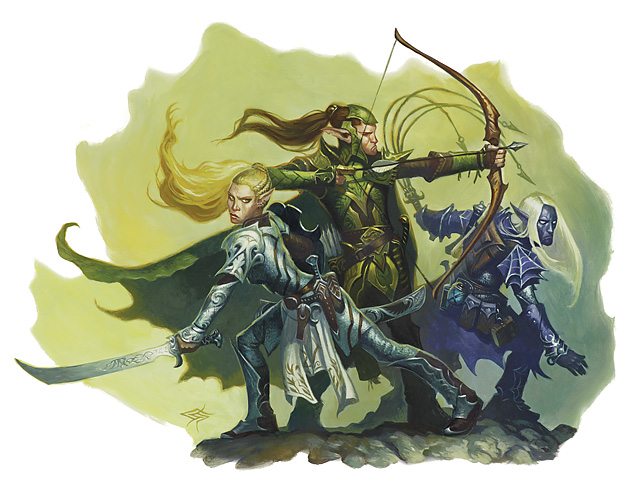
Elves are often depicted as the idealistic form by humans. Elves stand between five and six feet tall and are slender with long limbs and graceful proportions. They have angular or refined facial features, with high cheekbones, pointed ears, and almond-shaped eyes. Their faces are commonly described as elegant or beautiful. Their skin tone varies from pale to copper toned for above-ground elves and a pure black ebony color for Dark Elves. Eye colors vary between all colors of the rainbow. Their hair has fine, silky strands in a variety of colors, including blonde, silver, white, black, gold, and shades of brown.
Elvish physical superiority continues beyond beauty into more concrete advantages. Their long, pointed ears give them a better sense of hearing. Elves also have exceptionally sharp eyesight, capable of seeing in low light conditions and discerning details that might be missed by humans. Elves also have a drastically slowed metabolism. They maintain a healthy weight while also living for centuries, much longer than any other mortal race.
Culture
Elves have an affinity for magic, beauty, and all things that grow. Arcane spells are present throughout elven domestic life. A spoon enchanted to stir a pot, a shirt ensorcelled to fold itself, or a sink that cleans its own dishes. More powerful spells provide protection for elven communities. Wards prevent many forest villages from being discovered through illusion or violence. Magic is just another tool to the common elf, just as likely to be used for gardening as it is for self defense.
All plants are viewed with fascination by elves. Elven settlements are constructed as part of nature. With their long lifespans they can afford a lengthened outlook on construction. Elven buildings are made by slowly training trees to grow together for walls and ceilings. This same training can also incorporate natural elements for decoration. Flowers and vines are grafted on to provide a fey-like aesthetic. Small holes and cones are left in the wood so that when the wind blows through them it makes hauntingly beautiful music. Woodwind instruments are played by the inhabitants of elvish dwellings to accompany the music of the natural world.
Elves are natural born artists. Their skill shows in their delicate architecture and their singing. For more physical art pieces, elf talent truly shines with metal work. The finest jewelry in Cimmeria comes from elven whitesmiths. Elves also do amazing work with mithral, forging even better armor than the dwarves. While elf weapons are visually stunning, they are functionally no better than any other crafter. The one exception is bows and arrows. Elvish bows are sought after by hunters across Cimmeria and an elvish-made arrow is often a prized possession for a human family. All these goods along with tree-grown fruits are exported to human communities that are set up outside of elven forests.
History
Elves were created along with the other Conclave races when the Olympians moved from Greece to Cimmeria. The elves joined the rest of the Conclave races in war against the goblins. After fifty years of war, the elves left the Conclave to setup new societies in the different forests of Cimmeria. Four elven leaders led the largest groups of elves to four different forests. Croshan the Honorable took his people to the Whitewood Forest. Rarventataa the Wary took her people to the Dry Woods (which would later be known as Bigby’s Forest). Valor the Boastful took his people to Valor’s Forest and promptly named the forest after himself. Kithania the Strong took her people to the Hardtop Forest (now known as the Robber’s Forest).
The Dragon Hegemony put pressure on the elven people just as it did the other races of Cimmeria. At the start of the Dragon Hegemony the four elven kingdoms were attacked. Raventataa, Valor, and Kithania were all slain in the fighting. Rather than resist the dragons, Croshan elected to hide his people. He cast a powerful spell that forever changed the Elves of Whitewood. Their skin turned pure black and their hair pure white. Croshan’s people became Dark Elves adapted for life below ground. They went into the Underdark to escape the dragons.
The Dragon War sparked a civil war amongst the elves. Some had chosen to honor the dragons supremacy as the greatest beings in creation. Others still yearned for their freedom. The two sides were known as the Naturalists who favored the dragons and the Patriots who opposed them. In the end the Heroes of the Dragon War were able to defeat the Naturalists along with the other allies of the dragons. The surviving Naturalist Elves settled into different druidic communities around Cimmeria.
After the Dragon War the different subraces of elves remained separate. The dragons destroyed the monarchies of the three surface subraces. Without a clear leader to unite behind, the surface elves fractured state persisted to this day. Today, elves are known as fine wizards and craftsmen. The rest of Cimmeria sees them as unreliable in times of need as elves are more likely to retreat to the safety of their forests rather than soldier adversity with the other mortals of the Conclave.
The Dark Elves have largely hostile interactions with the surface world of Cimmeria. They raid a particular region of Cimmeria for decades, popping up from the Underdark and then retreating into their tunnels. Once that region develops the training and techniques to counter Dark Elf attacks, the Underdark pillagers move on to another area. The cycle repeats itself. The Dark Elves have even returned to some regions centuries later when the people there have forgotten how to fight invaders from below.
Elves have occasionally stood alongside the other races to fight an existential threat. When Kruk-Ma-Kali invaded Eastern Cimmeria he devastated Valor’s Forest. The elves fought off the attack with spells and traps. Through their protective magic they escaped total annihilation. Kruk-Ma-Kali promised to return, but his assassination forestalled any future repeat invasions. After Kruk-Ma-Kali the elves helped once again during the Second Alliance War, fighting with the Rebellion against Xoria’s dragovinians.
Subraces
The elves were a single race when they were a part of the Conclave. When they left the different rulers of the elves took their contingent of the race to different forests, causing the split into the four subraces known in Cimmeria today, High Elf, Dark Elf, Wood Elf, and Wild Elf.
High Elves: High Elves are on the taller end of the elf height spectrum. They typically have blonde, brown, or auburn hair. Their eyes are usually green or amber. High Elves are experienced users of abjuration magic, often learning a few minor protective spells and wards at a young age. They are adept at fighting goblins and orcs due to their proximity to the Orc and Hobgoblin Lands. Many High Elves choose magic as their defensive tool, but those who use weapons specialize in the bow and arrow or dual wielding swords. The High Elf combat style was refined into the way of the ranger and taught to outsiders after the Dragon War. High Elves are friendly towards the other races, but few non elves are allowed into the heart of Valor’s Forest where the High Elves make their home. High Elves are ruled by a council of elders.
Dark Elves: Dark Elves have jet black skin and white hair. Their eye color spans the whole range of colors with red, purple, orange, and blue being the most common. Dark Elves are taught to use illusion and necromancy magic from a young age and all are capable of a few simple spells.
Events in recent history initiated many radical changes in Dark Elf society. A civil war saw the rise of Queen Medrika, replacing Croshan, the original King of the Dark Elves. Medrika brought a dominating matriarchal culture and a strong connection to spiders. After Medrika’s ascension Xorian vampires invaded the Dark Elf kingdom. Many Dark Elves were kidnapped and forced into slavery on the surface to Xorian overlords. This bondage continued until the fall of the Xorian Empire. The Dark Elves are now repopulating the Underdark and their ancestral homeland of Whitewood Forest. Queen Medrika still rules her people and plots revenge against all those who have wronged her.
Wood Elves: Wood Elves are a captivating and enchanting people. Their eye color is always an earthy hue ranging from orange to green. Wood Elf hair is often red or brown. They have a particular talent for enchantment and nature magic. This magic allows them to manipulate plant life, communicate with animals, and even control the elements to a degree. Their spells are typically gentle and harmonious, enhancing the natural world around them rather than bending it to their will. The most famous Wood Elf magician is Bigby the Dragon War Hero. His magic altered the home of the Wood Elves, causing it to grow faster than woodcutters could cut it down. Because of his ensorcellment, the forest is now known as Bigby’s Forest.
Wood Elves have a deep-seated appreciation for craftsmanship and artistry, particularly in the realms of cooking and tailoring. Their role as chefs is not merely about sustenance but is an art form. They have a knack for creating dishes that are both visually stunning and delightful to the palate, often using ingredients that they gather themselves from the wild. Their cooking is celebrated for its ability to harmonize flavors and bring out the best in the natural ingredients they use.
Tailoring is another area where Wood Elves excel. Their garments are not just clothing but are woven with intricate patterns and enchantments that often reflect their natural surroundings. These clothes are both practical and beautiful, blending seamlessly with the environment and providing protection and comfort. The Wood Elves’ expertise in tailoring also includes the creation of items like cloaks and robes that have magical properties, such as enhancing stealth or providing camouflage.
Wild Elves: The scholars of Cimmeria know little of Wild Elves. Records from before the Dragon War indicate they were excellent hunters and masters of transformation magic. After the Dragon War they disappeared into isolationist societies. Some Wild Elf communities have experienced no peaceful contact with the outside world for centuries. Wild Elves are known to reside in Robber’s Forest and on Elf Isle. The Elves of Robber’s Forest seems to allow others to enter, but the only sign that elves inhabit the woods is the occasional glimpse of someone running through the trees or a lost arrow found hidden under bushes. The Elves of Elf Isle are certainly there, but they are also certain to kill any foreigner that enters their woods.
Location
Elves exist within human cities and within the forests of Cimmeria. High Elves live mostly in Valor’s Forest. Wood Elves live mostly within Bigby’s Forest. Wild Elves live mostly within Robber’s Forest. Dark Elves live in the forests of Xoria and in the Underdark. There are also groups of different subraces of elves living on the Elf Isle in the Caspian Sea. The Elf Isle is hostile to foreigners and there is no record of peaceful contact with the elves there in centuries.
Relations with Other Races
Elves often have strained relationships with the other races of Cimmeria. They are hostile to many races entering their forests. Honored guests are allowed within but must strictly obey the rules of hospitality or risk expulsion. Humans have set up trading posts outside elven forests for the sylvan people to exchange their goods with those of the outside world. Elves see humans and halflings as young children needing guidance and protection, but elven communities are often unwilling to provide either to outsiders. There is a natural respect for dwarven craftsmanship among the elves, but the rest of dwarven culture is viewed as alien and strange. Elves are hostile to orcs due to orkin participation in Kruk-Ma-Kali’s sack of Valor’s Forest. Ultimately, while elves navigate complex interactions with other races, their enduring commitment to preserving their own way of life often overshadows any potential for deeper alliances or understanding.
Common Deities
Elves connection to the natural world leads them to favor Artemis, Demeter, and Pan as their deities. Those with aggressive personalities typically choose Artemis while those who are not passively inclined will worship Demeter. Pan has a small cult following for those who primarily worship him. Outside of the cult the satyr god is respected as a powerful spirit and receives small daily sacrifices in most elven homes. Elves love of magic also leads them to worship Athena and Hecate. Elvish spellcasters bury a nut or seed in sacrifice to one of these two goddesses before they memorize their spells each day.
Place in Adventuring
Elves make excellent wizard, ranger, and rogue adventurers due to their unique traits and inherent qualities that align well with these roles. The longevity of elves allow them to master the most difficult arcane arts. In addition, each of the elven subraces has a unique talent for magic that allows them to explore spells from a young age. Elves make excellent rangers because the fighting style and skill set of rangers was invented by the elves themselves for slaying the monsters of Cimmeria. It’s no wonder that they take easily to their own methods. Elves make good rogues due to their natural grace and agility. They are able to avoid notice easily, see what others cannot, and slip away from danger before they are caught. All together, elves’ long lifespans, magical affinity, connection to nature, agility, and keen senses make them well-suited for roles that require a blend of intellect and specialized skills, such as wizards, rangers, and rogues. Their unique attributes enable them to excel in these diverse and challenging roles.
Elves can be both formidable enemies and invaluable allies to adventurers. As allies, elves offer unmatched skills in archery, enchantments, and command of the arcane and natural realms, often providing crucial aid in quests that deal with knowledge forgotten to the shorter lived races. Their deep connection to the land and centuries of experience can guide adventurers through treacherous terrain and complex lore. However, elves can also become adversaries when their intricate plots, ancient grudges, or fierce protection of their sacred lands come into play. Their long memories and high standards for behavior can lead to fierce confrontations with those who disrespect their traditions or threaten their homes. Thus, while elves can be allies of great strength and wisdom, their actions and allegiances are often governed by a complex interplay of honor, duty, and ancient history.