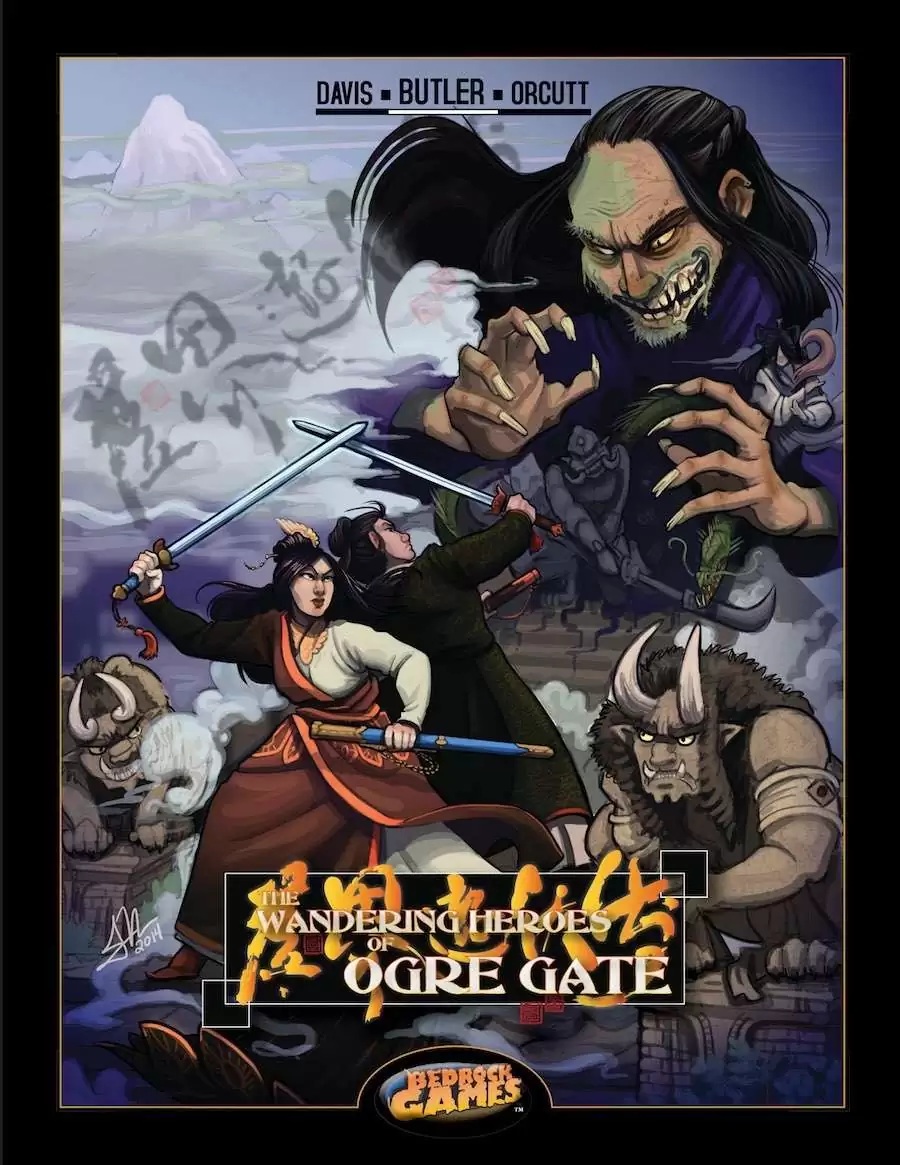
Continuing my journey through different China RPGS with Wandering Heroes of Ogre Gate (WHOG), the precursor to Righteous Blood, Ruthless Blades. One of the authors of RBRB, Brendan Davis, also worked on WHOG. RBRB is in many ways a slimmed down version of WHOG, keeping all the most essential parts and discarding the extra fat. After reading both, I think they both have merits. It’s more about whether you want the extra complexity of WHOG or the simplicity of RBRB.
WHOG is a 500 page book roughly split into five different sections which are somewhat intertwined. The first section guides you through character creation. The second section contains the rules to play. The third section provides lore for the alternate version of China that WHOG is set in. The fourth section has dozens of allies, villains, rivals, and monsters to fight with and alongside the PCs. The final fifth section provides guidance for designing your own adventures and campaigns for WHOG along with two sample adventures.
How to Play
WHOG is based on the Sertorius Network system that the publisher, Bedrock Games, has used for other TTRPGs they’ve produced. The system feels like a combination of D&D and World of Darkness. There are a lot of options that look simulationist in their intention. But action resolution is filtered through the d10 dice pool system of World of Darkness. And altogether it is unsurprisingly similar to RBRB.
To resolve an action you roll a number of d10s. The number of d10s you get is based on your skill ranks and other factors. Usually you’ll get up to 3 ranks from your skills and up to 3 more ranks from other conditions. After rolling your handful of d10s, you look for the die with the highest result. That highest number is compared to the TN for the task. If your roll is greater than or equal to the TN, you succeed.
Those are the basic rules. Bonuses and penalties are handled by adding more dice to the dice pool or subtracting them. Or by increasing or lowering the TN.
WHOG is like World of Darkness in more ways than just the d10 dice pool mechanic. World of Darkness characters are always set up with some sort of monster/human duality conflict. WHOG has that with Qi and imbalance. When using a kung fu technique you have two options, safe and dangerous. A safe use is weaker but has no side effects. A dangerous use is stronger but gives you imbalance points. Acquire too many imbalance points and an evil spirit will temporarily possess your body and permanently give you a new flaw. This is a trope that’s present in some wuxia stories and an excellent way to represent that duality between the pursuit of martial power and holding on to your humanity.
There are lots of extra rules. Mounted combat, carts, wagons, ships, and collisions all have rules. Poison and diseases have rules. There’s even some rules for how to resolve back-alley betting matches on crickets fighting each other. Definitely more than needed in my mind.
Character Skills
I wasn’t expecting this, but WHOG does have character races to pick from. In addition to humans there are Hechi, Juren, Kithiri, and Ouyan. Humans are the default. Hechi are goat people with a slow and steady approach to life and their horns are able to magically detect lies. Juren are strong and dumb with four arms. Kithiri are humans with metallic colored skin and multiple personalities. Each Kithiri is actually six people in one body, making them smart but also extremely quixotic. Ouyan are mostly human in appearance. They are slightly weaker and they have a third eye that can see people’s inner emotions. All of these races are listed as optional. You can include them in your game or not, depending on how fantastical you want your stories to be.
WHOG is a BP system with levels. At the end of each session you get about 3 XP to spend on advancement. After you’ve accumulated a certain amount of XP you level up, giving you some extra stats and access to more powerful kung fu techniques. Level 2 is only 6 XP away. Level 3 is another 12 XP. Level 4 is another 18 XP and each subsequent level requires more and more XP. Since you’re only getting 3 XP per session, its unlikely that you’ll advance beyond level 6 in any normal campaign.
The mechanical side of character creation is mostly about picking skills and kung fu techniques. Skills are split up into six different skill groups of Defense, Combat, Specialist, Physical, Knowledge, and Mental. Defense is your defensive stats for combat, conversations, and stealth as well. Combat is your offensive stats with different skills for punching, kicking, melee, ranged, etc. Specialist gives you training in professional skills like medicine or trade. Physical has skills for movement. Knowledge holds all those factoid skills that are in many RPGs. Finally, Mental is your social skills.
When you build your character you chose two primary skill groups. You get 12 points in each of your primary skill groups and 6 points in each of the other skill groups. Each point on a skill gives you a d10 to roll when using that skill, up to 3 points like I said earlier. The Defense skills are slightly different, with each point improving the TN that other characters have to hit when rolling against you.
There are a total of 35 specific skills to pick from during character creation. 15 of those are combat skills. There are also an additional 9 knowledge skills that require selecting a focus. The options are roughly equal to the amount in D&D 3rd edition. A number of choices that should be noted, was reduced in every subsequent edition. It’s really more than necessary and I’m glad it was also chopped down in the spiritual successor, RBRB, which narrowed down the choices to 6 combat skills and 31 total skills including the knowledge skills.
Kung Fu Techniques
The more exciting part of WHOG is the kung fu techniques. The techniques are split into four martial disciplines. These are waijia (physical moves like real kung fu), qinggong (wire-fu from Crouching Tiger, Hidden Dragon and other similar stories), dianxue (pressure points and acupuncture), and neigong (internal power or everything else that isn’t clearly one of the first three). You have four points to distribute between the disciplines. If a discipline has 0 points, you can’t learn techniques from that discipline. Having an uneven spread of disciplines will also affect how quickly your qi becomes imbalanced.
At character creation you choose six kung fu techniques from an absolutely enormous list. I think this is where WHOG really shines. Blasting Blade breaks an object and shoots the fragments at your enemies. Flying Swan Kick attacks one enemy and as you step on them you jump to kick another foe. Encompassing Energy of Sun Mai surrounds a foe in crushing green energy. Tons of cool choices to make during character creation and interesting stories to tell through the abilities your character gains. The moves are undisputedly wuxia techniques, firmly placing WHOG as a wuxia game, not just a martial arts game.
Using a kung fu technique is simple. You’ll usually roll a Skill for accuracy. Your martial discipline points will determine the power of that technique, like damage, duration, or area of effect. There’s also basic moves that don’t use fancy kung fu, but those aren’t as fun.
The main parts of character customization are in the skills and kung fu techniques, but there’s lots of other smaller options too. Your skills can have extra bits of expertise in particular areas. You can take flaws for additional BP. There are rituals for more complicated spells than kung fu magic. You can choose from a list of equipment that’s about as big as what’s offered in D&D books. Lots of little fiddly bits for people that like that sort of game.
Lore
WHOG‘s lore section is extensive and well done. The authors opted for a faux-China setting called Qi Xien, similar to others I’ve read. Cultural consultants were used to make sure the authors didn’t write something accidentally offensive. Maybe that’s why they used a fake setting. Their version of China imitates the Song Dynasty, a popular period for wuxia stories as its still Medieval China, but includes Mongols, gunpowder, and some contact with non-Asians. That’s outside my preference, but I get it. There’s also less anachronisms for Chinese culture at that point as many things such as Confucianism, civil service exams, Buddhism, imperial bureaucracy, and Daoism had grown to their mature forms.
The lore section incorporates little optional rules you can include. For example, if the day is a good horoscope for your Zodiac you can get a +1d10 to all your rolls. Conversely, a bad day can give you a -1d10 to all your rolls. Neat little extra treats to make the lore really integrated into the play experience for the game.
GM Resources
There’s lots of resources for GMs in WHOG. The main book has two sample adventures to get you started. Tons of plot hooks with the lore section. Dozens of NPCs, bad guys, allies, and monsters to fight or work with. Really everything you need to try the system or build a full campaign.
The really wonderful part of the book for me is the repetition of rules. Let’s say Rule A on page 50 is dependent on Rule B on page 30. Rule A won’t say, “flip to page 30.” Rule B is repeated on page 50 alongside Rule A. You don’t need to flip back and forth between pages! Everything you need to know is right there. Super helpful for understanding the rules on my read through. This is good for GMs and for players.
My Thoughts
WHOG is a great crunchy system for the typical wuxia stories in movies and novels. The are well defined rule choices to keep things predictable and lots of kung fu techniques to keep player choices interesting. It’s easy to make your own kung fu techniques as well. The authors even placed the kung fu technique chapter into the public domain to make it super easy to release your homebrew stuff for the game to the world. On the GM side, there’s tons of content to keep the enemies mechanically interesting for dozens of sessions. If you want a crunchy wuxia game, Wandering Heroes of Ogre Gate is the best one on the market.
Interestingly, in comparison to RBRB, there’s a lot more freedom in your optimal choices for kung fu techniques. Looking at the signature abilities in RBRB it seemed like you were often locked into your choices from character creation for what was “best.” WHOG avoids that with greater variety and less reliance on ability trees.
Unfortunately, WHOG isn’t quite what I’m looking for. Reading through it helped me to realize why some other games haven’t been hitting quite right either. My desire for a prominent wuxing system doesn’t match the typical wuxia story. The five elements of Chinese philosophy and magic just aren’t a prominent part of many of wuxia stories. My imagination of what could be isn’t matched by the source material that many of these other RPG designers pulled from when writing their wuxia games.
WHOG also felt a little too crunchy to me. You can get pretty much the same feel to your game using RBRB. I’d guess that Brendan Davis agrees with me on that. Why design RBRB if he didn’t feel that way? And he’s released RBRB conversions of WHOG content on his blog. The juice of WHOG just isn’t worth the squeeze compared to RBRB unless you’re REALLY into the genre.
I think Wandering Heroes of Ogre Gate is a fantastic wuxia TTRPG. Possibly even the best one out there for you. But it’s not the best one for me. If you’re interested you can grab it for a Pay What You Want price on DriveThruRPG: https://www.drivethrurpg.com/en/product/191631/wandering-heroes-of-ogre-gate




Leave a Reply