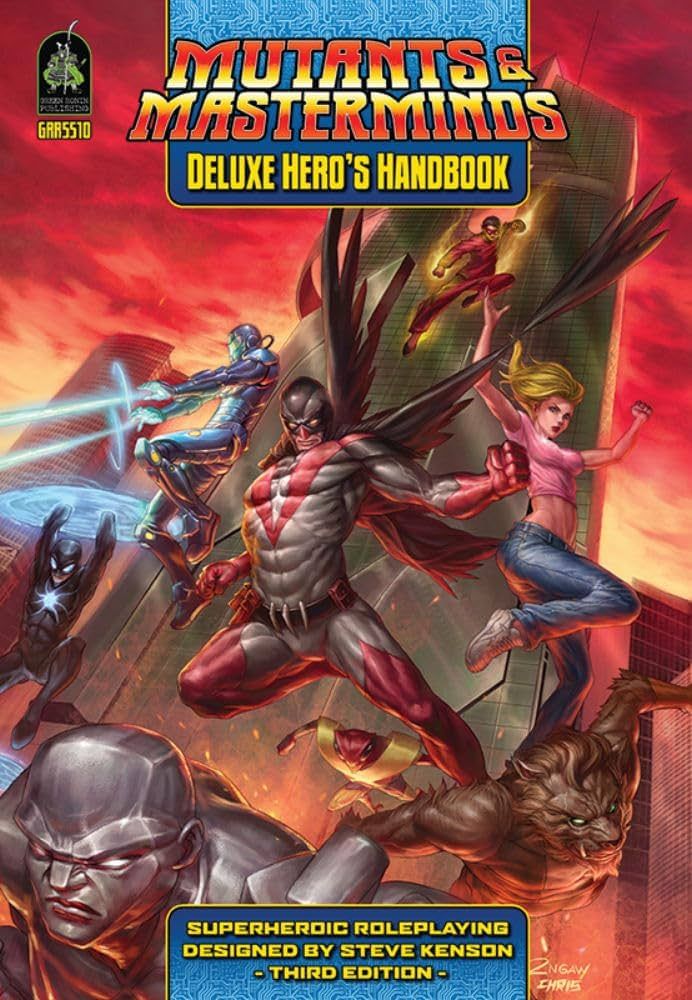
In addition to taking a look at BESM 4th Edition for a canceled Setting the Stage episode, I also read Mutants and Masterminds 3rd Edition (MnM). And despite being purpose built as a superhero system, I think it’s one of the worst I’ve seen.
Mutants and Masterminds grew out of the open license for D&D 3rd edition. The license allowed tons of games and content to be published for D&D and the d20 system without paying Wizards of the Coast. It’s one of the main reasons for the resurgence of D&D’s popularity in the early 2000s. More associated content means more purchases of the primary content. Mutants and Masterminds 1st Edition was one of those products, providing rules for superheroes within the d20 framework.
Action Resolution
A surface level look at action resolution for the system treads familiar ground if you’ve played D&D before. Most rolls are d20 + ability + skill + advantage against a DC. Most DCs are between 10 and 40 with the math from earlier editions of D&D. Start a DC at 10 and add bonuses to it as appropriate, just like you do when adding your bonuses to your d20 roll.
The main difference from D&D in action resolution is damage. When you’re hit in MnM you make a Toughness roll which is adjusted based on how badly the attacker beat your Dodge score. If you fail the Toughness roll, you get a penalty to future Toughness rolls. As your rolls get worse and worse, you eventually fail the roll by 20+ points and pass out. Or you could fail by 20+ at the start and pass out on the first punch.
Character Creation
MnM uses a building point (BP) system for character creation. The assumed starting number is 150 BP, but that can be adjusted as desired for different power levels. PCs typically earn 1 BP per session. All these BP are spent on four things, Abilities, Skills, Advantages, and Powers.
Abilities
There are eight abilities that represent your character’s natural talents. The eight are Strength, Stamina, Agility, Dexterity, Fighting, Intellect, Awareness, and Presence. A score of 0 in an ability represents an average adult. A score of 5 represents one of the best in the nation. 7 represents the peak of normal human ability. Anything beyond that is superhuman as fits a game about superheroes. Abilities cost 2 BP per point.
Skills
Skills represent your training and expertise. There are sixteen skills and a few of them have sub-skills that you specialize in. The sixteen are Acrobatics, Athletics, Close Combat, Deception, Expertise (represents a profession), Insight, Intimidation, Investigation, Perception, Persuasion, Ranged Combat, Sleight of Hand, Stealth, Technology, Treatment, and Vehicles. Spending 1 BP on skills gives you 2 skill points which can go into the same or different skills.
Advantages
Advantages are kind of like D&D’s feats or combat skills. They either let you do something special or provide a bonus to some combat or skill situation. A few examples are disarming opponents, being really lucky, or being really good at teamwork. Most advantages are something mundane that normal people could have as well as superheroes. Advantages cost 1 BP per advantage point.
Remember that action resolution is handled by adding the relevant Ability, Skill, and Advantage to a d20 roll.
Powers
Powers are the point of the game. There are tons of powers and tons of little modifications and adjustments you can make to them. Each of the little switches and dials change the BP cost of a power. Truthfully, powers are all over the place. Some are numbers boosts. Others let you change your enemies into chickens. And the modifications could have a +1 to Strength cost the same BP as chicken transformation. Without guidance, powers get really out of control. Unfortunately, the complexity of the BP system makes designing that guidance difficult to impossible.
Heroic Rules
MnM has a few special rules that I liked. Most of the rules boil down to “roll a d20 to do the thing or force opponent/s to roll a d20 or a thing is done to them.” These go a little beyond that.
The bonus rules start with Extra Effort which allows a superhero to push themselves to save the day. This gives you a little bonus like an extra action or a reroll. In exchange, you’re fatigued afterwards. Expending Extra Effort while fatigued is a bad choice as usually you’ll become exhausted which makes your character effectively useless. But that’s where the next layer comes in.
Hero points let you remove different conditions for free and do some other cool stuff. The most common use of hero points is to remove the fatigued condition. That means you’re not penalized and you can use Extra Effort again. You gain hero points from doing heroic things and from roleplaying your Complications. Which brings us to the next layer!
Complications are a set of weaknesses you set for your character during character creation. These aren’t necessarily things we’d consider weaknesses, but just something that might prevent you from taking an action or force a particular action. An easy one is “Must save civilians.” So a villain might set up a nefarious choice where you can catch the villain or save a dozen civilians that are about to get hit by a train. Your hero would have to save the civilians. Whenever a scene triggers your Complications you gain a hero point.
GM Issues
MnM seems like it’s fun to build PCs in, but an absolute nightmare to GM. There are constant reminders in the character creation section to “check with your GM before taking this power.” The ubiquitous nature makes it clear the system isn’t really balanced. Some choices are better than others, but which ones? It’s a secret. You can ignore balance or approach MnM like its a universal system. Just like GURPS, you need to agree on a concept, stick to that concept, and constantly remind people of that concept. And even with that in mind, someone might accidentally make an unbalanced character that ruins the game.
Character creation seems to operate under the assumption that PCs have a hero power concept in mind before the game and use the rules to execute that. If a player approaches with the idea of “I want a powerful character that can do anything” they will likely be able to achieve that if they study the rules or download a guide. Assuming d20/D&D 3rd edition players won’t do that is foolish. There aren’t any real safeguards on making broken characters besides the GM having enough system mastery to recognize the problems and tell the player “No.”
The reliance on a d20 system seems rather silly to me. It makes the math very granular with such a wide distribution of results, but the system is so easily broken at character creation that it doesn’t seem to matter. Why not just have fewer ranks and have a simpler system? Instead of 25 different ranks of Strength, have 6; Weak, Normal, Regular Hero, Super Hero, Super Strong Hero, and Hulk Strong Hero. The complexity of the rules is reinforced with the combat example in the book. Reading through it left me more confused than when I started. It serves to show how complicated the system is rather than simplify it.
There is a decent amount of good GM advice for designing adventures. Lots of talk about making good threats and plots. Sadly, that advice isn’t matched by concrete GM resources. There are a few stat blocks for minions, monsters, and villains but not nearly enough. There’s nothing for traps and hazards. No real guidance on challenge rating either. GMs are left building enemies in the same fashion as the PCs, with a complicated and imbalanced system. The villain you create might be perfect, might be a pushover, or might be a universe destroying god, all at the same BP price.
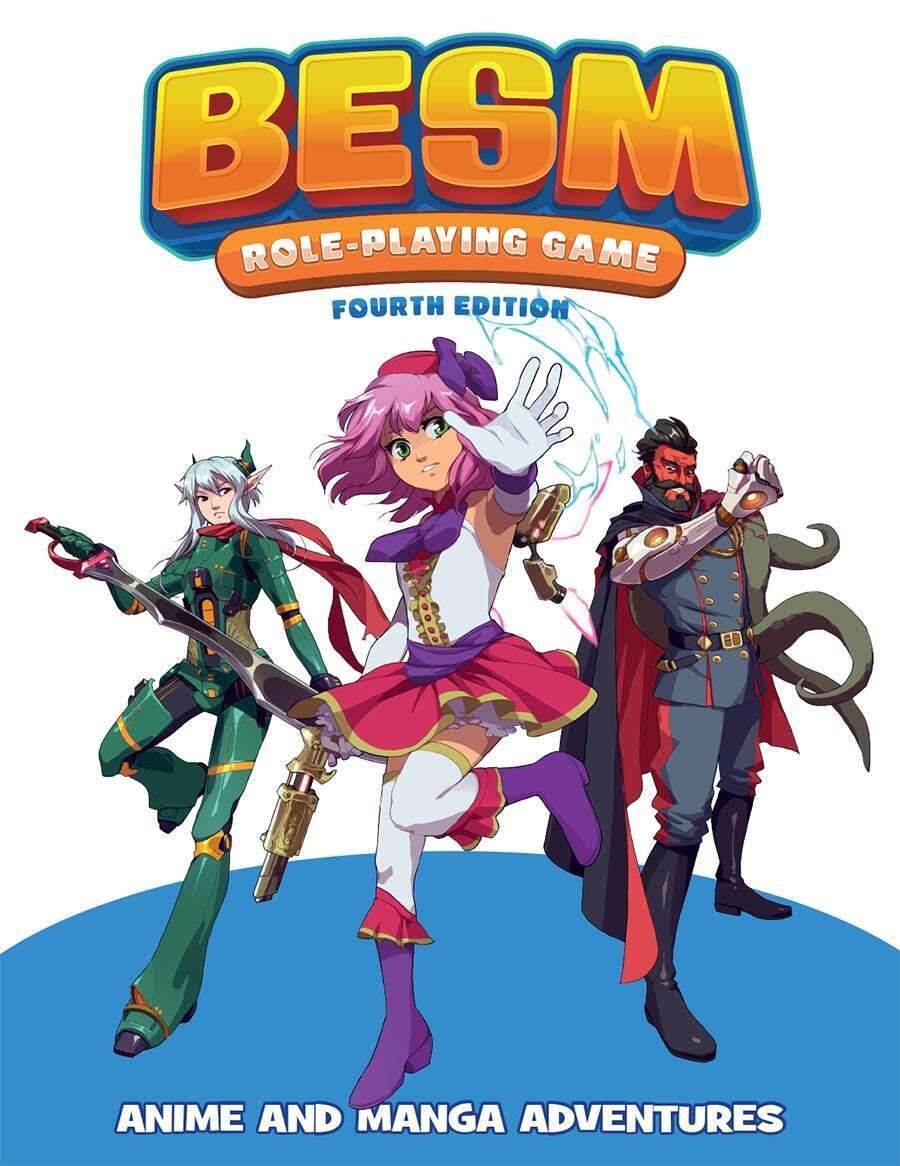
As a GM I’d prefer BESM or Marvel Multiverse over MnM for a superhero game. BESM had the same balance issues, but at least the math was easier to understand and there were a lot more resources to get started with as a GM. Marvel Multiverse had simple math and only a few abusable powers due to the six rank ability system. In contrast, MnM has a d20 system that’s probably easier to understand for people coming from D&D.
If you’re interested in Mutants and Masterminds the 3rd Edition is available on Green Ronin’s website: https://greenroninstore.com/products/mutants-masterminds-deluxe-heros-handbook
And the new 4th Edition is in playtesting now. You can pick up a beta copy on Green Ronin as well: https://greenroninstore.com/products/mutants-masterminds-heros-handbook-4th-edition-playtest-origin-edition

 GoCorral
Leave a comment