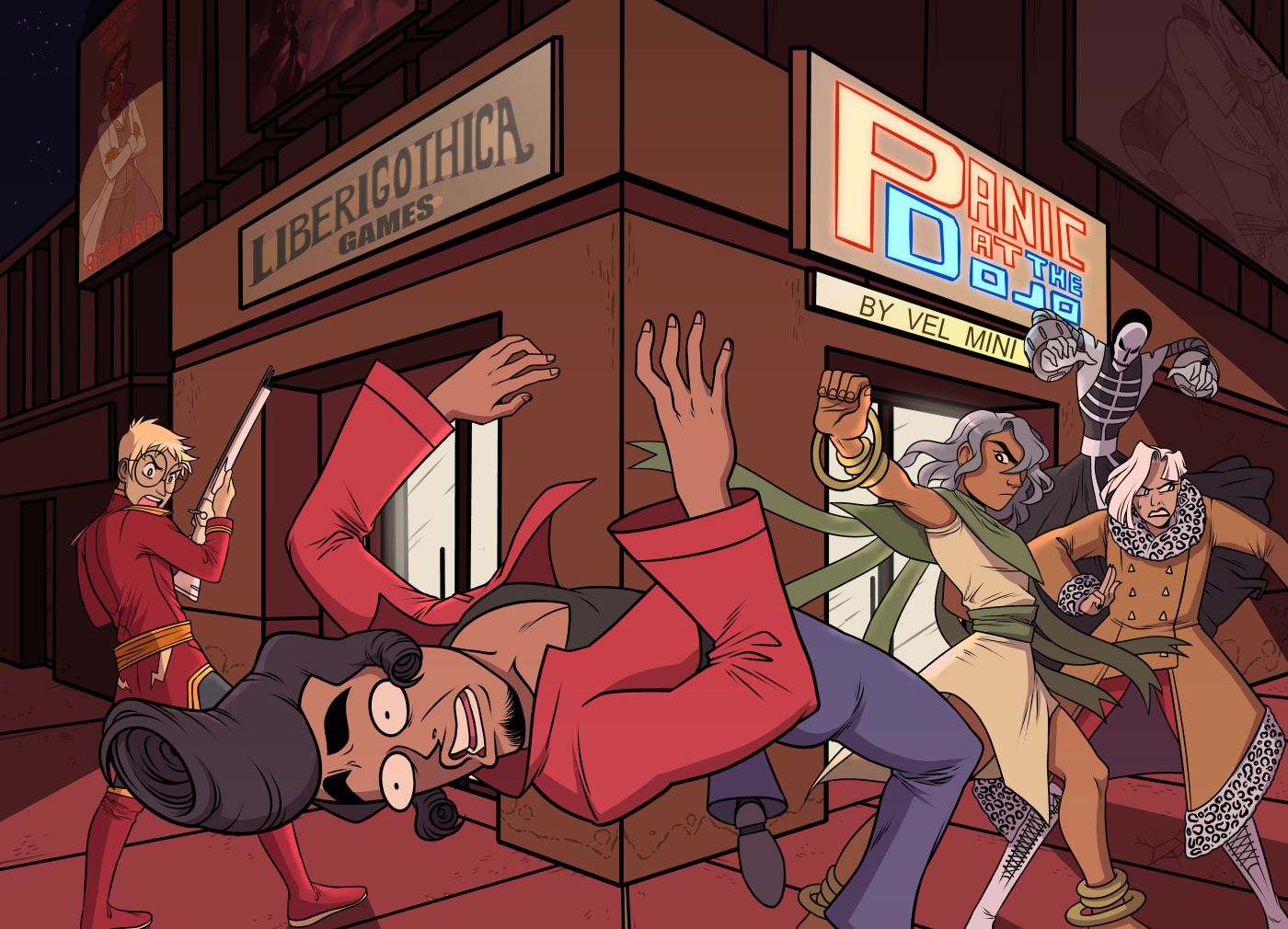
Closing in on the end of my tour of Chinese RPG systems. Panic at the Dojo (PatD) should be one of the last ones!
Panic at the Dojo was launched via a Kickstarter in 2016. The game was developed and successfully put up for sale for anyone to buy in 2018. An active Discord community supports the game. A second version is in development and should be launching soon.
Combat
Most of Panic at the Dojo‘s rules are focused on combat. That’s true for many RPGs, but even more so for PatD. The described setting is a world where every disagreement is settled by a fight. It reminded me of the Yu-gi-oh series where everything is decided by the outcome of a card game. In one of the Yu-gi-oh episodes a character even escapes prison by winning a card match against one of the guards. So PatD’s universe has a similar vibe. Kung-fu fights all over the place with no long lasting problems caused by them.
Fights have different scales. The scale decides how much HP each character has. So in smaller fights both the PCs and their enemies have less health. HP are also divided into bars. HP can be healed within a bar, but once you’ve lost all of a bar its gone and you can’t recover anymore within that bar. The concept reminded me of Capcom fighting video games where HP is recoverable up to a certain point.
Initiative uses the “zipper” method. One of the PCs goes first, then one of the enemies, then back to the PCs, etc. Each side maintains their total actions, so if you’re up against 4 foes, the enemy side always gets 4 actions. Even if you’ve defeated 3 of the 4 foes, the 4th one will get to act 4 times in a round.
At the start of a round you roll dice to decide how many action points you have per turn. The book lists an example of rolling 1d8+2d6 for action dice and getting 5, 4, and 1. The dice cannot be split up or combined, each must be used for its own action. Each type of action has variable action point costs. For example, an attack costs 1, 3, 5, 7, or 9 action points to deal 1, 2, 3, 4, or 5 damage. The roll of 5, 4, and 1 would give you a 3 damage attack, a 2 damage attack, and a 1 damage attack.
Interestingly, you never fail on an action. You always succeed on an attack. The initial action dice roll and your choices decide your level of success. The same is true for your opponents.
In another similarity to fighting video games, a lot of the game revolves around “ringing out” your opponent. Each fight takes place within a small map of some kind. Knocking people into obstacles deals damage. Knocking people off the Edge of the map usually defeats them (Boss level enemies will survive, but take damage). There’s also a decent amount of off-turn movement for characters to escape ring outs. If a PC is knocked out the team has to use an action to return them.
Character Creation
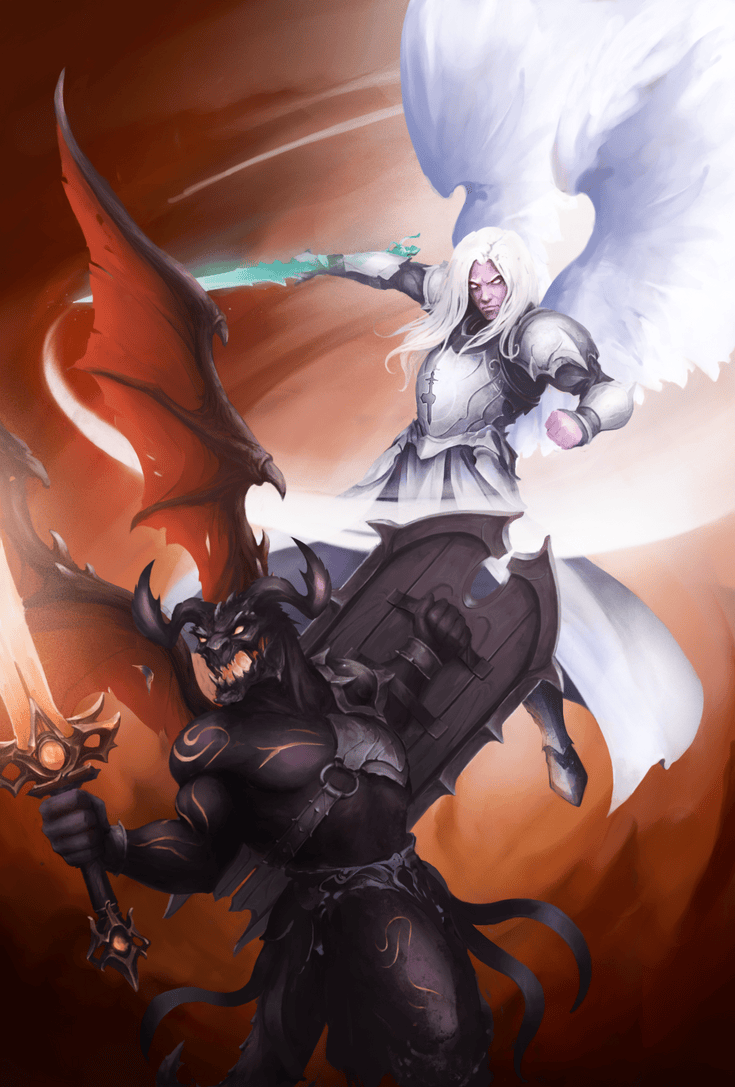
Character creation uses a class system referred to as Archetypes. There are thirteen Archetypes. The list is Angel, Cavalry, Cyborg, Demon, Flametongue, Gunkata, Phantom, Punk, Teacher, Trickster, Underdog, Wardancer, and Winterblossom. Each has unique actions related to movement, damage, introducing obstacles for foes, or helping allies. There aren’t any levels, advancements, or experience points. Once you’ve built your character, you’re done.
Character creation works by selecting Focused, Fused, or Frantic. Focused characters have a single archetype that all their powers come from. Fused characters get two archetypes. Frantic characters get three. It’s an oversimplification to say that you sacrifice focus for versatility, but that’s pretty much how it works. The game functions like a tactical board game once your characters are built.
Characters also select three skills to represent their out of combat capabilities. If you encounter a challenge where your skill is relevant, you succeed without having to engage in combat. Enemies can also have skills. If both sides have a relevant skill, then they must fight to decide the winner. So if I have the Cooking skill, I will win the baking contest. But if the nefarious Demon Chef with the Cooking skill also enters the contest, then we are both equally good. The contest judges won’t be able to decide and we will have to battle to determine the winner.
Why I Don’t Like It
The structural organization of the book is poor. Reading the book in order is not a good way to learn how to play. I’m not sure what order would have worked best, but it needs a major overhaul. There are no sidebars to assist with understanding or readability. There are a lot of color coded terms. That might seem nice at first, but when some sections feel like every other word is purple, red, blue, orange, or bold black its no longer useful.
Visually the book isn’t great. The layout is clean, but clearly done in Microsoft Word or Google Docs. It ends up feeling very flat. There also isn’t a lot of art. The art that is present is simple. I can forgive these issues though. Panic at the Dojo is a small indie game. The $6000 Kickstarter fund covered what it could, but unfortunately that isn’t enough for an RPG to look like a professional product.
The rules for out of combat action are minimal. The skills thing I mentioned? That’s it. A whole six pages devoted to out of combat actions in a 290 page book. EVERYTHING is combat focused. The whole fighting universe setting makes it clear that this is intentional. Skip to the good stuff, right? This plays further into my feeling that this game is simulating a fighting video game or something like playing with action figures. PatD doesn’t hide the intentions of the game, but it goes a bit further down that road than I like.
The GM side of the game is fairly well supported with many ready-made foes to throw at your players. Roughly half the book is baddies with simple descriptions, stats, and combat notes. GM guidance out of combat is minimal. The GMs role is just to set up the fights and quickly steer the plot to the next fight.
There’s some language in the book that indicates the system is designed for one-shots. It feels like tonally that’s true, but the designing characters is too complex for that. I wouldn’t want to put the work into understanding the complexities of character creation and the combat system for just a one-shot. But without a progression system for characters its also not well-suited for a campaign.
Overall, Panic at the Dojo is a solid independent RPG system for someone’s first attempt (It’s actually the 2nd one for the author, but nevermind). It’s got a good foundation to build on a popular premise judging off the successful Kickstarter and the 1000+ membership Discord server. The author can easily learn from their mistakes and release an improved version, which they are doing! And this is perhaps a harsh judgement to lay on someone. In comparison, Panic at the Dojo is certainly a better system than the original publications of D&D Basic or GURPS.
If you’d like to get Panic at the Dojo you can find it a https://liberigothica.itch.io/panic-at-the-dojo
The 2nd edition of Panic at the Dojo is in development and coming out “soon” since December 2024. The author, Vel Mini (formerly Jacob Randolph), recently posted that an August 2026 release is their target. Buying the 1st edition gives you access to the playtest material for the 2nd edition. You should also receive a discount coupon for the 2nd edition once it comes out.





Leave a Reply