Time for a Chinese based review look at the World of Darkness book line!
What is World of Darkness?
World of Darkness is a series of TTRPGs that have been released since 1991. It started off with Vampire: The Masquerade, a book for playing as an evil vampire in the modern age. The universe rapidly expanded with books for Werewolf: The Apocalypse, Mage: The Ascension, Wraith: The Oblivion, Changeling: The Dreaming, Demon: The Fallen, and Hunter: The Reckoning. There’s also some smaller properties about playing as a Mummy and some other stuff.
The basics of the World of Darkness setting is that Earth is infested with monsters. They’re everywhere in the shadows but people are blind to it. The monsters prey on humanity. But that’s not all. Every part of the world is worse. All the people, governments, and organizations are more hostile and corrupt than the real world. It’s a World of Darkness after all. The monsters are close to triggering some apocalypse event as well that will bring an end to the current global society and bring on something worse.
Additionally, in World of Darkness belief shapes reality. But only beliefs shared by many people or a single person’s strongly held belief. So vampires exist, partially because we tell stories about them, bringing them into existence. Same for werewolves, wizards, ghosts, faeries, etc. Some abilities in the game tap into this power of belief, allowing your character to warp reality as they believe it should be.
The World of Darkness is kind of a mess for publishing. The first four editions are all essentially compatible, so I just kind of went with whatever was available. I looked through:
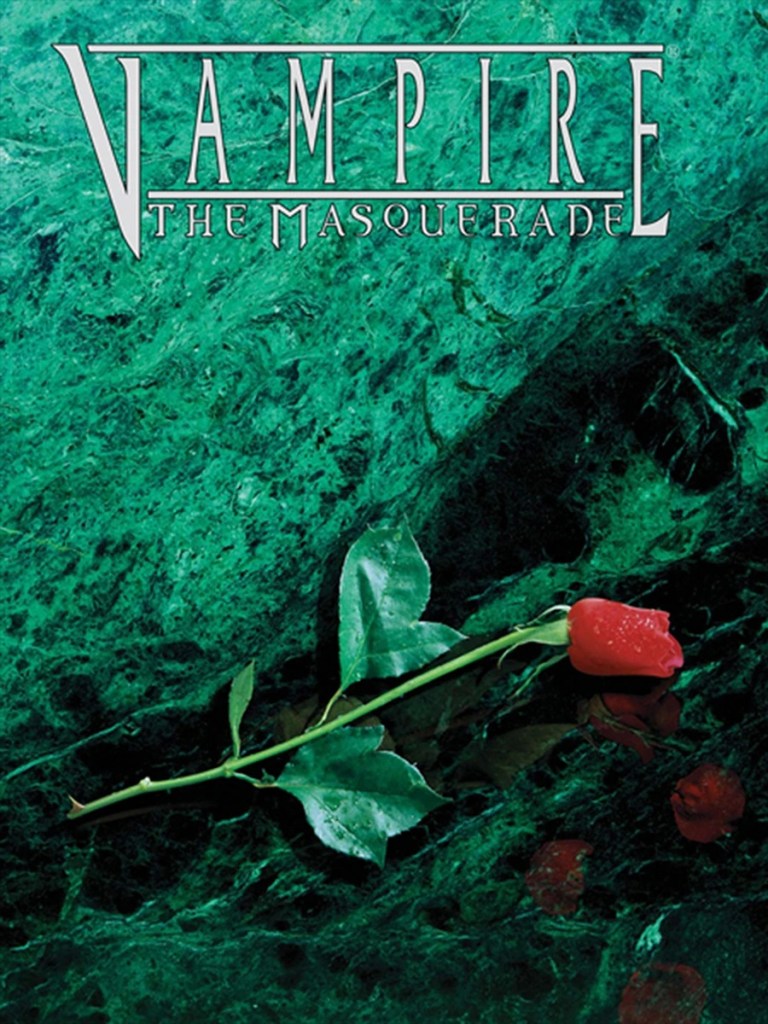
- Vampire: The Masquerade, Revised Edition (1998)
- Kindred of the East (1998)
- Dark Ages: Vampire (2002)
- Blood & Silk (2000)
- Hunter: The Reckoning (1999)
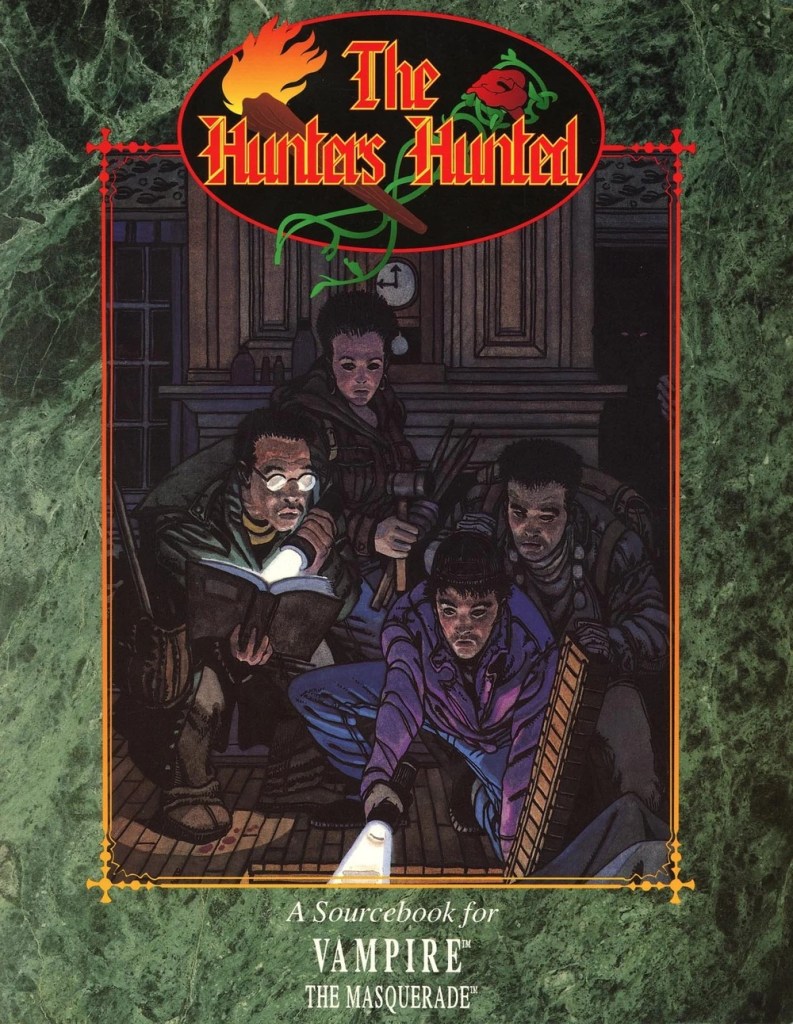
- The Hunters Hunted (1992)
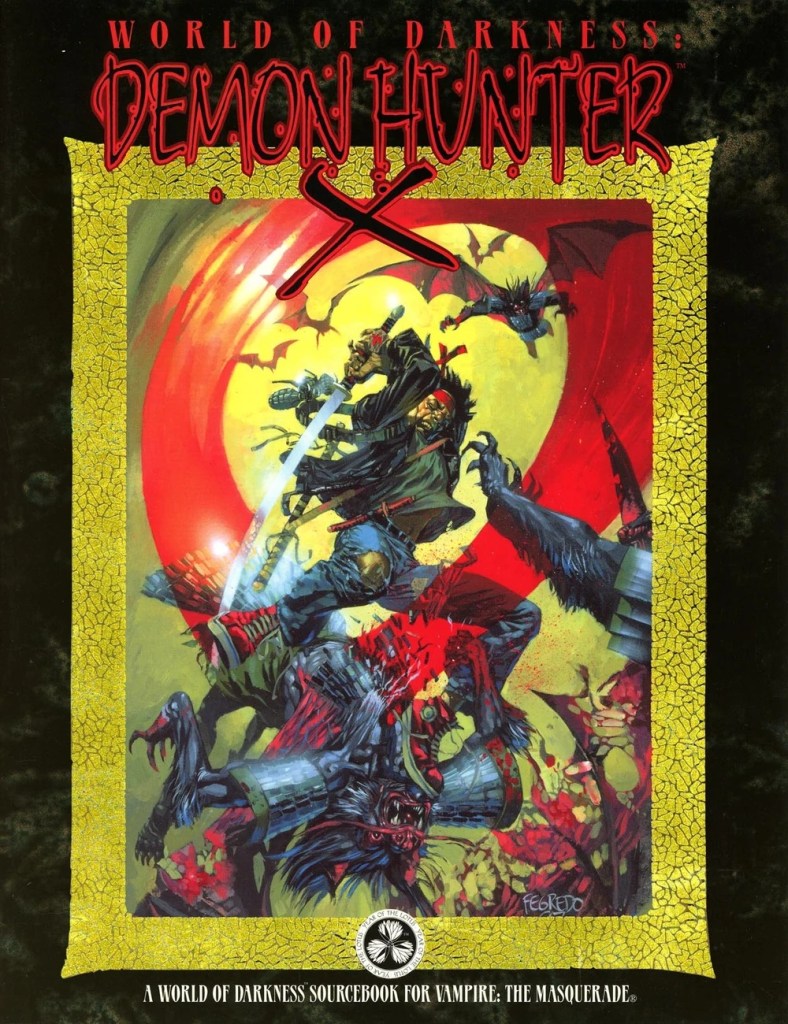
- Demon Hunter X (1998)
Maybe all those books aren’t intended to work together, but they certainly seem like they do.
Each of the World of Darkness books is a giant pile of lore. At least half of each book is stories about vampires or werewolves. The lore is presented in various ways. First-person retellings of encounters with monsters. Blog entries and ancient scripts. All sorts of stuff. There is A LOT, but there’s also a nice wiki that consolidates it all into something that’s easier to consume.

https://whitewolf.fandom.com/wiki/Main_Page
I’ll go through each book in turn. I read all of these books before I wrote this, hoping I’d be able to get a grip on how to use them all together. I’ll described how to do that after I’ve reviewed all the books.
Vampire: The Masquerade
As it’s the theme for World of Darkness, Vampire: The Masquerade starts off with 100 pages of lore before touching on the mechanics in any sort of detail.
Vampire’s lore is fascinating. It started long ago with Cain from the Bible. The Mark of Cain bestowed on him turned Cain into the first vampire. All other vampires trace their lineage to him through his vampire grandchildren, the thirteen Antediluvians. The thirteen vampire clans are descended from the Antediluvians. Each of these clans are struggling against each other to control the world. The two main sides are the Camarilla and the Sabbat. The Camarilla respect “The Masquerade” that the game is named for while the Sabbat do not.
The Masquerade is the lie that vampires have agreed to tell humanity. That lie being that vampires do not exist. Because vampires “don’t exist” all the awful crimes they commit couldn’t possibly be done by vampires. Thus humans don’t rise up and kill all the vampires. The Camarilla sect and their associated clans support the Masquerade while the Sabbat want to flex their vampire muscles and take over the world. The two sects are warring with each other to decide which strategy will be adopted with the Camarilla currently in the lead.
Character creation starts with choosing a clan. There are dozens of special vampire powers and each clan gives you cheaper access to three groups of those powers called Disciplines. Stats in Vampire and all World of Darkness games use what’s called the Storyteller system. All the books I read use the same system. So the steps for character creation are mostly the same between the different books.
World of Darkness uses a building point system for character creation. Stats mostly fall into two categories, Attributes which represent your natural strengths (Might, Dexterity, Resolve, etc), and Abilities which represent your training and background (Firearms, Investigation, Empathy, etc). Attributes and Abilities are both rated from 1 to 5. 1 is poor, 2 is average, 3 is good, 4 is exceptional, and 5 is world-class. Challenges are handled by adding together an Attribute stat and an Ability stat. You roll that many d10s. You score a number of successes equal to all the dice that are 6 or greater. Only one success is needed to complete your attempted action, but multiple successes increase the effect. The target number of 6 can be modified to adjust for harder or easier actions.
Each character has a personality type. The most important bit to pick is your Nature which describes what your character likes to do. World of Darkness characters have a Willpower stat which is your meta-currency pool. You can spend a Willpower point to automatically succeed on an action or ignore injuries or compulsions. Willpower is recovered by doing something associated with your Nature. So playing your character as they’re supposed to be personality-wise makes you more effective because you get more bennies.
Each different World of Darkness system has a few different stats to represent other parts of your character’s personality. These are often used to represent the struggle between the monster side of your personality and the human side. Most characters have a Conscience and Self-Control score to represent their ability to resist their monstrous impulses. The struggle between human and monster is tracked with a Humanity score which ranges from 1-10. A score of 7 is a normal human. Monsters must hold on to their Humanity, because if it slips to zero they become a savage beast (and an NPC) that goes on a rampage that probably results in their death.
For vampires they become more physically like an undead monster as their Humanity decreases. They also become more bloodthirsty possibly increasing their descent into beast territory. Humanity is typically only recovered by spending XP. But it is one of the cheapest things to increase.
Of course the big challenge is that vampires must drink blood to survive. Vampire bodies need 1 blood point per night which roughly translates to 0.5L or a tenth of the blood in a human body. Vampire PCs can hold 10 blood points in their body at a time, just like the human body contains 5L of blood. Vampires use blood to heal their injuries and to fuel their supernatural vampire powers. If they don’t have enough blood, vampires can enter a frenzy. Frenzied vampires will do anything to feed, causing a decrease in their Humanity score.
The final part of character creation is choosing your Disciplines. The magic vampire powers are varied. Physical empowerment, telepathy, mind control, summoning animals. Basically all sorts of stuff that’s been associated with different vampire myths over the years. Each use of a special power usually consumes 1 blood point.
The Storyteller system has very slow XP gain. At the end of each session you gain XP based off whether you had important moments during the session. It’s usually 1-5 XP per session. Most things cost at least 10 XP, with some upgrades costing way more. Outside of a very long campaign your character will typically be pretty flat in power level.
But we’re here for a look at using World of Darkness for a Chinese setting. Vampire: The Masquerade is for vampire stories in the North America or Europe. What about Chinese vampires?
Kindred of the East
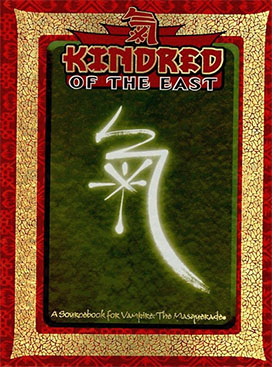
China has its own vampire stories that Kindred of the East is based on. Chinese vampires are called jiāngshī. They’re an independent creation from Western vampires which are based on rabies victims. Jiāngshī are also known as hopping vampires because one of their powers is jumping really high. The other major difference is jiāngshī drink the chi of the living instead of their blood. Still a type of energy, but metaphysical rather than physical.
Kindred of the East tries to blend a bunch of different things together with its version of Eastern vampires. They are called kuei-jin, a combination of Chinese and Japanese words, instead of jiāngshī. Kuei-jin were inspired by myths from China, Japan, Korea, Southeast Asia, and India into a mish-mash of Asian vampire tropes. They’re most similar to jiāngshī, but other parts are brought in that I’m not as familiar with. The lore in Kindred of the East is all over the book, but poorly organized. Lots of random bits are mixed in with the mechanics making it difficult to follow the narrative story along with the rules.
Kuei-jin are not vampires in the same way as Vampire: The Masquerade. Within the game’s conception of what the monsters are, kuei-jin are more like a ghost possessing their own dead body. A kuei-jin’s spirit escaped the Buddhist cycle of reincarnation, but in an evil fashion. If their current body dies a kuei-jin’s soul is destroyed. The only path out is to achieve enlightenment in their current extended lifetime.
Kuei-jin choose from five Dharmas instead of thirteen clans. The Dharma is their guiding principle for how they achieve enlightenment. Each of the five Dharmas is connected to new personality stats introduced in Kindred of the East. Devil Tigers want to become evil incarnate and use Po as their main stat. Resplendent Cranes want to improve the world and atone for their sins and they use Hun as their main stat. Shadows want to obtain all knowledge and protect families and they use Yin as their main stat. Thrashing Dragons want pleasure for themselves and others and they use Yang as their main stat. Thousand Whispers want to recreate the reincarnation cycle in themselves by living many different lives and use the balance between Yin and Yang as their main stat. Kuei-jin get stronger and stronger as they get closer to enlightenment so there’s a strong incentive to follow your Dharma.
Kuei-jin survive by consuming chi, just like vampires consume blood. In fact they usually drink blood in order to get a person’s chi. More powerful kuei-jin can harvest chi from someone’s breath or from spiritually infused environments. Chi comes in two varieties, Yin and Yang. Yin is roughly “dead” chi while Yang is “life” chi. If a kuei-jin has equal Yin and Yang chi they look normal. Too much Yin chi and they start to look like a corpse. Too much Yang chi and they become infected with diseases.
Kuei-jin have other aspects of their soul based on Chinese philosophy. These are the heavenly soul Hun and the demon soul Po. The Hun and Po are somewhat obscure parts of Chinese philosophy which indicated to me that the authors were approaching this idea with some serious intent. The blending of all Asian folklore feels unnatural, but it is balanced by each piece making individual sense as it’s presented.
Each of these four new stats power different abilities within the game. Yin chi let’s you look at auras of undead creatures and use powers associated with death. Yang chi let’s you heal, look at auras of living creatures, and use powers associated with life. Po provides strong demonic powers that use a special type of Demon chi that refills every night. Hun let’s you master your darker nature, which is effectively using your Po powers without becoming evil. Balance between your Yin and Yang chi prevents penalties for being out of balance.
The rest of the stats for kuei-jin are the same as for vampires and other characters in World of Darkness. The Disciplines that kuei-jin choose for their magic powers are different. They’re each powered by Yin, Yang, or Demon chi. The selection is similar enough to what vampires get. Some are wuxing based, others are based on different Asian monster stories. All of them have a heavy Yin-Yang focus.
With Kindred of the East completed, I know how Chinese vampires function in World of Darkness. I’m not necessarily interested in the modern age though. My search for China games is focused on the Tang dynasty in the 600s CE. What changes are made for World of Darkness in the Medieval period?
Dark Ages: Vampire
Dark Ages: Vampire details the setting and rules for playing Vampire: The Masquerade in the Medieval Age. The book is set in 1230 prior to the institution of the Masquerade by the Camarilla clans. Because vampires aren’t limited by secrecy they are a lot more evil. Thus there are lots of options for playing as a vampire that’s surrendered to your monstrous side and abandoned humanity. The other main difference besides evil vampire rules is a different Ability list to reflect the technology differences between 1230 and the present. Also mounted combat rules.
There’s lots of repeated content in Dark Ages: Vampire and Vampire: The Masquerade. In both the lore and the mechanics. Dark Ages was released as a stand alone product instead of as an expansion. You could just buy Dark Ages and make a party and adventures without any need for the “core” book. And it honestly feels like an odd choice. Way too much of the book is used for repeated rules which increases the printing cost and/or cuts into space for original content.
I feel that Dark Ages was a missed opportunity. All the broad background info about Europe and vampires during the Medieval Age is nice, but what’s really needed is deep information on one city. Knowing that the advisor of some king is a vampire is a story seed for a motivated Storyteller to develop their own campaign. Giving a detailed look into the vampire politics of Paris would be more helpful for actually diving into the setting. I saw that White Wolf did release a few deeper books like that later on for the Dark Ages setting. As it stands though, I’m not sure this book is even worth buying for folks that wanted to run a European setting. You can mostly infer the rules and setting from what’s given in the main Vampire: The Masquerade book.
Blood and Silk
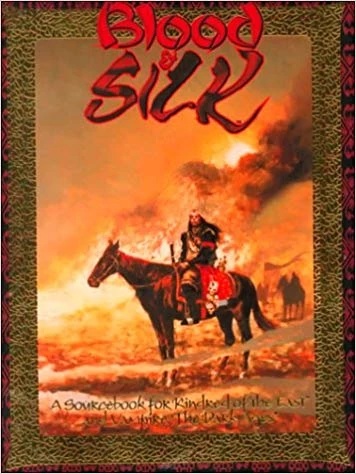
Blood and Silk is the Asian version of Dark Ages: Vampire. All you need to get started running a Medieval Age World of Darkness game in Asia. Blood and Silk is fortunately less repetitive than Dark Ages. It assumes that you have a copy of Kindred of the East and doesn’t repeat rules over dozens of useless pages.
The time period of Blood and Silk is 1197 at the height of China’s division before the Mongol invasion. The setting is broad just like Dark Ages. Probably worse as it spreads across China, Japan, Korea, Mongolia, India, and Southeast Asia. There’s a lot of cultural notes but few details for running an actual campaign in a city like Beijing or Kyoto. Most of the book is lore but once again it doesn’t feel very useful for playing the game.
Kuei-jin in Blood and Silk have the opposite moral progression as vampires in Dark Ages. Kuei-jin were nicer in the Medieval Age. The demon Po spirit is selfish instead of manically destructive. The Abilities are changed to reflect the time period just like in Dark Ages. There’s also new disciplines for wuxing stuff. While I like wuxing getting a nod, it feels like an afterthought. The authors needed some new mechanical options for kuei-jin and quickly threw together five Disciplines based on the five elements.
There are a few other changes made in Blood and Silk to reflect the time period. The reduced spread of civilization means there’s more nature chi for kuei-jin to gather. It’s easier for kuei-jin to drain their energy from the environment instead of people’s blood. There’s also rules for mounted combat and period-accurate advanced weapons such as early flamethrowers, rockets, and repeating crossbows.
Blood and Silk still feels like it missed the mark somewhat on usability. Not reprinting all the rules was a smart choice. Altered rules for the technology level and natural chi level of the world are good to include. Unfortunately, there’s not enough to start running a campaign without a massive amount of work from a Storyteller. Just like Dark Ages the setting is too broad. Covering one half of the Earth’s population is fine, but I would’ve appreciated a smaller focus.
Hunter: The Reckoning
Hunter: The Reckoning provides rules for playing as humans that fight back against the monsters of World of Darkness. After humans witness magic or monsters, sometimes they become Imbued. A force known as the Heralds mark Imbued with special powers to see the monsters that exist in the World of Darkness, and a compulsion to kill those monsters. The reveal of monsters is similar to the reveal of the aliens in They Live. Suddenly the Imbued’s eyes are open and they see signs of monsters everywhere. The Imbued also know that alerting others to the truth is useless. The public would rather keep their heads in the sand than confront the truth and the government is already compromised by monsters.
Imbued receive superpowers that put them on even footing with vampires, kuei-jin and other foes in the World of Darkness. All Imbued possess the ability to see through magical illusions and disguises and can resist magical mental control from the creatures of the World of Darkness. Imbued also receive superpowers similar to the Disciplines vampires choose from. As examples the superpowers provide: a shield against monsters, a magic laser beam to shoot at monsters, or invisibility from monsters. There are nine groups of Imbued powers based on three guiding Virtues of Zeal, Vision, and Mercy.
Each of the three Virtues has three groups of powers called Creeds. The Creed serves a similar game purpose to a vampire’s clan or a kuei-jin’s Dharma. Imbued have scores in the Virtues which dictate how many points they have for Creed powers. An Imbued with a Virtue beyond 6 starts to go crazy as they become obsessed with slaying monsters.
Imbued have a resource called Conviction for their powers. Conviction takes the place of blood for vampires and chi for kuei-jin. Each power requires at least 1 Conviction to activate. Imbued can also risk an additional 1 Conviction on a power. This boosts the power and if the power succeeds, the Imbued gets all Conviction returned plus 1 additional Conviction. Thus Imbued are encouraged to play aggressively with their Conviction points. There are a few other ways to recover Conviction, but the main method is this pushing strategy.
Conviction is also the method for advancement on the Virtue tracks. The maximum Conviction is 10 and 10 Conviction can be exchanged for 1 Virtue point. So not only is risky behavior how your Conviction pool regenerates, it’s also how you upgrade your character. All the other stats of the Imbued are the same as other World of Darkness characters with Attributes and Abilities.
The mechanics of Hunter: The Reckoning work well together. The Storyteller system is usually designed to adjudicate conflicts between a PC’s monster side and human side as they participate in an adventure. The conflict within Imbued is between their human side and their hunter side. Imbued long to confront the darkness, but in doing so they lose their individuality.
The presentation of Hunter: The Reckoning is goofy. While the rules make sense, the lore is a mess. There are dozens of notes, diary entries, emails, and “screen caps” of blog posts that provide additional juicy information about how the Imbued fight back against the World of Darkness. It’s all lore, but it’s organized in such a disjointed way that it’s very difficult to consume in a whole and coherent way. Perhaps this was the author’s intention so that the reader experiences disorientation similar to how an Imbued might feel as they enter the World of Darkness? I don’t know, but I found it frustrating.
The Hunters Hunted
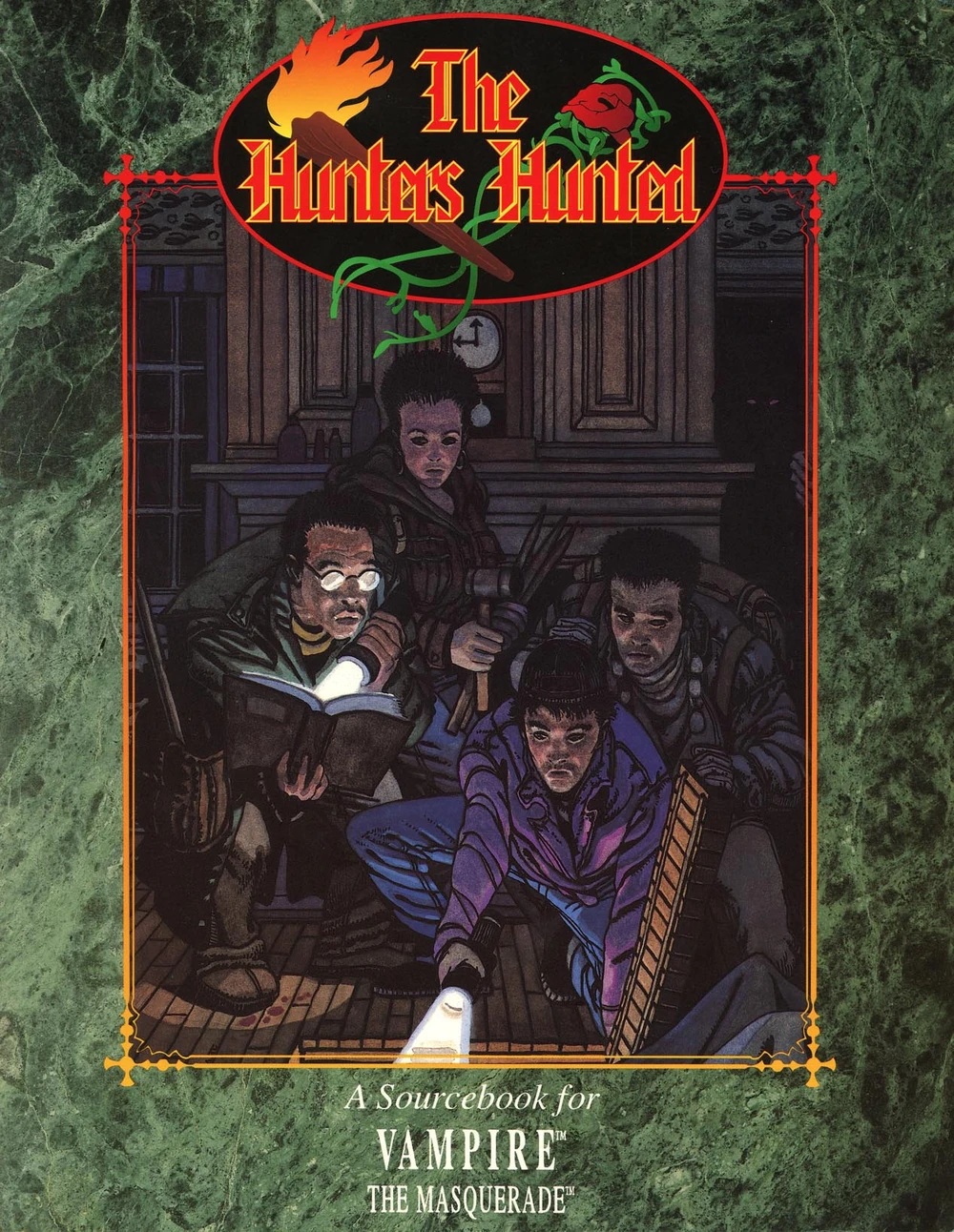
Hunters Hunted came out before Hunter: The Reckoning and deals with a different kind of Hunter. Hunter: The Reckoning details normal people who become gifted with supernatural power and become the Imbued. Hunters Hunted details normal people who are… normal people that hunt monsters. No fantastic supernatural powers here! Just guns, gear, and gumption.
Hunters Hunted details a couple different Men in Black (MIB) like organizations. I feel like these partially contradict other lore in the World of Darkness series. The government and any associated MIB organizations are controlled by the monsters. They wouldn’t be hunting the evil creatures of World of Darkness, they’d be helping them. And maybe that is the truth behind the truth?
Regardless there are lots of monsters hunting organizations offered. The players could belong to some of the more independent ones and occasionally work with the more government MIB style organizations. Lots of options for however the Storyteller wants to set up the campaign.
Regular humans are mechanically a little weaker than vampires and kuei-jin for their basic stats. There are a few Discipline-like powers, but most of them are extremely weak. Humans get very limited psychic powers or wizard spells while vampires easily get death magic. The most important power for humans is Faith. Faith is belief in anything that gives protection from monsters. As belief influences reality in the World of Darkness, the character’s belief in the power of their faith is reflected as actual power. The Faith power has 10 ranks instead of 5 like the other standard powers. At the weakest level it can repel monsters when you present a holy symbol like a cross. At the highest level Faith allows the character to turn monsters back into normal people. The highest level is basically the second coming of Jesus.
Hunters Hunted is a shorter book than the previous ones, coming in at less than 100 pages. It feels more useful than the other side books though. Plenty of rules for playing as normal humans and the book provides enough details to start playing as something like the Scooby gang from Buffy. Hunters Hunted lacks the inner personality conflicts that other World of Darkness games have. There’s no monster side fighting against the human side within a hunter’s personality. They’re all human and all business. So while Hunters Hunted delivers on its promise, it’s weaker than some of the other World of Darkness games because the promise is smaller in substance.
Demon Hunter X

Demon Hunter X is an expansion to an expansion. The book expands on the groundwork in Hunters Hunted with additional lore and mechanics for playing hunters in Asia. There’s tons of well-organized lore and a solid Storyteller section. There are two new types of hunters, the Shih and Strike Force Zero.
Shih are an ancient line of independent monster hunters. They have chi powers made for fighting monsters and their base stats are actually slightly stronger than vampires and kuei-jin. Shih also get kungfu moves that are the perfect counter to different World of Darkness foes. Shih start every day with 5 Yin and 5 Yang chi. Yin chi comes from Self-Control and Yang chi comes from Courage. Shih also have Hun with Conscience and Po, but they aren’t as central to the mechanics of the character. Chi is used as fuel for the Shih powers, but using it is exhausting, inflicting a condition similar to wounds until the chi is recovered.
Strike Force Zero (SF0) agents are a MIB organization started by the Japanese government after World War Two. SF0 agents are cybernetically enhanced, but only as strong as vampires instead of slightly stronger like Shih. An SF0 agent’s robot parts draw power from their chi just as Shih do for their magic and kungfu. The agents also have simple psychic powers drawing from the same list as Hunters Hunted. The main draw is the cybernetic powers which are extremely varied. Pretty much everything you could think of for anime robot superheroes. Laser eyes, magnetic hands, an arm that turns into a laser cannon? All on the table.
Demon Hunter X is stronger than Hunters Hunted in some ways and weaker in others. The personality conflict elements are replaced by tracking a hunter’s Po score. The Po does nothing for a hunter. It’s tracked simply for deciding what happens to the Hunter when they die. If Po is higher than Hun then the Hunter rises as a kuei-jin or similar undead monster. So be careful or your PC could become the next villain! As for the weaker elements, I felt that Hunters Hunted gave more useful lore information for the present. A lot of Demon Hunter X‘s lore was focused on the history of Shih and Strike Force Zero instead of the current state of Asia.
All Together
One of my original ideas for a China RPG was instigated by Hardcore History’s Supernova in the East series on Japan’s expansion during WW2. Japanese occupied Manchuria felt like a Wild West setting with new ground to break due to the “exotic” nature of China, Japan, and Korea compared to the American West where I’ve been to most of the locations. World of Darkness could work for that sort of campaign with plots focused on real things like Japanese incursion, but also on evil spirits and monsters. Sunset Empires is probably the most useful for that time period, but I’m tired of reading World of Darkness books.
World of Darkness is difficult for the Storyteller/GM. The game is primarily about relationships. Maintaining relationships between all the PCs’ personal attachments and the relationships between all those NPCs and the other allies and villains is expansive and complicated. It would be nice if there was a published campaign with that detail ready to go, but the Asian kuei-jin stuff has nothing in that area. All the lore in the setting books is too broad strokes to run a campaign without immense work from a Storyteller.
You could wing a World of Darkness game, but the game encourages fully fleshed out NPCs to interact with. It would be hard to really wing a World of Darkness game without more system mastery by playing and GMing more structured games. I don’t feel that I have that mastery yet. Is a foe with a rank 5 attribute and a rank 1 attribute the same threat level as one with two rank 3 attributes? I don’t know.
Most importantly, World of Darkness isn’t really a setting that attracts me. I don’t want to GM a game where the PCs are basically evil power-hungry villains. That’s why I started a look at the Hunters splat books. But even then, the work required to run a World of Darkness game was a turn off. If I did put in all the work for a structured campaign like that, I’d probably use a different system. My original choice for that Manchuria game was going to be a Forged in the Dark system like Fistful of Darkness. I might still go in that direction at some point. A Medieval Age game seems woefully unsupported in World of Darkness, so I’ve abandoned that idea.
World of Darkness also feels like a poor fit for the a Chinese game I’d like to play. Wuxing elements are an afterthought in Blood and Silk. Confucianism and Daoism are largely absent. Buddhism is present but from an Indian point of view instead of Chinese Buddhism. The Zodiac isn’t there at all. Kindred of the East is a blend of China, Japan, India and other nations that it loses the specific appeal I was looking for. I might be able to homebrew my way to where I want, but at that point I should be playing a different game.
While World of Darkness wasn’t what I was looking for, it’s still a well designed game. If you’re interested in a dark game where you play one of the monsters of the night in the modern age, you can check out the books I read at the following links.
Vampire: The Masquerade, Revised Edition (1998) – https://www.drivethrurpg.com/en/product/647/vampire-the-masquerade-revised-edition
Kindred of the East (1998) – https://www.drivethrurpg.com/en/product/2552/kindred-of-the-east
Dark Ages: Vampire (2002) – https://www.drivethrurpg.com/en/product/2676/dark-ages-vampire
Blood & Silk (2000) – https://www.drivethrurpg.com/en/product/33/world-of-darkness-blood-silk
Hunter: The Reckoning (1999) – https://www.drivethrurpg.com/en/product/639/hunter-the-reckoning
The Hunters Hunted (1992) – https://www.drivethrurpg.com/en/product/459/the-hunters-hunted-ww2205
Demon Hunter X (1998) – https://www.drivethrurpg.com/en/product/337/world-of-darkness-demon-hunter-x



Leave a comment