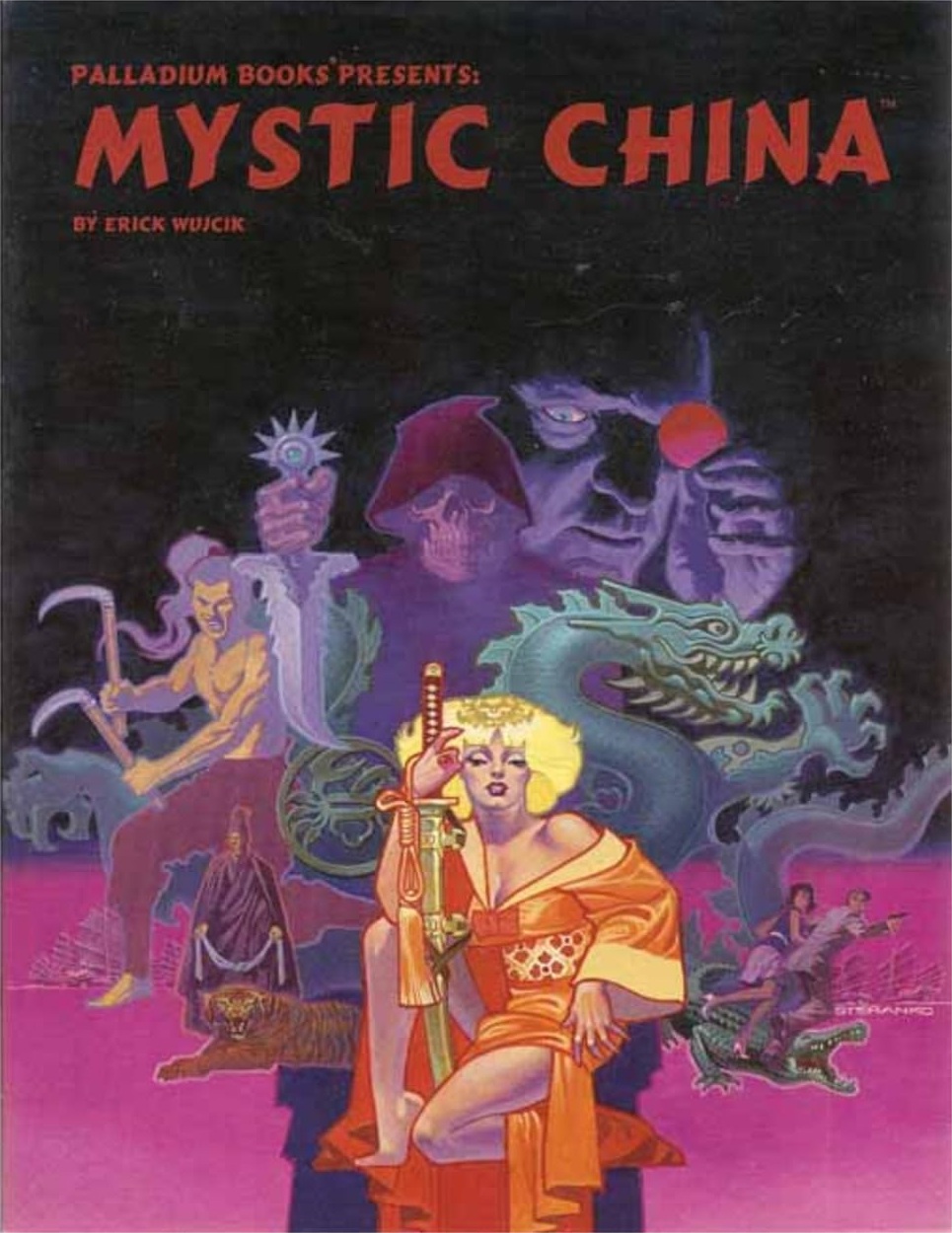
I looked into the Palladium rules and the Mystic China supplement to see if they’d be a good fit for any Chinese games I plan on playing. I’ve already found some games that are a good fit for what I want but I’m continuing to read more systems just for completeness. I’m not as familiar with Palladium in general so I went through both the base rules and the China add-on. Palladium doesn’t seem like the right system for me, but it’s not that bad for a kung-fu style game.
Starting with the base rules, Palladium has a lot in common with AD&D 2nd edition. It’s a tad different, but there are far more similarities than differences. For character creation you pick a race that affects your stats and a class that affects your proficiencies, skills, and access to magic. You roll d20+bonus against a target number in combat or a d100 for out of combat skills. You level up in your class to increase your bonuses and access to special abiltieis and spells. All very familiar.
An obvious difference between Palladium and AD&D is the organization. The way Palladium organizes the rules just feels a little off. Everything is just text with very few tables, sidebars, diagrams, or examples to help people understand the rules. Magic rules are split up between different magic classes instead of being unified. The insanity rules are oddly inserted into character creation almost like it’s assumed that everyone should be playing a PC with a personality disorder. It’s a big enough change from AD&D that I feel like it could almost explain why AD&D was successful where Palladium wasn’t. If one set of rules is far easier to understand and reference during play, that’s the one that will attract a larger player base.
Characters in Palladium definitely have the feel of normal people instead of superheroes. Not surprising from an older game. Can you call a game from 1983 part of the Old School Renaissance (OSR) or is it just old school? I’ve tried a few OSR games and adventures. They have a fun flavor to them, but I feel its more a decision that impacts the players than the DM. Do they want a campaign where they feel less powerful than in modern systems? Is that even something my play group can say confidently before trying it out with a new rule system? Hard to say.
The experience system for Palladium is a unique setup that I haven’t seen duplicated in other systems. It’s sort of a hybrid between milestone level-ups and tracking experience directly. PCs still earn experience for defeating baddies, but they also get experience from coming up with plans, avoiding violence, being clever, using their skills, and self sacrifice. Some of these are clear but many are subjective. Fortunately, there’s also ranges for how much to award so if a plan is only a little clever it goes at the bottom of the range and if it’s a mastermind original it gets top dollar. I like the idea but I can also see why it didn’t catch on. “Standard” D&D experience is impartial so no one complains. Milestone is subjective but it’s guaranteed to get you where the DM wants you in power level. Palladium’s experience system doesn’t offer either of those advantages. So a unique idea but ultimately a failed one.
That’s the basic system and now we come to the Chinese elements. There’s an enormous amount of character and GM options along with little lore tidbits to go with Mystic China. But does it cover my design goals of wuxing, the zodiac, yin-yang, and the three teachings? The answer is pretty clearly no. The representation of China is based off Hong Kong martial arts films. There’s plenty of rules for swords, kung fu, and evil eunuch sorcerers. Lots of tropes that were present in exported Chinese culture in the 70’s and 80’s, but not much for something grounded in ancient mysticism. Similar to Feng Shui 2, Palladium Mystic China might be right for a different China game, but not the one I’m imagining.
I think the Palladium system is worth a look for people that like OSR games. It might be just what you’re looking for, China themed or otherwise. The base game is available on Palladium’s website along with the Mystic China supplement and many more: https://palladium-store.com/1001/category/Palladium-Fantasy-RPG.html




Leave a Reply