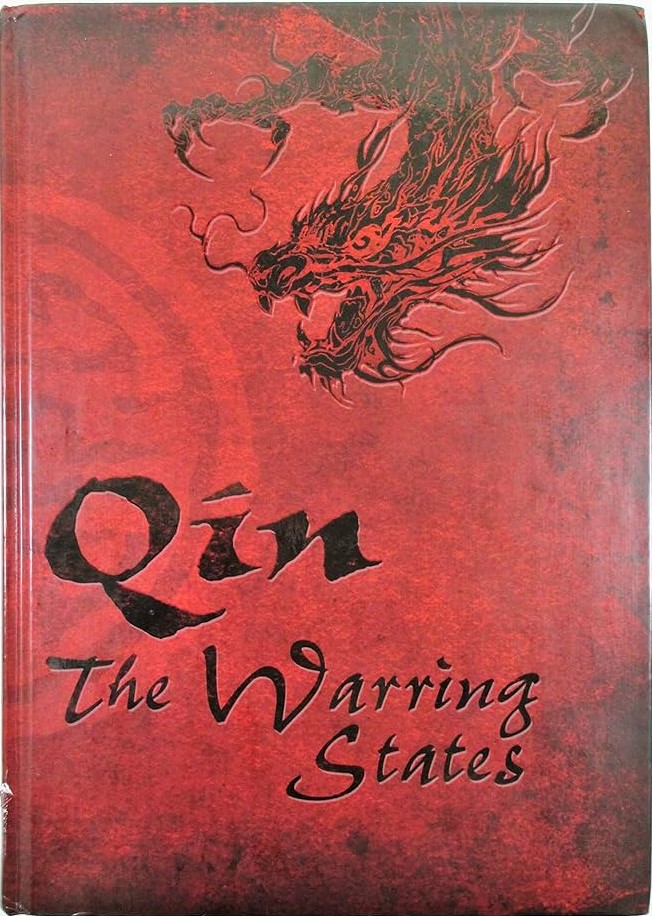
Qin, The Warring States is an RPG with the goal of representing stories and folktales at the end of the Warring States period in Chinese history. Players take on the role of wandering spies, warriors, wizards, or scholars. Your character could try to become the greatest swordsman ever known or insert themselves into the events of China’s formative history. You could banish demons or save a town from bandits. There’s a lot of freedom for players to enjoy exploring ancient China in a system that is thoroughly attached to that setting.
Characters are created with five primary aspects, the five elements of wu xing! At last a game that has a central focus on the elements. Unfortunately instead of interpreting the elements through the classical lens, the author mapped them onto rough equivalents to D&D stats. Metal is Strength, Water is Dexterity, Fire is Charisma, and Wood is Intelligence. Earth is a bit different, being more of a general magic stat which D&D doesn’t have a straight equivalent for. The stats are decided by a point buy system with 14 points to put between them. No stat can be less than 1 or greater than 5.
On the surface it seems like we won’t see any interactions between the five elements during play, but that’s not so. Qin introduces the secondary aspects to have a little interplay between the five elements and make character creation a far more compared endeavor than it might appear at first. The secondary aspects are your character’s Chi, Passive Defense, Breath of Life, and Resistance. Chi is determined using something close to the following equation:
Earth x (4 - ⌈|Metal + Water - Fire - Wood|/3⌉)If that seems like a lot, you’re right. Fortunately its an equation you only have to fill out during character creation and whenever any of your primary aspects change due to character progression. The other three secondary aspects have less complicated formulas, but you get the idea. All the primary aspects come together to form the secondary aspects. The game’s rules are actually encouraging a form of balance where it can be a viable choice to keep all five primary aspects close together rather than minmaxing. A character that throws all their points into Metal to be the best swordsman will most likely have low Chi. The swordsman is spiritually weak as a consequence of their single-minded obsession.
In addition to the primary and secondary aspects Qin also offers Skills, Taos, Combat Techniques, and Spells for characters to master. Skills are simple number boosts to make you better at a particular action such as fighting with swords, using a type of magic, or mastering diplomacy. Taos are the fancy “wire-fu” moves we’re all familiar with from wuxia movies like Crouching Tiger, Hidden Dragon. Combat Techniques are more mundane martial arts moves. They could be summarized as a +1 to your roll in specific situations, but unfortunately the game’s writing suffers in this section. It’s sometimes unclear what exactly a Combat Technique is supposed to be doing or how it is supposed to help.
The spell system is thoroughly grounded in Chinese cultural practices and myths. There are four branches of magic, Internal Alchemy, External Alchemy, Divination, and Exorcism. Every single spell pulls from some piece of Chinese folklore whether its casting someone’s fortune with yarrow sticks or enchanting a mirror to shoot burning sunbeams at people. The magic is also aggressively hard to learn compared to martial arts. A wizard has a long road ahead of themselves at character creation before they’ll be useful in combat situations. The game isn’t that different than the early editions of D&D in that respect though. It contributes to a low magic feel for the game.
The resolution mechanic for Qin is simple but also evocative of Chinese culture. You roll two d10s, a black Yin die and a white Yang die. On a test you roll the Yin-Yang dice and calculate the difference between them. Say you get a 5 and a 2, your result would be a 3. The 3 is added to your points in the primary aspect most relevant to the action along with your points in the most relevant skill. This is compared to a Success Threshold. If you meet or beat it, you succeed at your action.
Rolling two of the same number on the Yin-Yang dice is counted as a critical success. Rather than the difference between them which would always be 0, the result is counted as the number on them and as an automatic success. So a roll of double 6’s would be a 6. The only exception is double 0’s which is counted as a critical failure.
Similar to the GURPS China book there is a wealth of information on China that could be used for any RPG system. Over a hundred pages of details on China at the end of the Warring States period. The game’s official starting date is 240BCE, 20 years before Qin Shi Huang’s ascension to become the first Emperor of China. At the time the Emperor was 19 years old and his kingdom was still ruled by a regent. There’s lots of facts about the future Emperor and his lands, but also tons more on the other six kingdoms of China during this period. The culture, administrative structure, legal code, ritual practices, all of it has a place in the Qin book. It’s really an excellent resource for the late Warring States period and would be an great starting point for any campaign in pre-Imperial China if you wanted to go further back in time.
Unfortunately all that content doesn’t help with the complicated task of writing a fun adventure as a GM of Qin. There’s 100 or so pages on making a character and how the rules work. There’s another 100 or so pages on ancient China. But for GMs? They get a measly 13 pages. Seven pages of stats for animals and supernatural monsters and six pages on adventure design. There’s no basic stats for bandits, or court officials, or police to easily drop in. You’d have to design those yourself. There’s no structured guide for taking different pieces from the book to make a real adventure. It’s just six pages of general advice and a pat on the back. I feel like its a real weakness within the system. It seems to encourage play where your characters grow stronger and end up influencing the course of historical events, but there is minimal guidance on how to orchestrate that as a GM. I think it’s the most disappointing part of the book.
Physically, Qin is a beautiful book. Wonderful art throughout with a consistent Chinese ink brush style. The book’s information is all well organized and easy to find using the table of contents. I wish there had been markers on the edge of the pages to indicate what chapter I was in, but I can do without that. The only real flaw was the page numbers’ location on the side of the page instead of the bottom. The pages numbers are set in a lovely coiling Chinese dragon though so I’ll have to forgive the author for wanting to use that image instead of a less attractive design on the bottom of the page.
All together Qin is the closest to what I wanted conceptually for a Chinese RPG system. The five elements are a prominent part of every character. The setting’s magic is decidedly Chinese even if it doesn’t use a wu xing system for magical interactions. The Taos are perfect for wuxia fighting mixed in with the simpler Combat Techniques. Sadly, something seemed off to me while reading Qin. I think my dislike stems from how weak magic is in the game compared to martial arts. I’d wanted a game defined by the elements in a real magical sense and in a philosophical sense. Qin offers the five elements, but in a completely abstract way. The Metal aspect has little to do with the Metal element besides the use of weapons. The Wood aspect is Intelligence, but within the wu xing system there isn’t a well-defined “smart” element at all. I think Qin might be more intuitive, but less flavorful if it dropped the wu xing charade and just named the aspects what they actually represent.
I think Qin is worth a try as a Chinese RPG. Who knows, maybe the system will surprise me during play! At the moment it remains behind Ironclaw and Righteous Blood, Ruthless Blades in my list though.
If you’d like to try out Qin, the Warring States, the PDF is available on DriveThruRPG,




Leave a Reply