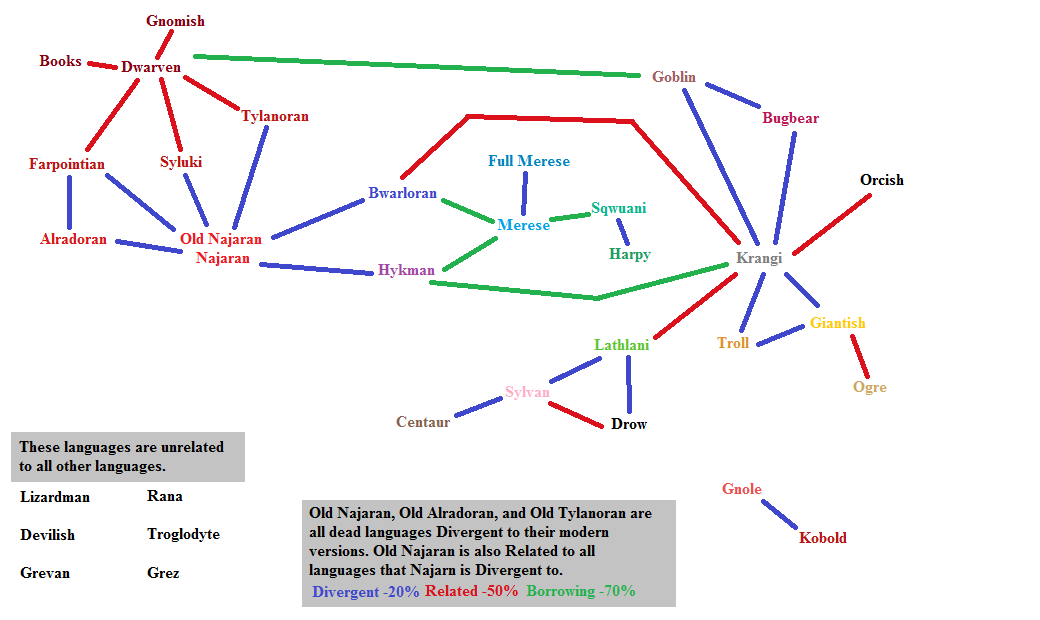
Last night I made a map representing the relationships between different languages in Gurutama.
Since I am playing on using the Hackmaster rule system for Gurutama I modeled the relations between the languages on how languages work in Hackmaster.
Languages are treated as skills in Hackmaster with proficiencies ranging from 0-100%.
0-25% is when you know a few words in the other language. Most Californians have at least this much understanding of Spanish.
26-50% is when someone knows how to construct sentence frames, but can’t really carry a conversation. Someone who’s still learning the language.
51-75% is when someone knows enough to go on vacation to another country and speak that country’s language, but not enough to have a conversation about philosophy or something. My wife and I probably have this level of proficiency with Spanish.
76-87% is a normal mastery of a language. Hackmaster treats this level as the amount most people have in their native language.
88-100% is when someone knows lots of fancy words in their language. My dad has a PhD in linguistics, so he probably falls into this range.
That should give you a better idea of what the penalties listed in the image above mean.
Lets say that English is Merese on that map up there. My dad with his PhD in English linguistics would have around 20% mastery of a language that English borrows words from, like Swedish. He’d recognize a few cognates between the languages and he might know how to construct sentences, but he can’t really speak Swedish.
I’d guess that I have around 60% proficiency in Spanish. French is a very similar language. Everyone else in my family spoke French occasionally when I was growing up and the little bit of Spanish I know allowed me to understand the gist of the conversation even if I couldn’t participate. French and Spanish would be considered divergent languages in the Hackmaster system (along with Portuguese, Italian, Romanian, etc.).
A few of the languages up there might not be recognizably from Gurutama. Some of those are for monster races like trolls, giants, and orcs. The others, like Krangi, Lathlani, and Sqwuani, are for a few of the main races. Krangi is Hobgoblin, Lathlani is Elven, and Sqwuani is Avian.
The other members of my D&D group are getting a little more interested in Gurutama lately and there was talk of setting up a wiki for the campaign setting so everyone could edit and add stuff on.
If the wiki is set up I’ll start moving content there. The stuff I create will still be posted here but my friends can’t make the same promise.
That’s it for today!
-GoCorral





Leave a Reply