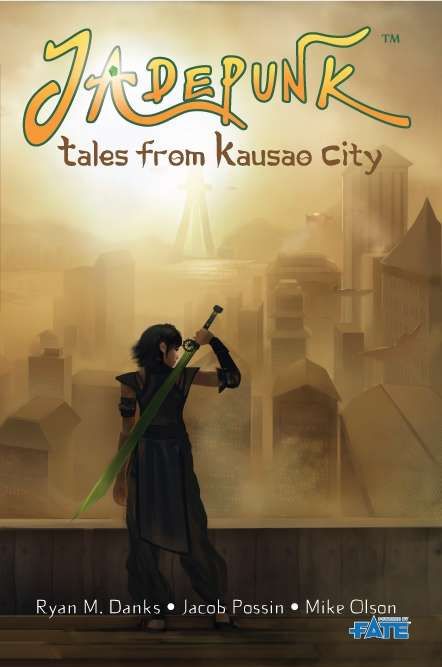
Continuing on my Chinese RPG reading quest, I got the FATE game, Jadepunk, recommended to me.
I already reviewed the more official FATE China game, Do: Fate of the Flying Temple. Jadepunk uses the FATE system as well, so mechanically it is very similar to Do. The main differences are the Approaches and Stunts.
Approaches in Jadepunk are renamed Professions. The six Professions are Aristocrat, Engineer, Explorer, Fighter, Scholar, and Scoundrel. They don’t quite line up with the Approaches, but they can still accurately describe pretty much every activity that a group of PCs will undertake. There’s a small concern I had that players may end up stuck with whatever Profession is relevant for a long time, while Approaches can be varied or used in unusual ways more often. For example, a mission in the criminal underground is going to keep using Scoundrel a lot, while you could conceivably use any Approach in the same situation. It’s hard to say without actually playing the game for a few sessions though.
Stunts have more rules than Do, creating a more crunchy system. Stunts are renamed Assets. They cover special kung fu techniques in addition to useful contacts and powerful weapons. Assets are purchased by lowering your Refresh pool. Instead of 3, the Refresh pool starts at 7. There is a formula for calculating the power of an Asset and the purchase cost is dependent on that power. Acquiring new Assets is part of leveling up and advancing, just like acquiring new Stunts and Aspects in Do.
Mechanics aside, Jadepunk is truthfully more of a campaign setting book than a FATE system. The authors are upfront about this in the foreword. Jadepunk‘s world was originally created for writing novels but the authors realized it worked for RPGs as well. About half of the book is about the setting. It’s really well thought out and I can see how it is a great backdrop for stories, written or roleplayed.
Jade in Jadepunk is a magical substance that powers all the cool technology in the world. This led to a steampunk industrial revolution and to the name of the system, Jadepunk. There are five colors of jade that match with the different elements of the Japanese five element system. Green for Earth, Red for Fire, Blue for Water, White for Air, and Black for Void.
Black jade was a recent discovery within the Jadepunk universe. A large black jade deposit was discovered in an area known as Kausao. Four governments descended on the area and fought some wars over the territory before deciding to split the wealth amongst them. Each of the governments has rough equivalents to Europe, Arabia, China, and Japan, but its stretching to call them direct analogs. The authors have done a good job at making the culture and governments of these different places seem unique and not derived entirely from real-world nations.
Kausao City with all its black jade wealth and foreign influence has grown into a fabulous port city similar to Hong Kong or Macao. With all this wealth also comes a whole lot of corruption. And if there’s a corrupt government, there’s a rebel insurgency. That’s where the players come in. The PCs are expected to make characters that are part of the Jianghu resistance to the Kausao united government. A solid start to any sort of freedom-fighting story you’d like to tell. To help you on your way as a GM, there’s also a decently sized GM section on how to design and play adventures. That section along with the similar stuff in the original FATE books should leave you set up to run your own adventures without too much worry.
The overall structure of the book is well done. Lore sections alternate with rules sections in an odd fashion, but it works fine due to a solid index and table of contents. There isn’t much art, but as an independent project, I can’t fault the book for that. What is present is nice and the text layout is quite thematic with sidebars replaced by little blood splashes or secret notes as if the book was a freedom-fighter’s handbook given to a new member, the reader.
There are two main flaws I found with Jadepunk. The first is a system choice. The setting is wonderful and it seems perfectly made for a system I’m familiar with. That system is Forged in the Dark (FitD), not FATE. An urban environment, bleeding edge technology/magic at the start of the Age of Reason, a resistance movement against an evil government… These are all things that FitD was made for and does very well. The introduction of purchased assets also feels like the authors searching for some sort of hybrid option for FitD’s downtime mechanics. You barely need a new ruleset to use Jadepunk with FitD because the original Blades in the Dark playbooks fit so well with the setting.
The second flaw is that the setting isn’t really Chinese. The existence of jade and a colonization event similar to Opium Wars isn’t really enough to solidify the Chinese feel for me. The jade uses the Japanese elemental system instead of China’s. Philosophy takes a heavy backseat to realpolitik in how the world is described. Jadepunk also occupies a later equivalent time period than what I’m interested in for my roleplaying games. Overall, the book is too far off the mark on this count for me to be interested in using it.
If you’re interested in Jadepunk and the FATE system you can check them out using the following links. I’d recommend Jadepunk just for the fascinating setting. And the FATE rules are free/pay what you want if you’d like to read the base system.
Jadepunk: https://www.drivethrurpg.com/en/product/127543/jadepunk-tales-from-kausao-city
FATE: https://evilhat.com/product/fate-core-system/


 GoCorral
Leave a comment