
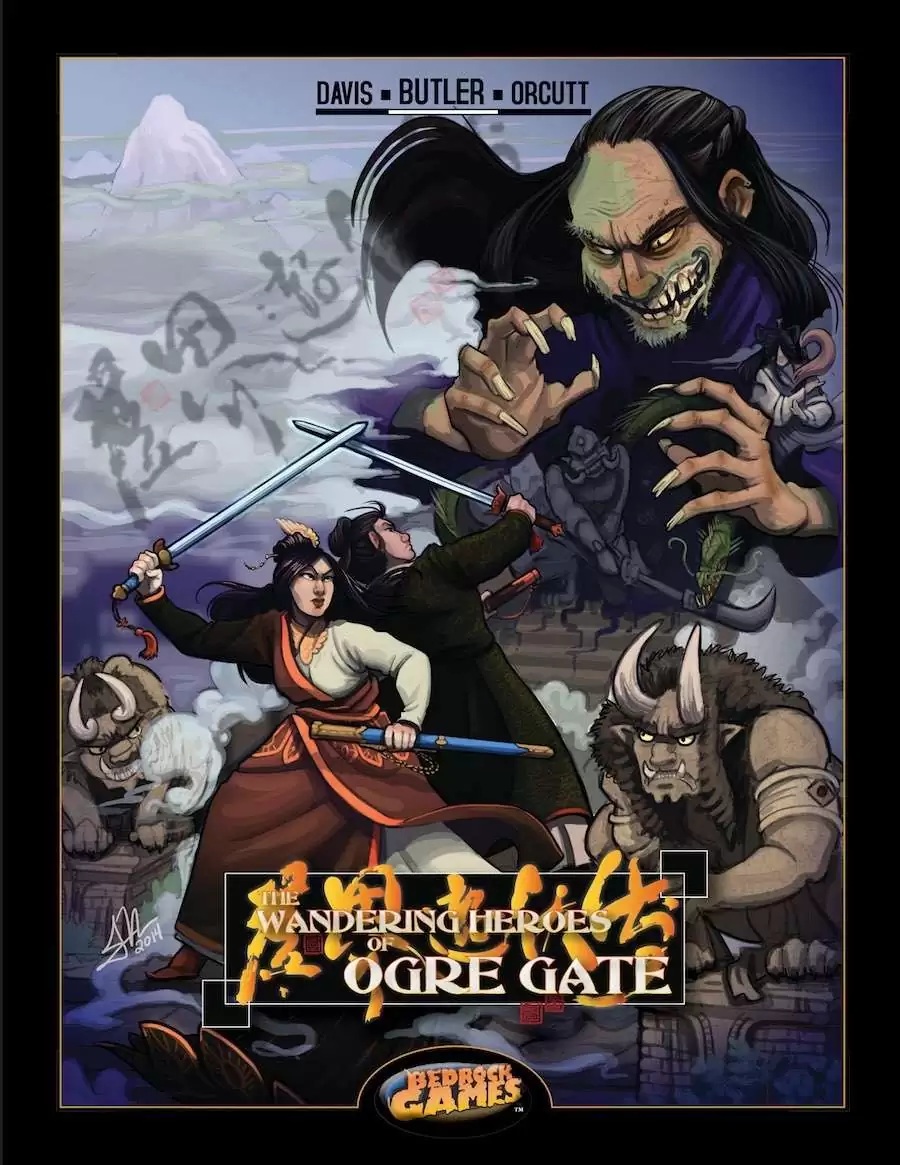
Flying Swordsmen is the next RPG in my review hit list. The system is a derivative of D&D 3rd edition under the OGL. Just like other d20 systems you resolve most actions by rolling a d20 plus something to hit a target number. Everyone is a human and picks a class and a class profile, similar to D&D 5th edition’s archetypes. I feel like if I come back to a d20 system it would be Hackmaster, D&D 5th edition, or Pathfinder (1st or 2nd). Flying Swordsmen has some tough competition in the d20 space.
Flying Swordsmen is set apart from other d20 systems by a few key mechanics. Instead of flat modifiers derived from a character’s attributes, they get a die to add to their rolls. So a fighter with 18 strength adds a d6 to their d20 attack roll instead of a +4. Saves are also done differently. There are five different saving throw numbers based on the five Chinese elements. Every character has set numbers in the saves between 17 and 5 depending on their class and level. When a save is called for the character rolls a d20 and has to get over that set number or suffer the effect. No more spell saving DCs! A spell’s efficacy is completely dependent on the affected target instead of anything related to the caster.
Flying Swordsmen seems to be written by someone who loved D&D 2nd edition and wanted a version of Oriental Adventures for 3rd edition that blended 2nd edition concepts. Experience required to level up is different for each class and only thieves get skills, just like in 2nd edition. Feats are still included but the designer changed their name to maneuvers, made them weaker, and gave everybody more of them. Saves are similar to the “roll below your attribute” style from 2nd edition, but with the five elements instead of the six attributes.
I feel that overall the mechanics don’t support the designer’s vision. The system intends combat to be highly descriptive, but there’s no mechanical prompt to initiate those descriptions. Some players can run with an idea like that, but my experience has been that people need a starting point to include extra narration in their character’s actions. Why include the scenery in my description of my attack? It doesn’t do anything. Instead, the maneuvers should have descriptions that help a player imagine how those techniques would be used in a particular situation. Ironclaw did a fantastic job of having a bunch of options and having narrative connections for what the characters were doing. Flying Swordsmen unfortunately does not.
The book has good organization but the designer clearly expected readers to have already played 3rd edition. He openly admits in the intro that he assumes you have played RPGs before. Distances are given in flat numbers with increments of 5 like D&D, but the correlation to an actual measurement is mentioned only once in a glossary section. Action resolution of taking a d20 + stunt die + other modifiers is explained very quickly with only a single play example. It’s possible I’m even making a mistake in my interpretation of the rules compared to how the designer envisioned it because the actual explanation in the text is so sparse.
From my tone you can probably already tell that I don’t want to run Flying Swordsmen. I’ve done a lot of d20 DMing and I’d like to move to something different. Flying Swordsmen‘s rules are too shallow for me to be pulled back to the d20.
The system does many things really well though. The magical items are small but fun little pieces. They’d be good additions to other games. The magic system is mostly guided by a Yin-Yang philosophy instead of the five elements. Many spells have a Yin version and an opposite Yang version with Yin being a beneficial spell for allies and Yang being a harmful spell for enemies. The spells keep a good pace with what the martial maneuvers allow and the descriptions are top notch. One that stood out to me was getting snakes tattooed on your arms. You can throw the tattoos at an opponent and the snakes come alive to bite them. The snakes then fly back to your hands and you have to swallow them whole to restore the tattoos. Wild imagery right there!
Overall, I feel like Flying Swordsmen isn’t for me. It might’ve worked better as a third party supplement for 3rd edition. In fact it may have started as a supplement for 2nd edition and then reworked into a 3rd edition derivative product. It’s a great product for ideas, but I’m not personally interested in playing it. If you’d like to check it out for yourself the system is available for free on the creator’s blog.





Leave a Reply