
Jadeclaw Legacy has been the best fit for the type of Chinese fantasy game I want to play. Jadeclaw Legacy got its start as a spin-off game from Ironclaw 1st Edition. Ironclaw is a game for playing traditional Medieval fantasy, but in world inhabited by anthropomorphic animals. Jadeclaw has rules for the five elements and the three ways like I wanted. The basic rules are easy to use, but with a lot of nuance that I think could make for a fun adventure.
The setting while fantastical, matches fairly well with real world China. Close enough that changing it back to real world China is a snap of the fingers. Jadeclaw is a tad different than most other systems I’ve played before though since the characters are not humans or human-like beings, but instead anthropomorphic animals. Each character is a mammal, bird, or reptile that walks on their hind legs with their forelegs/arms/wings having hands for grasping things (except snakes which use their tails). There’s also a few Chinese language jokes in the setting such as the Yellow Emperor being a horse and naming his capital Majing, meaning Horse Capital.
Character creation starts with choosing a species and a career. Each species has a natural weapon, natural senses, a special set of gifts, and a set of skills they are good at. Gifts are like advantages from GURPS or feats from D&D. Elephants have tough armor and a trunk. Oxen are strong but have poor eyesight. Each career has a set of skills they are good at as well as defining the background of a character. A librarian is probably going to have a more privileged upbringing than a pickpocket for example.
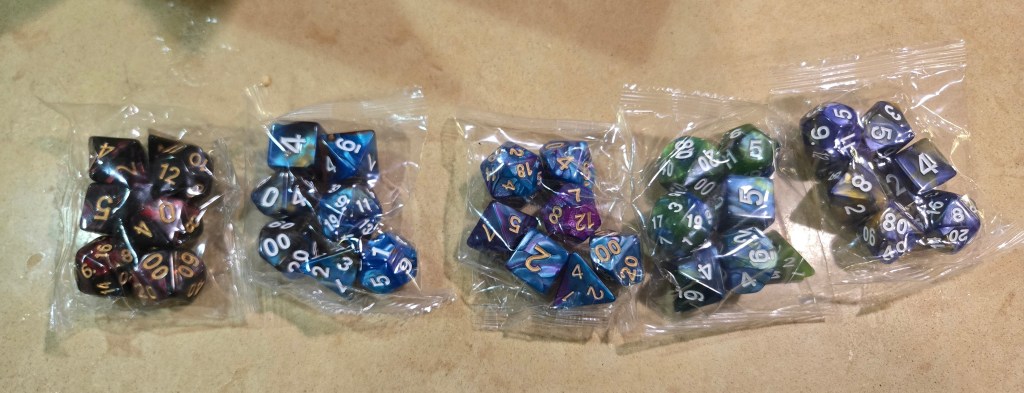
After picking a species and career you assign your trait dice. Everybody starts with a d12, a d10, two d8, a d6, and a d4. The bigger the die the better your trait is. These dice are assigned to the four traits of Body, Mind, Speed, and Will, as well as your Species and Career. Body represents your strength and size. Mind represents your intellect and crystallized knowledge. Speed feels pretty self explanatory, but also covers the dexterity attribute used in other games. Will represents willpower and force of personality.
After traits, you use your remaining build points to pick gifts and learn skills. You can also take flaws to gain a few extra points. Flaws can be physical limitations or mental limitations on what your character would do. These mental limitations aren’t always what we’d consider flaws though. For example, Heroic is a flaw that limits your character’s actions since they must help someone in need if they have the power to do so.
All this comes together with the conflict resolution mechanic of the Ironclaw/Jadeclaw system. If a lion warrior wants to hit something with his axe he adds the dice from his warrior career, his Speed, and his axe skill. He rolls all those dice and gets a 9, 7, and 3. His target tries to dodge and rolls just their Speed dice getting a 6 and 5. The highest results of each roll are compared, 9 vs. 6. The 9 is higher so the lion hits. Non-combat skills have a similar resolution, roll all your relevant dice against a difficulty based off your opponent’s skills or the environment.
Jadeclaw is an RPG so as you play your character gains experience and improves their traits, gifts, and skills. The experience rules require your character to improve four different things at the same time, ensuring some diversity in your build. Our lion warrior can’t just put all his points into Warrior, Speed, and Axe. As you improve traits and skills their dice size improves, d4>d6>d8>d10>d12. An improvement after d12 adds a new die at the d4 size which can then be improved in turn. Thus as your stats improve your dice pools for your favored pools get more dice and the dice improve in size, increasing your chance of getting the highest number in a contest.
There are tons of rules for out of combat resolution, but they vary between different situations. Negotiating a treaty plays differently than sneaking into a base obviously, but also differently than haggling in the market place. There’s so many intricate rules that I can’t summarize them in a blog post. The nice thing is that everything is well organized and easy to reference. I don’t need to dig through the rulebook and flip back between different sections and tables. All the relevant rules for each situation are grouped together.
Combat has an easy flow and beginners can learn it quickly. There is a deceptive complexity to it though. Each character rolls initiative and chooses their action in that order. The highest roll goes first and can choose a First Rank maneuver. First Rank moves go first, but often have a penalty. Each person has a chance to pick a First Rank or delay. Then everyone has a chance to pick a Second Rank maneuver. Second Rank moves are the default, offering nothing special. Finally there are Third Rank maneuvers. Third Rank moves come with bonuses. So why not just take a Third Rank move? Because if you get hit before you make a move you might be sent Reeling, which takes away your action for a turn. If you wait too long your turn might just get skipped!
The maneuvers get more complicated when your character learns martial arts techniques. They can have simple modifications like “First Rank maneuvers don’t have a penalty for you.” There are also more powerful and complicated moves that let you strike three times or shoot an arrow through a keyhole. Through these advanced maneuvers and the ability to interrupt your opponents the combat takes on a more dynamic feel than just “I swing then you swing.” If you and your opponent are both low do you strike first or hold your strike until the Third Rank to get a better chance of finishing them?
Magic is wonderfully flavorful in Jadeclaw. Magic is split into three schools, Changes, Purity, and Dao. The three schools match the Three Teachings of China with Changes for Confucianism, Purity for Buddhism, and Dao for Daoism. The match isn’t exact though. Purity is presented more as divine magic while the spells from Changes seem to match better with the cultural feeling of Buddhist magic I’ve seen in other fantasy works. Additionally, Jadeclaw‘s official setting doesn’t have Buddhism. Regardless, the Three Teachings are present one way or another. And Daoist magic is further split into the five elements, earth, fire, metal, water, and wood, to bring in that aspect as well.
Casting a spell is just like rolling any other skill. Mind dice + career dice (the 3 different types of magic correspond to 3 different wizard careers) + skill in that particular spell. This is rolled against a set difficulty that’s different for each spell. If you win, you cast the spell. Each spell also has a magic point cost. If you have a number of skill points in a spell equal to the magic cost, you no longer need to roll to cast it.
Most of the spells are non-combat related. Enough to make me think that magic isn’t intended to be a fighting discipline in Jadeclaw the way it is in other systems. The combat can also get exceedingly complicated with layering spells. There are lots of spells that improve the next spell that’s cast. I got the sense that wizard duels were fought mostly in preparation for the duel and less in what you actually did during the fight. And just like for martial combat, that complexity can be used or ignored as desired.
Jadeclaw has a versatile system for combat, non-combat, and magic. It matches the Chinese theme I’m trying for in my campaign. I read Usagi Yojimbo, so I’m used to the anthropomorphic animal component. Is my search for the best ancient China RPG over? Unfortunately, not quite.
The main issue is there isn’t a good online way to run Jadeclaw Legacy. The game came out in 2002 and all the virtual tabletops came afterwards. It isn’t fair to say that Jadeclaw didn’t evolve alongside them, since it did. Ironclaw 2nd Edition came out in 2010 and the revised Book of Jade followed in 2012. There are plenty of resources for running Jadeclaw with the 2nd edition rules, but the character sheets don’t quite work for the 1st edition rules that Jadeclaw Legacy operated under. The underlying complexity of the system makes this a little difficult. Ideally there’s a character sheet that makes it easy and fast to combine trait and skill dice for resolving a check. Without that, play can get bogged down because you have to add a bunch of variables together instead of just one big number like in D&D. Simple solution though, play 2nd edition. There are online character sheets for that!
I loved the theme and rules of Jadeclaw Legacy. It’s definitely made me want to look at Ironclaw 2nd Edition next. Jadeclaw Legacy did have some organizational flaws that I’m hoping are improved on for the sequel. The rules were separated into different glossaries instead of putting them in order of how they should be learned and read. Great for reference after you’ve learned them! Not so great for reading cover to cover to learn how the intricate parts of the system work together. Anyways, I really liked Jadeclaw Legacy and I’m hopeful that the 2nd edition books will be just as good. If you’d like to check out Jadeclaw Legacy its available on DriveThruRPG. You can also read a bit more about Ironclaw and Jadeclaw on the website for Sanguine Games.






Leave a Reply