The Olympians are not the only gods present in the world of Cimmeria. The campaign is located on an altered landscape of the real Earth, thus real world gods and religions exist alongside the Olympians. The most notable pantheons are the Egyptian, the Persian, the Norse, and the Indian pantheons. The goblins also worship an animalistic pantheon of their own that has syncretically combined with the Titans of Greek mythology.
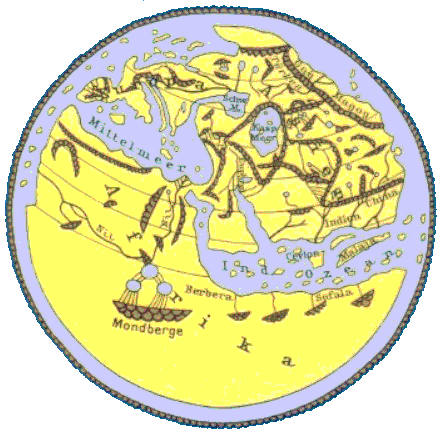
Each of the pantheons has an area of influence where their power is strong. Divine servants of a deity have full access to their granted powers in the realms of their pantheon. If they travel outside that region their powers weaken and decline. Once fully in the realm of another pantheon a priest will only be able to call on half of the divine power that they would normally have available to them. In game terms, clerics and other divine classes have their magical class features restricted to half their level, rounded up.
Each of the cosmologies of the different pantheons is true for those who believe it. Followers of the Olympians can use magic to travel to the magical planes of Olympus, Elysium, and Erebos. The Olympian follower could bring along a practitioner of a different pantheon on their journey if they wished, but the heathen in question would never be able to get to the fantastic places of a different pantheon without this assistance. Similarly, a follower of Olympus would be barred from entering the extraplanar realms of other pantheons without a guide of some kind.
Egyptian – The Egyptian pantheon is headed by Ra-Horakhty, the falcon king of the sky. Ra takes physical form as the god, Horus, who is the living pharaoh of Egypt. When the pharaoh passes on he becomes Osiris, the father of the current pharaoh and the god of the Underworld. Ra is constantly struggling with the vile god, Set, until the end of days. Each of the Egyptian gods have human bodies, but animal heads. Good Egyptians go to the afterlife where they serve Osiris, while the souls of wicked Egyptians are eaten by the monster, Ammit.
Persian – The Persians worship Ahura Mazda as the prime deity. Ahura Mazda is the source of light and wisdom. Ahura Mazda created many other gods to assist in his fight against Ahriman, the god of lies and darkness. Many of these gods serve as patrons of different cities within Persia. Followers of Ahura Mazda are encouraged to do good to improve the world. Once all lies and darkness are banished from the land, all those who have died in Ahura Mazda’s service will be revived and live eternally.
Norse – The Norse pantheon is headed by Odin, the one-eyed wanderer. At the center of Norse cosmology is Yggdrasil, the tree that separates the nine realms. Followers of the Norse pantheon typically worship the gods of Asgard while fearing the gods of Jotunheim and Svartalfheim. The Norse gods are still in their infancy. To discover more of the world and build their mythology they wander the world possessing the bodies of different mortals. Thor possessed the body of Antapike until his death. Many of the Norse gods are active in the Orc Lands and a cult following has developed, devoted to the worship of Odin, Thor, Loki, Syr, and some of the evil giant deities.
Indian – Gods abound in the Indian religion of Hinduism, but the central figures are Brahma the creator, Vishnu the preserver, and Shiva the destroyer. Brahma creates more of the world in the cycle of the seasons. Shiva works to destroy the world. Vishnu wishes to preserve the world and the mortals that live within it. Hindus who die are reincarnated into a new body. The value of the new body corresponds to the weight of their deeds, good and bad. Good deeds are rewarded with the soul having an easy life in their next reincarnation. Evil deeds are punished, perhaps by becoming a dung beetle, rat, or a diseased human. The multitude of gods leads to a multitude of thoughts and paths to worship within the Indian religion.
Goblin – The goblins worshipped an animalistic pantheon before the Olympians arrived. Through worship the goblins hoped to please the ideal spirit of that animal. If the ideal animal was pleased then it would provide the worshipper with a blessing related to the unique traits of the animal. When the Olympians invaded and defeated the animal pantheon there were syncretic changes that occurred to the pantheon. The Animal Pantheon became associated with the Titans that the Olympians had defeated during the Titanomachy. Now each of the Animal gods shares a prison cell in Tartarus with a Titan as the two personalities slowly merge due to syncretism.
Other fictional pantheons – Players may wish to have their PCs worship deities from other fictional campaign settings. They are free to do so, but those deities will have smaller followings within Cimmeria and the wider world around it. There may be a priest of Mystra, Pelor, or Kelemvor, but there is expansive priesthood to support them.



Leave a Reply