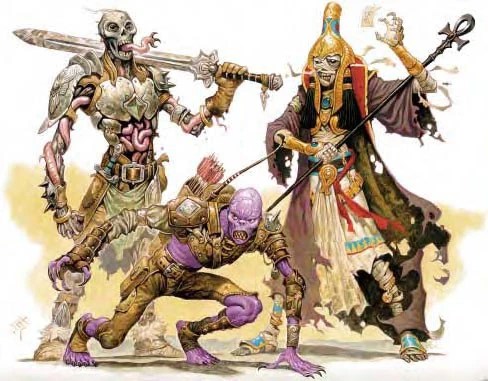
Physical Description
Undead are the animated corpses and spirits of the deceased. Their dead forms move as they did in life, but now as horrid monsters. Most undead are warped to think only of the consumption of living beings from their previous species. This obsession is further twisted by undead that retain some of their memories. They remember, but only act on their memories in negative ways. Possessive love, hatred, and jealousy are all motovations for a ghost’s behavior.
Physically, undead vary wildly between different subspecies. Undead can rise after the death of any living species from ants to dragons. The conditions for each undead type change, but typically require a conscious being holding on to a goal or obsession that was unfulfilled in their life. Risen undead have rotted bodies and clothing. Broken pieces of what they wore and used in life accompany them. This is true even for the appearance of incorporeal undead.
Culture
Undead culture is as varied as the races that become undead. Many maintain the cultural trappings from life, often with the addition of some funerary trappings. Regardless of what existed in life, undead thoughts are dominated by a hatred for all living things. They seek to destroy or corrupt any spark of goodness they encounter. Thus, undead do not truly have a culture of their own. They cling to their memories of life for themselves and deny everything else for others.
History
Undead were rare in Cimmeria when the Olympians arrived. The first undead was King Aeëtes of Colchis. He used the secret rituals of his daughter Medea to transform himself into a unique type of undead, a curst. This act denied the right of Hades to have Aeëtes as a citizen when the mortal king died. An angry Hades brought his subjects out of the Underworld to claim his property, but was defeated. Some of Hades’s soldiers were left behind, becoming the first basic undead in Cimmeria.
Over time, the undead were studied by Cimmerian magicians. These wizards discovered more about how the undead worked, pioneering the magical field of necromancy. All undead sought to extinguish life and bring more subjects to Hades’s kingdom. However, with the right type of magic energy, undead could be controlled. Some undead were capable of killing living creatures to produce more of their type of undead, but there was initially no other method of producing more undead.
Necromancy changed after the resurrection pact was formed. King Karnafaust of the dwarves was killed but then returned to life by sacrificing diamonds to Hades. The resurrection pact modified how dead bodies could be brought back in more ways than one. While diamonds returned a person fully, black onyx gems transformed a body into an undead monster, the kind of monster depending on the gem sacrifice and the magical infusion of the caster.
The city of Crux was founded to organize the study of necromancy. Dozens of necromancers gathered to research and collaborate on developing this new magic. Hades sent a representative to assist with Crux’s initial stages. This was the Antenator, a giant three-headed bodak. Crux developed a society of necromancers practicing their trade while the Antenator kept undead docile and compliant with necrotic energy emanating from his Silver Tower home in the city’s center.
Vampires were the most notable type of undead in Cimmerian history. After the Draco-Gith War, Blendegad of the Gish Trio turned himself into the first vampire. Vampires spread across Cimmeria over the centuries. Blendegad sought additional power, turning himself into a dragon, and then the Reaper God of the dragovinians. The dragovinians of Xoria threatened the whole of Cimmeria. Fortunately, Blendegad perished fighting the Second Alliance and the vampire scourge was cleansed by Eathirilu’s use of Pan’s power. All vampires and dragovinians were turned back into their mortal forms.
Undead are at a low point in Cimmeria’s history after the Second Alliance War. King Aeëtes is gone. The powerful undead stronghold of the Lich Shade is abandoned. Vampires are gone, and Crux is weakened by their absence. Despite this, undead remain a terrifying threat to many people in Cimmeria. An evil power that could return to consume civilization at any time.

 GoCorral
Leave a comment