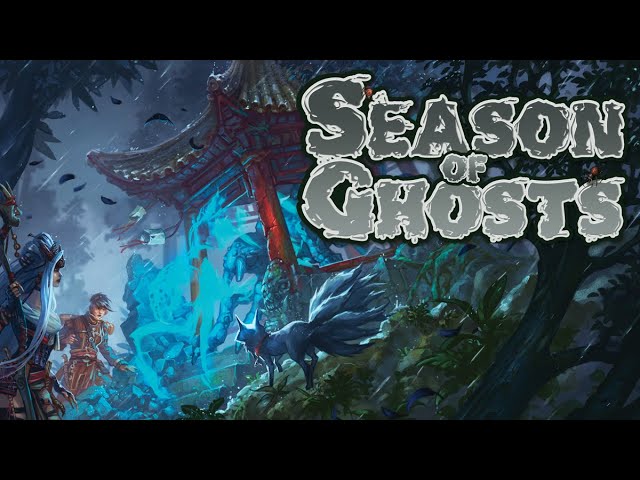
Paizo’s Season of Ghosts is one of the most recent adventure paths set in Tian Xia, Golarion’s version of China. Normally, I’d review the four part adventure path as four blog posts devoted to each one. I’ve decided to take a different route for this adventure path though. I’ve mentioned how excited I am to run Season of Ghosts when reviewing the Jade Regent and Ruby Phoenix adventure paths. You’d think I’d be ready to go on a review. Sadly, I don’t think my usual style is quite appropriate for Season of Ghosts. The plot of this adventure path is just too intricate and twisty to review without giving way too much away. The other adventure paths were fairly straight forward while Season of Ghosts feels like Inception at some points. I can’t discuss it in depth without going too far past what players should know and I don’t want any of my players to stumble on this review by accident while looking at other parts of my site.
I can at least discuss the setting of the adventure. The adventure is set one hundred years before the standard Pathfinder canon, at the dawn of the Age of Lost Omens. The players are residents of the sleepy lumber village of Willowshore. Willowshore is located within the country of Shenmen which is Pathfinder’s place for spooky ghost stories from East Asian culture. The village was founded about a hundred years ago to build a monastery on the grave of a famous warrior-monk that died one thousand years ago. The monastery was built, but abandoned about fifty years ago. Willowshore remained as a lumber village that exported wood downriver to the sea. Like many places within Tian Xia, Willowshore was part of the Lung Wa Empire in Tian Xia. The Empire collapsed recently and the villagers are just starting to stretch their limbs of independence.
Season of Ghosts begins immediately after Willowshore’s annual Reenactment Festival. Due to the spooky ghost nature of Shenmen, the villagers have some rituals to prevent ghosts from bothering their town. On the last day of spring the townsfolk dress up as ghosts. A few of the townsfolk (the PCs) remain in their normal clothing. The “ghosts” kidnap the PCs and drag them into the woods where they stay the night. This practice is meant to trick any ghosts that happen by into thinking that the town has already been haunted. The kidnapped people are meant to be awakened the next day with a nice breakfast brought into the woods, but the PCs discover no delicious meal on their awakening. Instead the town is haunted by ghosts and possessed animals (Ghosts in the Season of Ghosts adventure path set in ghost country? NO WAY!). The PCs must rescue the town, defeat the ghosts, and discover why their town is haunted so that the specters can be fully exorcised.
Unlike most adventure paths, Season of Ghosts has a four act structure instead of a three act structure. Each module is set during a season of the years, starting in summer and progressing through autumn, winter, and finally spring. The books claim this is based off the kishōtenketsu story structure of
- Introduction
- Escalation
- Twist/Climax
- Results
Of course most adventure paths have these elements but are thin when it comes to the Results section. That’s mostly left up to the players and DM within a particular group. Willowshore is a bit different by including a fourth adventure that actually focuses on the results of the previous three. It’s a well-written piece, but I’m also unsure if its actually necessary. I think when I run the adventure path I’ll probably check in with my players and see if they want to run the fourth adventure or perhaps run a smaller version of it. This could also be independent of my plan to take these same PCs into the Ruby Phoenix adventure path if we’re still in the mood for Pathfinder 2nd Edition.
While the active adventure parts of Season of Ghosts are excellent I think where the adventure path really shines is what happens while the PCs are not adventuring. There’s dozens of little events that happen around town as the PCs get to know the other villagers and live with them for a year as the adventure path progresses through the seasons. Willowshore has a bit over 200 residents. Of those about 100 are mentioned explicitly during the adventure path and about 50 are given names and short backstories. These are all meant to be people that the PCs have grown up with and spent their whole lives interacting with. As the ghosts threaten the town the PCs’ homes, families, and entire lives as they know it are threatened. And just like in real times of struggle, the people of Willowshore come together to overcome their adversity (or die if the PCs don’t save them I suppose).
Along with all these town events and people is a reputation tracking system. Willowshore is split into two factions, roughly separated by which side of the small river the town is built across. The traditionalist Southbankers are descended from folks who built the nearby monastery. The industrious Northridgers came more recently to transform Willowshore into a lumber town for the Lung Wa Empire. These factions are butting heads at the start of the adventure. As the PCs make decisions and take on challenges the two factions respond depending on whether their side of the town was helped or harmed by the PCs’ decision. The PCs have to work to smooth things over so that Southbank and Northridge can come together for the good of village. And of course this comes with mechanical benefits for the little munchkin inside of all PCs.
I’d love to give more info on all the cool things in Season of Ghosts, but unfortunately I can’t without giving too much away. If you’d like some spoiler free info you can check out the free Player’s Guide on Paizo’s website. It comes with lots of info about Willowshore, some new backgrounds for your PCs, and details on the eight practices that ward off ghosts. The adventures themselves are also available on Paizo’s website and have an excellent conversion for use on Foundry’s VTT. Complete with stats, maps, notes, music, and sound effects, it has everything you need to have a great time playing the adventure path remotely.



 GoCorral
Leave a comment