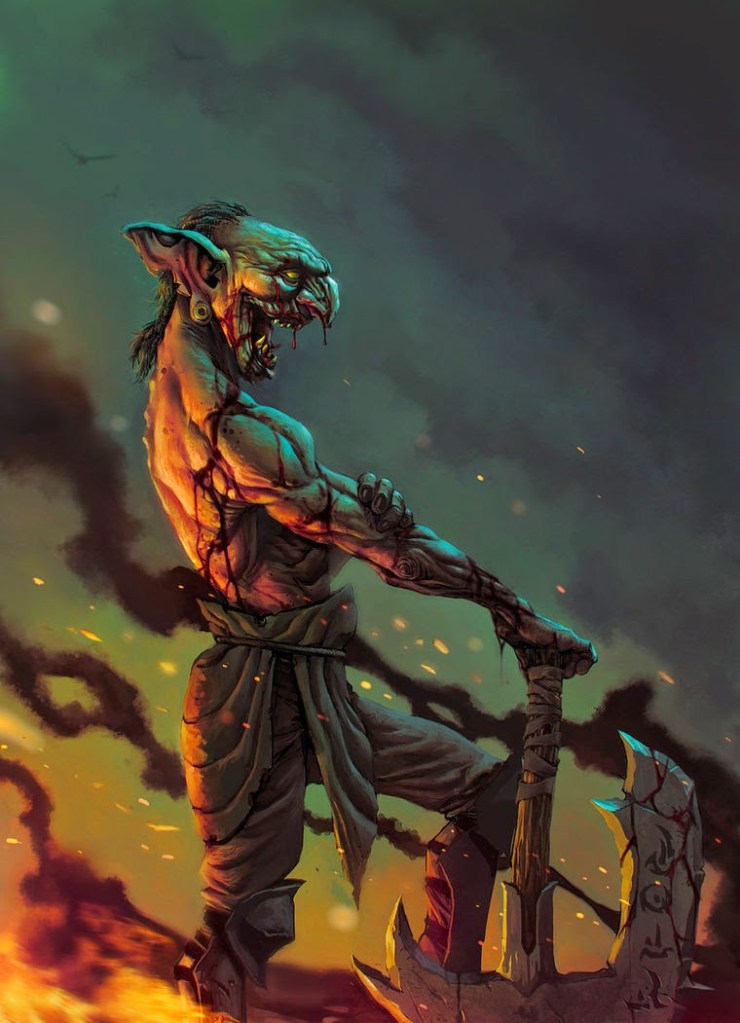
When the Olympians invaded, the Animal Pantheon of the Goblins gave their subjects a blessing. Prior to the invasion, the goblins were a relatively homogenous race. When war started various sub-races were born to goblin mothers. One out of every hundred births was a hobgoblin. One out of every five hundred births was a bugbear. One out of every twenty thousand was a barghest. Various other sub-races came about as well (bakemono, dekanter, tasloi, etc.). Each of these new goblinoids were more powerful than the original goblins and better suited for war agains the Conclave races of the Olympians. The Animal Pantheon had hoped that this infusion of strength would bring their petitioners victory, but it was sadly not enough.
Since before the Olympian invasion the goblins practiced ritual cannibalism. At funerals a goblin’s family would consume portions of their corpse so that the goblin’s spirit would continue to reside with the family. Additionally, the goblins consumed the flesh of powerful foes they had defeated to absorb the spiritual strength of that foe into themselves. This tendency towards cannibalism increased among the sub-races created by the Animal gods, most notably in the bugbears and barghests. During the Goblin War the two sub-races had plenty of Conclave races to eat, but after the retreat into the east they found their dinner selection rather limited. Without enemy races to consume, the bugbears and barghests began to devour those they were meant to protect, the goblins.
In the six centuries since the Goblin War, cannibalism has become common within the Hobgoblin Lands. Bugbears and barghests continue to hunt the lesser races. Additionally the scarcity of resources in portions of the Hobgoblin Lands leads to cannibalism out of necessity. A fresh body can command a decent price among the upper-class. Poor goblin families occasionally sell their children, not as slaves, but as meals for a local noble to eat.
The goblinoids of Cimmeria have a diffuse population distribution. Most of them do not live in centralized communities, but instead in small villages supported by subsistence farming. Each of these smaller communities are typically ruled by the hobgoblins within them. A hobgoblin birth is considered a blessing for a goblin family as their child will be strong and enjoy an elevated position within the community. Bugbear births are more akin to a curse. Most goblins eat their bugbear children or kill them through exposure. If they reach adulthood, they can be an asset to their family, but they’re also a risk. After all, what’s stopping the violent cannibal from eating its parents?
The goblins worshipped an animalistic pantheon before the Olympians arrived. They valued the particular accomplishments of each animal. Through worship the goblins hoped to please the ideal spirit of that animal. If the ideal animal was pleased then it would provide the worshipper with a blessing related to the unique traits of the animal. When the Olympians invaded and defeated the animal pantheon there were syncretic changes that occurred to the pantheon. The Animal Pantheon became associated with the Titans that the Olympians had defeated during the Titanomachy. Now each of the Animal gods shares a prison cell in Tartarus with a Titan as the two personalities slowly merge due to syncretism.


 GoCorral
Leave a comment