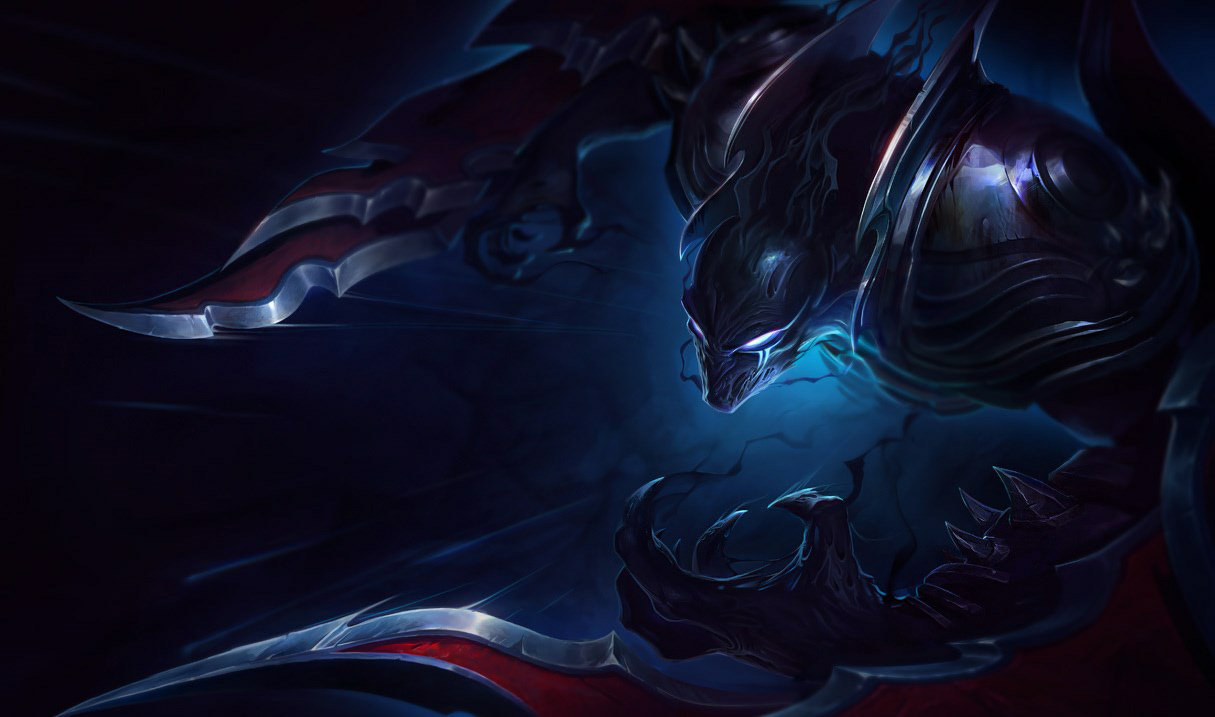
In this post I use the word champion a lot. A champion is the character a player uses within League of Legends. There are over a hundred champions to choose from. The picture above is of one of my favorite champions, Nocturne.
How do people actually play on the map for League of Legends? Why have I described all these turrets and minions and monsters?
The reason is the one of the in game currencies, gold.
League of Legends has three in game currencies, Influence Points (IP), Riot Points (RP), and gold.
IP and RP aren’t used when actually playing the game. They can get you new champions to play with or new looks for those champions. They also get you minor bonuses in game called runes.
Gold is used for purchases while actually playing the video game. Gold starts at 475 at the beginning of every game, enough for one small item.
For a bit of perspective, short games often end with each player having 6,000-9,000 gold. An average length game ends with each player having 12,000-15,000 gold. A long game ends with 15,000-20,000 gold for each player.
Gold buys items. These items can do tons of different things.
They all provide a few basic statistics, making your champion stronger in particular areas. Attack damage makes your attacks stronger, ability power makes your abilities stronger, armor and magic resist prevent a bit of damage to your champion. Health lets your champion take more damage over all. Speed makes your champion faster. You get the idea.
The big items also provide a few special bonuses. One of them lets your champion freeze in place for one second and ignore all damage during that period. Another gives extra strength to all the other players on your team. Another makes your attacks hit three enemies instead of just one. There are dozens of other cool little bonuses.
But how do you get more gold to buy items? There are four basic ways, killing things, having items that give gold, destroying towers or other large objectives, and just waiting (everyone gets a certain amount of gold per second no matter what).
First, killing things. If your champion gets the last hit to kill a minion, monster, or opposing champion, then your champion gets a certain amount of gold.
The amount of gold from kills is decided by how hard it is to kill the target. Champions give the most, followed by the big monsters at each monster camp. After that are minions, with the small monsters at each monster camp being last.
There are a few items that give you more gold just by having them. The ways they give you gold vary. Some give it when you are close to someone else who kills a minion, some give you more for each thing you kill, etc.
Destroying towers or other large objectives is the point of the whole game. Taking down one of those gives a bunch of gold to the whole team. Often the team of five people will gather up to take down a specific tower or objective.
What are the other objectives? Remember the Baron Nashor and Dragon I mentioned in a previous post? Those are the other objectives.
Baron Nashor and the Dragon are two large monsters that sit in their camps adjacent to the River. They are effectively as big as a turret and can deal nearly as much damage as one. Because of this the whole team or close to the whole team is usually required to take them down as minions will not be taking the laser shots like they do at towers.
Killing Baron Nashor or the Dragon gives the whole team a buttload of gold. Baron Nashor has the additional benefit of giving a buff to your whole team, increasing all of their statistics. This buff lasts for four minutes.
The Baron respawns after seven minutes while the Dragon respawns after six minutes.
A lot of the gameplay of League of Legends requires teamwork. I’ll describe how a team is chosen in another post.
If reading this has gotten you interested in League of Legends you can click this link to download the game for free. Doing so also gives me a little boost in game, so we’re both winners! League of Legends Signup Link
-Mister Ed







Leave a Reply