Sunday is the day I typically play D&D with my friends, so I am thinking about making Mondays into my “talk about D&D days.”
Last week I talked about the history of D&D and said a little about how I feel when I play D&D in contrast to video games. Today I’ll be talking about how D&D and other pen and paper roleplaying games work in practice.
First, a group of friends get together and decide they want to play. Typical group sizes range from four people to as large as eight. Most groups meet in person. My group meets on the internet using a program called Roll20 which I’ll talk about another time.
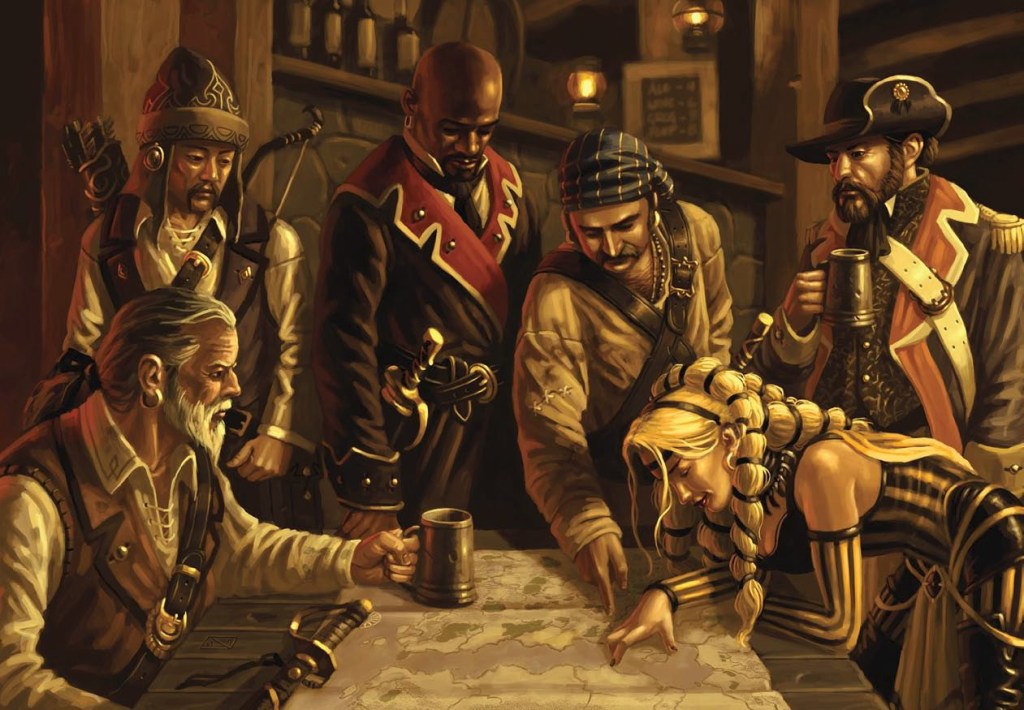
My group has six people in it including me. Out of the six players, only one is the Dungeon Master (DM). The other five are Player Characters (PCs). The PCs usually form a team while the DM plays against them. If D&D were a typical competitive game like Scrabble or Monopoly, then the PCs would cooperate to beat the DM.
Each PC designs one character to represent themselves in the D&D world. There are essentially no limitations in what you can design. When I first started playing I wanted to be a talking bat that cast spells. D&D does allow for this option, but my dad eventually convinced my nine year-old self to play a delinquent elf teenager. I’ve since played hobbit gladiators, dwarven drunks, and elf pirates among many others.
So the PCs each create a hero to play. The PCs control every aspect of that hero, how old he is, what his hair color is, how tall he is, how he fights, how he talks. Everything. But that’s only five people, what about all the others that inhabit the fantasy world that the heroes live in?
The DM creates and plays everything else in the world. If the PCs go to a city, the DM decides what that city looks like and what businesses are there and it is the DM’s responsibility to tell the players that information. The DM creates challenges for the PCs, the traditional challenge being a dungeon with a dragon at the bottom of it (The game is called Dungeons and Dragons for a reason).
The PCs could do anything they wanted. They could open a T-shirt shop together if they wanted to; however, most don’t open shops. D&D is most fun when fighting monsters or overcoming other violent challenges. My villains in my current world are vampires. There are also zombies, dragons, giants, ogres, evil wizards, and many other evil threats to the imaginary innocent people in my world. The PCs try to make the world a better place through their actions. The fun comes from how they decide to do that and the choices they have to make along the way as well as the thrilling action scenes that we play out.
That’s all for now, but more to come next week!
-Mister Ed

 GoCorral
Leave a comment