I thought I’d explore what I’d written about RPG player motivation types further by applying the types to my own group. I’ve been playing with my D&D group since I was 9 years old. I’m 35 now when I’m writing this. We’ve had six consistent members including me nearly since the beginning. I’m the main DM for my group so I’ve gotten used to what their motivation types are before I could properly describe them. I’ll identify their motivation types and walk through how I adjust my stories for the five of them.
Avery: Slayer into Actor
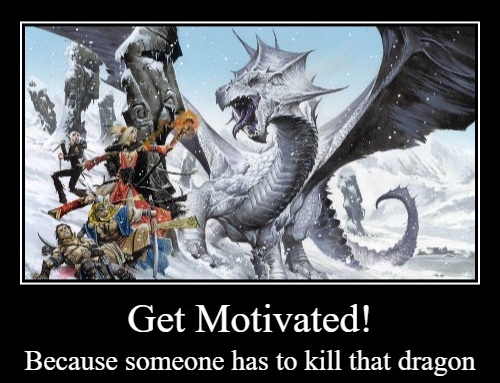
Avery started off as a Slayer type. He loved the violence of D&D and taking trophies from his kills. Satisfying a Slayer type is pretty easy, you just have to include big monsters/enemies in your adventures. The most notable adventure I designed for Avery was when I asked the group what kind of adventures they wanted to go on. He said he wanted to kill a dragon. I designed a dragon hunt as a quest. That went really well for Avery, but it ended up not having enough for the other players. Having the Slayer archetype as the main focus wasn’t a good idea for my group. I continue to include big monsters in my adventures, I just don’t make them the point of an adventure anymore.
Over time Avery has evolved into including the Actor motivation type as part of his play style. He likes designing characters that are quite different from himself in background and tone. There isn’t much that’s required to please this part of his motivation. He can often have fun just interacting with the other players in character, even if I haven’t supplied a social scene that’s perfectly tailored to him. In fact, he’s somewhat shied away from scenes that explicitly feature his character. He prefers the secondary role instead of the main focus. Having his character tag along as a supportive friend on someone else’s personal journey has worked better.
Ben: Thinker and Power Gamer into Instigator
Ben started off as a Thinker and Power Gamer. He was the first of our group to read about powerful character builds online. He copied those builds to make strong wizards that had the perfect Swiss army knife solution to every problem. I think Ben basically played the same wizard character for about twenty years when we were doing 3rd edition D&D.
I think Ben’s Power Gamer side is partially a reflection of a Thinker under the surface. Ben likes the puzzle side of the game. He gets a scenario and wants to solve it. Playing a super powerful wizard gives him the most tools to solve problems. If those tools don’t work in an obvious way, then Ben enjoys thinking of a different way to solve the problem.
Ben’s evolution into Instigator was a more recent development. I’m sure many of us are familiar with having less time for gaming as we get older. Ben is a victim of that, often missing sessions as the rest of his life gets in the way. The effect on his play style is that Ben will often want to skip to the good stuff. He’ll rush forwards into the dungeon without fully preparing. He does this because rolling dice is more fun from him than planning.
Satisfying the Power Gamer and Thinker sides of Ben’s motivation isn’t difficult for me as those are my own motivation types. I know what I like there. I create powerful challenges that are difficult to overcome. Within the D&D framework of “8 encounters a day” I average more like 2-4 because I structure them to be more difficult. I think that makes the game more fun as the risk is higher.
Satisfying Ben’s Instigator side requires a more nuanced hand. The rest of my players might want to dwell on a particular scene more than Ben does. To make that work, I move scenes around in the campaign so that the slower scenes take place when Ben isn’t there. He doesn’t feel frustrated with the pacing and the other players get to enjoy a longer exploration of their characters without Ben metaphorically fidgeting in the corner. Everyone wins!
Jamie: Power Gamer, Storyteller, and Thinker
Jamie started off as a Thinker, enjoying the unique problem solving dimensions of roleplaying games. He rapidly developed into a Power Gamer. He took a different tack than Ben did though. While Ben played pretty much the same wizard for two decades, Jamie varies his builds for each campaign, trying out new things that stretched the power limits of different archetypal fantasies.
The method for pleasing that parts of Jamie’s motivation isn’t radically different than Ben. Create a tough challenge and when Jamie’s character proves stronger, let him defeat it!
There’s two schools of thought for GMing that relate to my approach for Jamie. One says that if a player makes a fire mage, I should make all the enemies fire resistant to balance out the game. The other says, I should make some of the enemies weak to fire so the fire mage can shine. I’m the second type. Wanting to reduce power only comes from playing unbalanced games where one strategy is too overpowering. Unfortunately D&D outside of 4th edition often has this problem. Regardless, letting Jamie occasionally succeed against enemies that weak to fire (or whatever his character is doing) was how I designed encounters for him. The vindication of his build was more enjoyable for him while Ben enjoyed the journey to that victory.
As we’ve gotten older, Jamie revealed a Storyteller side to his play style. He isn’t necessarily interested in his character’s position within the story like an Actor. He enjoys the broader story itself. Jamie pays a lot of attention to the story beats. Jamie keeps all the plot information in his head instead of needing reminders as many other RPG players do. That means that he consistently realizes the implications of plot twists more than my other players.
What works best for pleasing Jamie’s Storyteller side is foreshadowing. BBEG threats, warnings from allies, prophetic visions, and out of character visions of scenes. Whatever it is, I give the group a vague glimpse of something their characters couldn’t have known otherwise. Jamie sees those scenes, but doesn’t fully understand them. Once all the pieces come into place he loves the feeling of realization.
Trajan: Actor and Storyteller
Trajan has never been terribly attracted to the combat and mechanical character building aspects of the game compared to Avery, Ben, and Jamie. He likes the stories we tell together. Before a campaign starts his focus is on designing a character with an interesting and complex journey. He messages me more than any of the other players about how to make his character fit within the world and the plot of the campaign. His communication with me results in his characters getting more attention within the plot. After all, he’s asking for it!
Trajan’s desires are a combination of Actor and Storyteller types. He wants to embody a character just like Avery does. Additionally, Trajan wants to have a character that’s strongly connected to the plot. This positions his characters as the closest ones to main characters within the story. There’s even a Setting the Stage episode (#28) where we chatted after a campaign about how we handled his character being the main focus of that campaign.
Satisfying Trajan’s desires in a campaign tends to be fairly straight forward. He’s messaging me about how he wants to incorporate his character in the plot. I just do what he wants and he’s happy. The struggle comes from not having Trajan’s characters overshadow the others. I fortunately don’t need to do much in that regard. If you listen to that STS episode, you’ll learn that Trajan is self-conscious about that issue himself. If he’s taking too much of the spotlight he’ll check in with the other players and ensure they get the opportunities they want as well.
William: Watcher, Thinker, and Actor
Will is a Watcher motivation type. I think he’d be just as happy playing Age of Empires or Magic: The Gathering with us. Over the years I’ve learned that Will actually doesn’t enjoy being the focal character in RPGs. That means I don’t need to do much to satisfy the Watcher part of his personality. Just hang out and have fun!
Will is a Thinker motivation type as well. Will enjoys game theory problems like the trolley problem or the prisoner’s dilemma. He’s often approaching games with a game theory mentality. He’ll look at a situation in a roleplaying game and try to determine what the most efficient, accurate, and complete solution is. Will doesn’t do this in the same way that Ben and Jamie do. Ben and Jamie tend to approach problem solving by designing characters that are mechanically powerful. Will tries to apply his thinking through the lens of his character’s personality. In that way he becomes a bit of an Actor as well. Will does tend to play characters that are a lot like himself though, so he’s not as fully into the Actor type as Avery or Trajan are.
Satisfying Will’s Thinker side isn’t accomplished through designing tough encounters. He prefers tough moral decisions similar to the trolley problem or prisoner’s dilemma I mentioned before. He enjoys puzzling through difficult moral choices from his character’s perspective. I enjoy designing plots like that as well since they’re more fun for me, so no problems there! Since Will is approaching these problems from his character’s point of view, this also satisfies his Actor side.
Conclusion
There you have it! How I work to satisfy the five long-term players at my table. I’ll post a separate blog that focuses more on the techniques themselves for each motivation type.





Leave a Reply