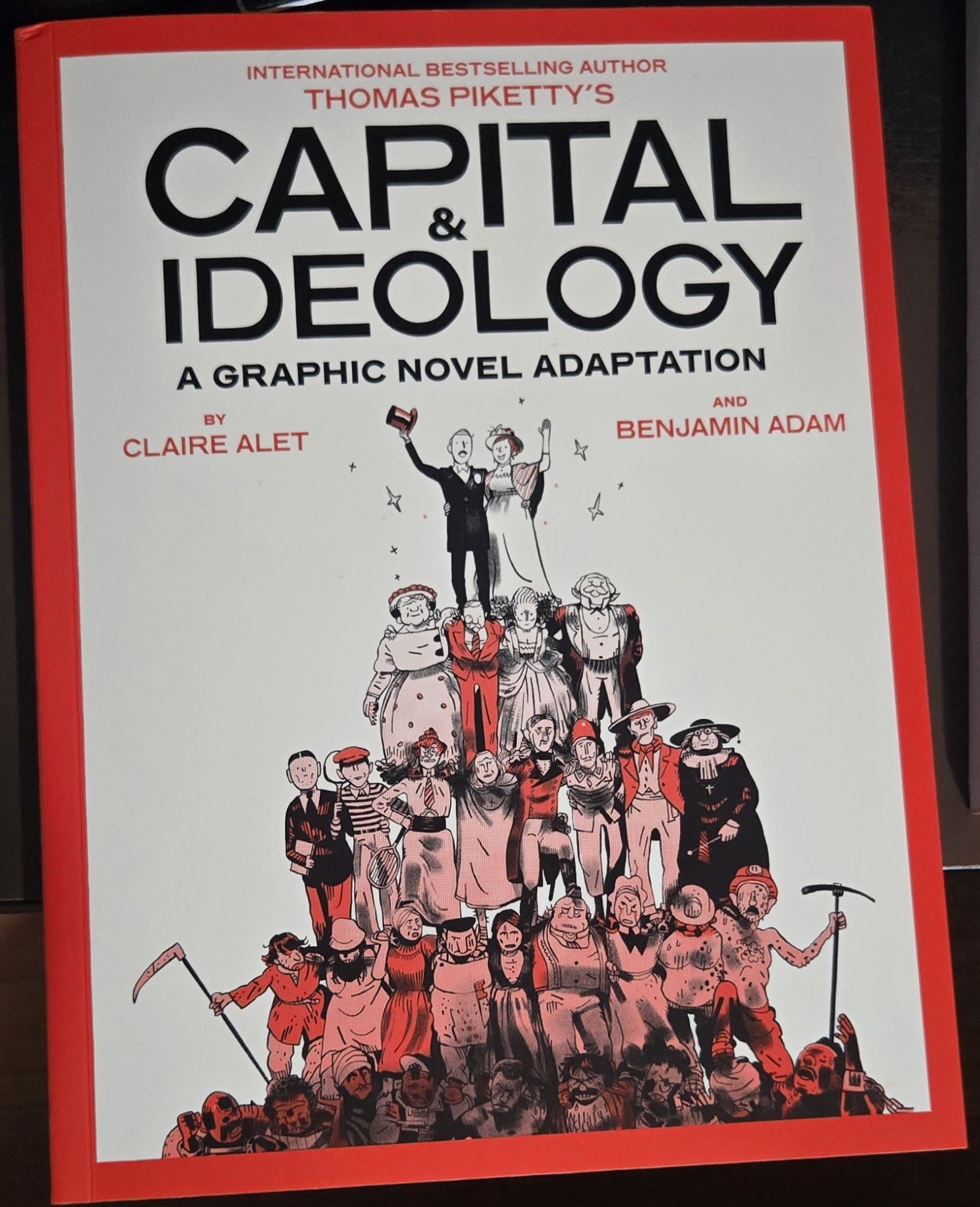
A lot of my learning comic books are gifts from my dad who is also a comic book lover. He got me Capital & Ideology for Christmas 2025. It’s a comic book adaption of the economics book of the same name. The original book was about how the structures of capitalist power evolved and what can be done to ethically change the system.
The comic adds an entire entwined story to the factual approach of the book. The comic’s author invented a family to represent the changes in economic power over the last three centuries in France. The family were originally minor lords under the French Monarchy before the Revolution. Each chapter starts with a picture of the family tree. The focal character of that chapter is highlighted on the family tree. As the book explains the evolution of France’s economy, the fictional family shows how those changes impacted people living during those times.
The mixing of the factual essay content and the family drama is well done, but not perfect. There are certainly awkward points. Overall though, it is a great story telling device. Seeing the impact of the politics/economics on named characters and their connected lives does a great job at personalizing the topic and making it easy to understand.
The actual facts of the book were not anything terribly new to me. I’ve got a college education. I’ve taken a few economics courses and read lots of history. But most of my experience is from a United States perspective. Seeing the same development from the French perspective was refreshing.
The central premise is that while capitalist democracies have been better economically than other systems, they still require improvement to remove poverty and other inequities.
The author finishes with six proposals to create a more egalitarian society.
1. Social Ownership of Capital
Shareholder decisions for companies are largely focused on profit in the next quarterly report and only that. Long term consequences for the public and the employees are forgotten. By requiring businesses to have employees as voting members on company boards, decisions are less likely to be shortsighted, selfish, and evil.
2. Temporary Ownership of Capital
This would be a wealth tax. Currently taxes are placed largely on cash and properties when they are transferred. So money moved from your employer to you is taxed. Money moved from a stock exchange is taxed. Money moved from buying a house or a toy is taxed. A wealth tax would be on property that isn’t moving, but it would be progressive. So something like taxing wealth greater than 10 million dollars at 2%. Thus someone with 11 million dollars in property would have to pay $20,000 in wealth tax. This kind of redistribution is actually typical of economic systems under monarchy, it just occurred every few centuries with more violent tax collection methods…
3. Towards a Social & Federal Europe
The European Union is about the size of the United States in territory and population, but the EU doesn’t act like the United States. Both are made up of smaller entities, but there is a different sense of unity between the two political units. People from the United States are more likely to say they are Americans first. People from Europe are more likely to say they are French/German/etc. first.
Part of this is because the EU is not the main governing body of Europe. The individual states still control the majority of political spending within Europe. To have a stronger EU and a stronger European identity, more of the money from taxes needs to be in the hands of the EU instead of the individual states. This change would allow more unified action from Europe, both internally and on the global stage.
4. Vouchers for Democratic Equality
Preventing corruption within Western politics is currently focused on campaign spending. Running for a political office requires money to run the campaign. Most of the money for those campaigns usually comes from large companies and rich people. After a successful election, a politician has to look at what they can do to get elected in the next election cycle. If that politician wants money for their next election campaign, they’d better make political decisions that favor their political donors. This leads to a system where political power can become captive to economic power, leaving poor people without a real voice in how they are governed.
The solution is to more aggressively empower everyday people to finance campaigns. The idea is that every voter would also get a voucher worth $5 or something. You would give that $5 voucher to the party, candidate, and/or ballot initiative that you wanted in an election cycle. The campaign for that vote would receive your $5 and use it to finance the campaign. This gives a more equal playing field in elections and hopefully would also get voters more engaged as they figured out where they wanted to spend their $5.
5. A Progressive & Individual Carbon Tax
Climate change is coming! Just in like in the World Without End comic. To prevent the really disastrous effects of climate change, everybody should only create 1 to 2 tons of CO2 per year. Your average Westerner creates about 5 tons per year. To control that, carbon usage would be tracked and taxed beyond a certain threshold. That tax would also be progressive like an income tax. $10/ton from 5-25 tons. $30 per ton from 25-100 tons. And so on. By putting a price on reckless consumption individual and organizational consumers will avoid the price by producing less CO2. Additionally, the taxes would be used to compensate people that have already been damaged by global climate change.
6. A Personal Fund for Education & Training
The largest predictor of economic success is education. People with PhDs are more successful than people with Master’s degrees. People with Master’s are degrees are more successful than people with Bachelor’s degrees. People with Bachelor’s degrees are more successful than people without higher education. Unfortunately, many people don’t have access to higher education or even good quality primary education because of funding inequities. Affluent people can choose a home because of the good public schools. Can a poor person make the same choice? By making school funding equitable and free, the barrier of education to economic success can be minimized. If everyone has access to education, systemic inequalities will erode over time.
I really liked the book. I devoured in a single day once I started reading it. It might sound like a lot of complicated stuff, but I promise it makes it easy to understand. If you’d like to check it out you can buy a copy at your local bookstore or with this link: https://store.abramsbooks.com/products/capital-ideology-a-graphic-novel-adaptation






 GoCorral
Leave a comment