Game History
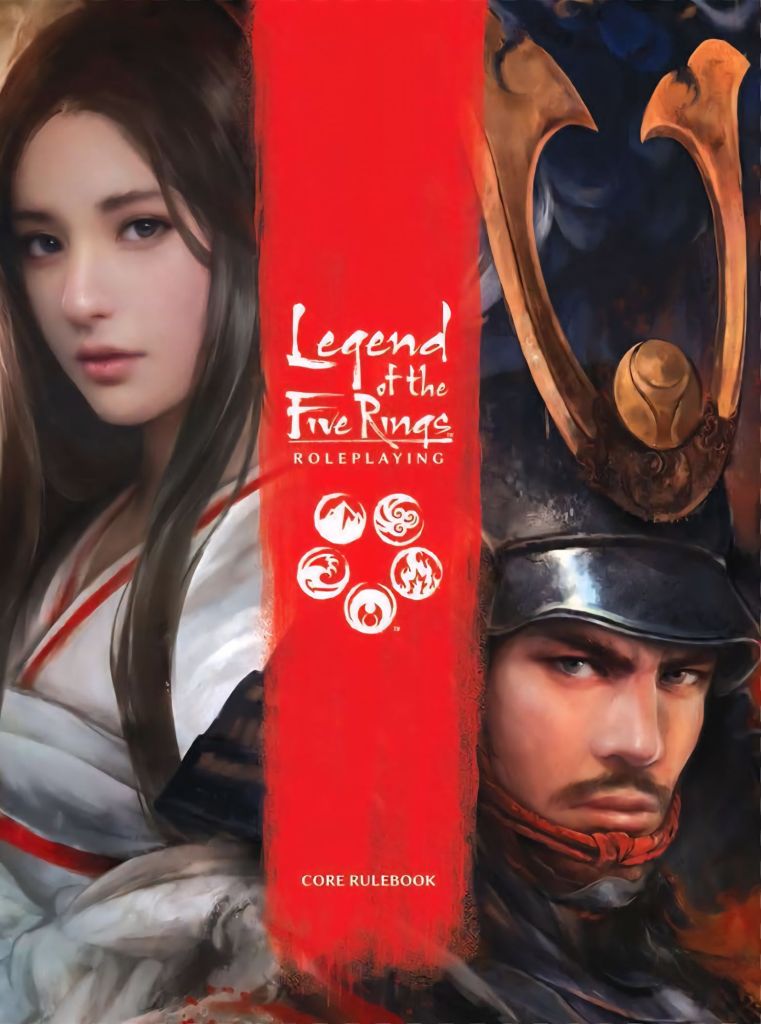
Legend of the Five Rings (L5R) is a game with an interesting history. The name of the game derives from the philosophy and martial arts guide, The Book of Five Rings, written by the famous swordsman Miyamoto Musashi in the 1640s. The book uses a Buddhist five element system to describe swordsmanship and the world. The L5R game uses those elements and builds an alternate reality version of peaceful Edo-period Japan, called Rokugan. Evil demons play the role of Westerners trying to introduce foul magic instead of guns to corrupt the people of Rokugan.
L5R was first published as the setting of a card game in 1995. The card game had a storyline that developed based on the events of a yearly tournament. Whatever cards made it to the finals and the outcome of the finals dictated the story going forward. So next year’s card set was something the best players got a heavy hand in influencing via the decks they brought to the final match. The card game faded over time and went out of print in 2015 or 2021, depending on how you count it.
Along with the card game, a roleplaying game was published for L5R in 1997. The first four editions used a roll and keep resolution system with d10s. Similar to how D&D stats are rolled with 4d6, keep the highest 3. An action might let you roll 5d10s and keep the 3 highest. So if you got a 5, 6, 6, 8, and 9 you’d keep the 9, 8, and 6 and add them together for a result of 23. Probably easier to understand than the 5th edition rules, as you’ll see.
As interest in L5R declined, the RPG was licensed to a new company, Fantasy Flight Games (FFG). FFG adapted the Rokugan world and existing rules to their own Genesys narrative RPG system. The FFG fifth edition of L5R is what I’m looking at in this review.
Game Basics
The action resolution for Legend of the Five Rings fifth edition is similar to FFG’s other RPGs. You roll some special dice with symbols on them. The symbols are:
- Successes
- Exclusive Successes (counts as a success and roll an extra die)
- Opportunities (small extra good thing)
- Strife (mental damage to your character)
Some of the die faces have more than one symbol. There are d6s and d12s. d6s have a total of 2 successes, 1 explosive success, 2 opportunities, and 3 strife. d12s have 5 successes, 2 explosive successes, 4 opportunities, and 3 strife. That makes d12s slightly better, with a higher ratio of successes and a lower ratio of strife.
A challenge roll requires a certain number of successes. The TNs range from 1 to 8 with descriptors of
- Easy
- Average
- Difficult
- Very Hard
- Extremely Hard
- Extraordinary
- Heroic
- Legendary
The highest number of dice you can roll is 10, and even at that number, your average result would be about 6 successes. TNs of 7 or 8 require luck or something special from even the most accomplished person.
When rolling, you get to choose which dice you keep for determining your success. The only bad result, strife, is always paired with a good result. So you might choose to accept some strife in order to succeed at a difficult task. Opportunities can also be used to cancel out strife.
Your basic stats are your elemental Rings of Air, Earth, Fire, Water, and Void. You also have a number of skills such as Composition, Command, Martial Arts (Melee), or Skulduggery. Your elemental Rings and your skills are both rated on a scale from 1 to 5. 1 represents a weak Ring or an amateur skill level. 2 is average. 3 or higher represents a character strength, with 5 being the pinnacle of human ability.
Determining the dice you roll for a challenge is easy. Identify the relevant Ring and skill for the task. Take a number of special d6s equal to your Ring score and a number of special d12s equal to your skill score. Roll all those dice and you’ve got your result.
Details of Play
An interesting part of playing L5R is picking which Ring to use in a situation. Each of the five Rings has a personality attached to them. So there’s a similarity compared to wu xing even if it’s using a different five element system. Air is grace, cunning, precision, and subtlety. Earth is resilience, patience, memory, and calm. Fire is passion, invention, candor, and ferocity. Water is flexibility, awareness, efficiency, and calm. Finally, Void is mysticism, intuition, instinct, and wisdom.
Each of the Rings has different approaches for different types of activities. Air is tricky in social encounters and feints in combat. Earth reasons in social and withstands in combat. Fire incites in social and overwhelms in combat. Water charms in social and shifts in combat. Void enlightens in social and sacrifices in combat. Depending on how you describe your action, you will be using a different Ring for action resolution. And that creates an incentive to play to your character’s strength, which also plays into a personality for your character. A solid Earth character will usually take a slow, reasoned approach to solve problems, which might be quite different than a character that favors a different Ring.
Opportunities add something small to a scene. This can be a little spice that you work out with your GM or a delayed benefit that won’t pay off for a while. Fortunately, L5R did not leave this solely to GM adjudication. There is an extensive list of acceptable uses that should allow strict playstyles to still use opportunity rolls for their intended effect.
Strife provides another level of play to L5R. As a player, you take on the role of a noble samurai, which comes with many duties and expectations. The stress of these expectations is represented by strife. If you lose too much strife, your character becomes compromised, preventing them from using any further dice results with strife on them. You can relieve strife by relaxing or by “unmasking.” Unmasking is an extreme and embarrassing outburst of emotion. Scream at someone, bawl in public, or challenge someone to a duel to relieve the stress you’re experiencing. Relaxing reduces some strife, but unmasking removes all your strife, providing an incentive for dramatic emotional scenes.
Character Creation
Character creation in L5R is done with a set of 20 questions. We start with three basic choices. Which of the seven major clans of Rokugan are you from? Which of the families within the clans are you a part of? And which school tradition did you train under? The school choice is the most important, defining most of your skills and means for advancing as a PC.
Other questions help you decide different advantages and disadvantages your character has. These provide small conditional bonuses or penalties to rolls. A typical advantage allows you to reroll two dice in certain situations. A disadvantage is the reverse, forcing you to reroll two successes when the disadvantage is relevant.
Your school defines the techniques you have access to. These are your cool moves. Techniques include combat styles, magical spells, ninjitsu powers, or social maneuvers. Each school has a few unique techniques and gives you access to three groups of general techniques. There are over a hundred techniques, giving plenty of variety for building mechanically unique characters.
Advancing as a character is done with a building point system. 1 XP is awarded for each hour of play, along with bonuses as determined by the GM. Improving a Ring costs 3 x the new score. Improving a skill costs 2 x the new score. Techniques cost 3 XP each. So you’ll typically see an advancement of some kind each session at the start of a campaign and maybe every two sessions at the end.
Gamemaster Side
Actual scene resolution and GMing are too complicated and extensive for me to describe in this review. There is lots of guidance, but L5R has a different focus than other RPGs I’m used to. There is much more emphasis on social interactions and social consequences than the typical adventure and combat kind of RPG. Emphasis on social encounters requires you to know and love the setting, and that’s where my problem is.
Ultimately, I’m not a fan of the Rokugan setting or the PCs’ role within the setting. I’ve consumed a lot of samurai stories (chambara) over the years. The chambara stories I like are pretty much exclusively about ronin (Yojimbo, Sanjuro, Zatoichi, Seven Samurai, Rurouni Kenshin, etc). L5R has minimal support for playing as a ronin. The clear intention is to play as a landed samurai with all the baggage that entails, rather than the “one warrior against corruption and evil” stories that I grew up enjoying. There’s a distinct mismatch between my expectations for a Japanese inspired setting and what L5R offers.
L5R falls short from my “looking for a good Chinese TTRPG” perspective as well. L5R is for simulating a game in medieval Japan, not China. There are pieces of Buddhism, but Daoism and Confucianism are absent. The five element system is not wu xing. The resolution rules could be adapted to the wu xing element system, but because so many other rules are built on those, you’d have to essentially build a new system to support the changes. Maybe Fantasy Flight will do that eventually, but I’m not holding out for it.
Legend of the Five Rings fifth edition looks like a great TTRPG for playing out noble samurai dramas. That’s not what I’m looking for, but if it’s what you’re interested in, you should check it out by clicking this link. https://www.legendofthefiverings.com/products/roleplaying-games/legend-of-the-five-rings


 GoCorral
Leave a comment