China: the RPG frontier. These are the voyages of the Isaac Shaker. His continuing mission: to explore strange new TTRPGs; to seek out new systems and new supplements; to boldly go where many have gone before!
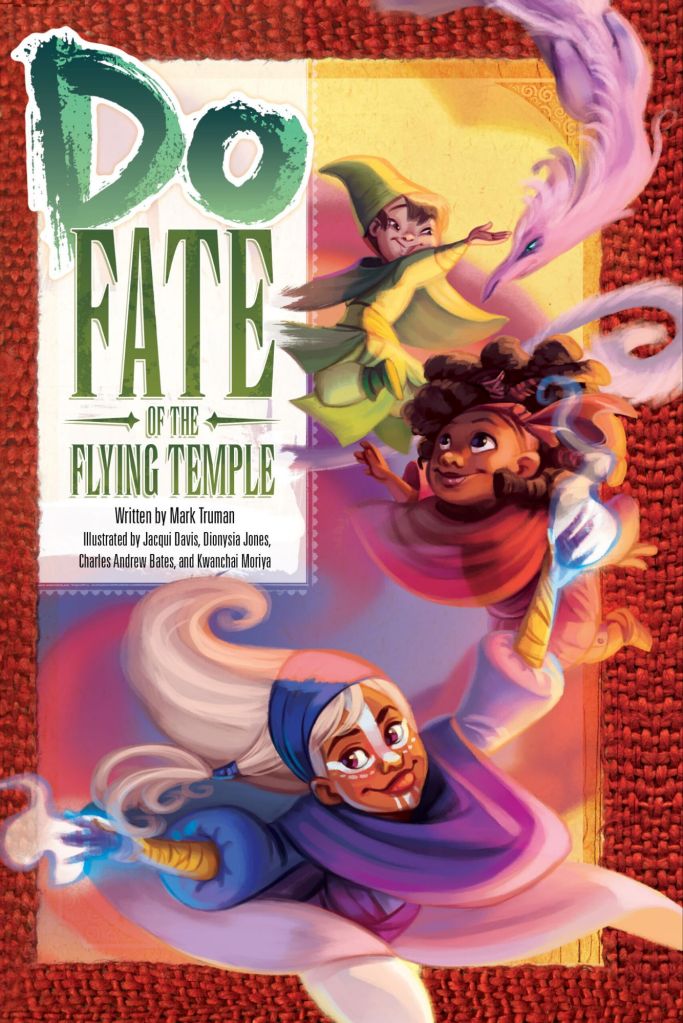
I read through Do: Fate of the Flying Temple while on vacation. It uses the Fate system to simulate a Chinese story and setting. Or at least it supposedly simulates a Chinese story and setting. The limitations of the Fate system make it so Do isn’t really tied to any particular type of story.
Do‘s official setting is the Many Worlds, a bunch of closely located floating planets and moons in an endless atmosphere. Gravity is subjective so everyone can fly once they figure out how to fall and miss the ground. The Many Worlds are home to pretty much any culture, society, and story the play group wants to explore. The players are Pilgrims of the Flying Temple, a beacon of light at the center of the Many Worlds. Pilgrims are problem solvers for the Many Worlds, almost exactly like Jedi from Star Wars.
Do assumes a campaign frame of the Flying Temple disappearing without explanation. The party of Pilgrims arrives to find a dragon egg in the temple’s place. The party must care for the egg and eventually the hatched dragon while solving problems and finding the missing temple. Rather open-ended and not really what I’m looking for.
Do is a simple RPG system and this character creation is also simple. You pick a name with an adjective and a noun, like Mischievous Badger. You gain two Aspects related to your name, like Stealing Shiny Things and Aggressive Digging. You also add Stunts that are more specific in application. Each character’s stats are defined by Approaches. There are six Approaches, Careful, Clever, Flashy, Forceful, Quick, and Sneaky. You start with a +3, +2, +2, +1, +1, and +0 that you assign to the different Approaches. Your final stat is your Refresh number, usually 3,which represents the amount of Fate points you start each game session with.
Action resolution starts with a difficulty set by the GM, 0 for Mediocre, 1 for Average, 2 for Fair, 3 for Good, 4 for Great, and 5+ for Superb. Players choose an Approach and roll 4 Fate dice. Fate dice are d6s with two +1 faces, two +0 faces, and two -1 faces. So the roll ranges from -4 to +4 and averages to 0. There are four levels of success for each action, fail, tie, succeed, and succeed with style (succeed by 3 or more). If you didn’t meet a difficulty, you can adjust your roll by +2 with stunts if they apply or by +2 by spending a Fate point to invoke an Aspect in the scene. Your character has their Aspects, other characters have their Aspects, and the scene also has Aspects like Dangerous Cliffside, Harsh Blizzard, or Evil Presence. That’s a bonus for invoking an ally’s Aspect, as the Fate point you spend is given to them. The optimal strategy is teamwork where players pass their Fate points between each other rather than depleting them.
Aspects can be used against players. A negative Aspect can compel an action. When a character is compelled, they gain a Fate point. If they don’t like the compel, they can spend a Fate point to refuse. This is how you gain more Fate points to spend invoking Aspects. You can also gain a free innvoke on Aspects that you introduce to a scene.
Do‘s book is well organized. Everything is in the right place for understanding the system. There’s fun art throughout the book. The best part is a huge number of examples of play. Each different rule has an example of play next to it. Read together the examples tell the story of a group going through their first few sessions of Do, learning the system along with you as you read the book. The back third of the book is for the GM, but the examples of play do a great job of showing how to run the system as well. It’s amazingly well done and a great example of how to construct a TTRPG book.
The whole system is like a tug of war between the players and the GM over Fate points. The players spend points to succeed at actions. The GM tempts them to follow the story with compelled Aspects. Do is a great guide to improv storytelling but not a robust roleplaying game. While there is a game to the system, it feels more like it’s intended to provide a framework for storytelling instead of being intrinsically fun to play independent of the story.
As for Do being a China TTRPG, the rules of Do don’t really tie it to any setting. The provided setting has almost no limitations. But, then why is it Chinese themed? The system works just as well for Italian Renaissance themed steampunk as it does for medieval China. The rules have no wu xing elements. The setting has no significant pieces of Chinese culture in it. There’s no Confucianism, Buddhism, or Daoism. The dragon of the temple is an Eastern dragon in all the art, but the players could easily describe it otherwise if they wished. The game also has a heavy emphasis on non-violent resolution. While that’s admirable, it certainly doesn’t fit with a wuxia/xianxia inspired story.
Do: Fate of the Flying Temple isn’t the right game for me. It could easily be the right game for others though. I’ve heard other people talk about the Fate system before and this seems like a good example of it. I understand how the pieces fit together. It feels like it would be easy to run, have fun, and tell good stories with. If you’d like to check it out, the game is available on Evil Hat’s website: https://evilhat.com/product/do-fate-of-the-flying-temple/




 GoCorral
Leave a comment