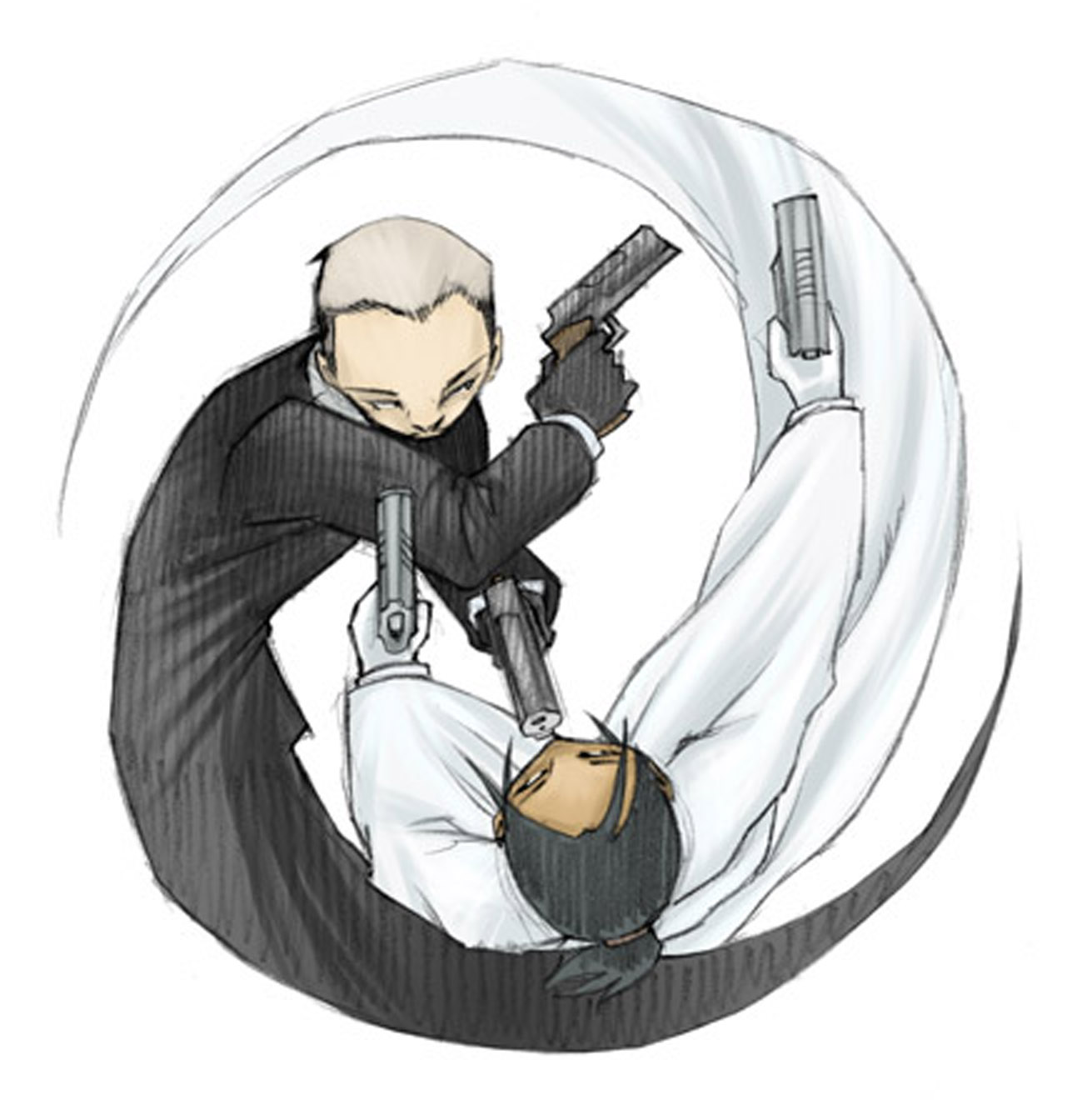
I read through Wushu in my continuing quest to read all Chinese wuxia inspired games. Wushu is an independently published game that you can get for free. Very simple rules and art, but sometimes that’s all you need. The game is available directly on the author’s website or as a downloadable PDF. The PDF is formatted for easy reading on a phone or tablet with giant text, silhouette images, and not much text per page. The 200 pages fly by quickly.
Action resolution is quick. You describe your action. The number of details you provide equals the number of dice you get to roll, up to a maximum set by the GM (6 is the default). Every die you roll that is equal to or under your relevant trait is a hit/success that contributes to defeating the current challenge. Because your mechanical power derives from providing details, players are encouraged to roleplay exactly what their characters are doing. Every action in the game is resolved the same way, combat, investigation, conversation, etc., so there’s no need to approach challenges from any particular angle. The system is VERY fluid in the stories it can handle.
Character creation is similarly simple. You choose three traits which are used for rolling equal to or under. Your first trait is your Motivation trait with a value of 5. It represents what drives your character and should only be relevant during emotional moments in the story. Your second trait is your Combat trait with a value of 4. Maybe you fight with guns, swords, kungfu, or magic. Or maybe its an intrigue game and your “Combat” trait is hacking computers or demolitions expert. Your third trait is your Profession trait with a value of 3. A farmer, a diplomat, or a police officer. If it’s the most relevant trait you get to roll with a target of 3 or less. Everything else you might roll for has a trait value of 2. Characters can improve their traits or gain new ones as a campaign goes on, but there’s no hard rules for it.
Threats in Wushu are represented by stacks of poker chips. Each hit you get with an action roll removes one poker chip. When the poker chip stack is gone, the threat is defeated/overcome. Additionally, every turn a threat removes a Chi token from players. Players start each scene with 3 Chi tokens. A player is removed from the scene at -1 Chi. Players can split their action rolls to defend as well, with each defense “hit” countering a Chi removal. The optimized play to prevent Chi removal seems to be using 4 dice for offense and 2 dice for defense.
So where does the GM come in? Threats aren’t really controlled by the GM. The players control the mechanics of the game with their action rolls. The GM just describes the threat, puts down a stack of poker chips, and narrates the action. The GM does have one other tool though, a Nemesis. These are characters just like the players with Traits and Chi. A Nemesis is more active, allowing the GM to interact with the game mechanically and have some extra punch for “boss” characters.
The first 40 pages of Wushu provide the rules for the game I’ve detailed here. The rest of the book is devoted to an enormous “How to GM” section. It’s quite impressive giving lots of tips, suggestions, adventure ideas, examples of play, and optional rules. Very well written and clearly useful.
My favorite optional rule is Flashbang Dice. The idea is to start an adventure in media res. So a car chase is happening and the players are shooting their guns at three goon cars that are following them. As the scene proceeds the GM and players write down some details about the scene. The car, the goons, why they’re being chased. Then the GM flashes back to a previous scene. The players now have to connect the dots to reach the original scene. They have to initiate a conflict with the goons, get chased, and acquire the car they were driving in the initial scene. For each detail they recreate, they get a Flashbang Die which can be added on top of their usual maximum in a later scene.
Wushu is an extremely simple system. You probably could play it with everything I’ve said here instead of reading the proper rules. And that’s the problem with using it for a Chinese inspired game. There’s really nothing tying Wushu to Chinese culture, wu xing, the Zodiac, or really anything at all. The system is only one step above unstructured improv. It’s a great system for what its aiming to do, but its no where near what I’m looking for.
If you’d like to take a look at the Wushu rules for yourself you can check them out at the creator’s website: http://danielbayn.com/wushu/



 GoCorral
Leave a comment