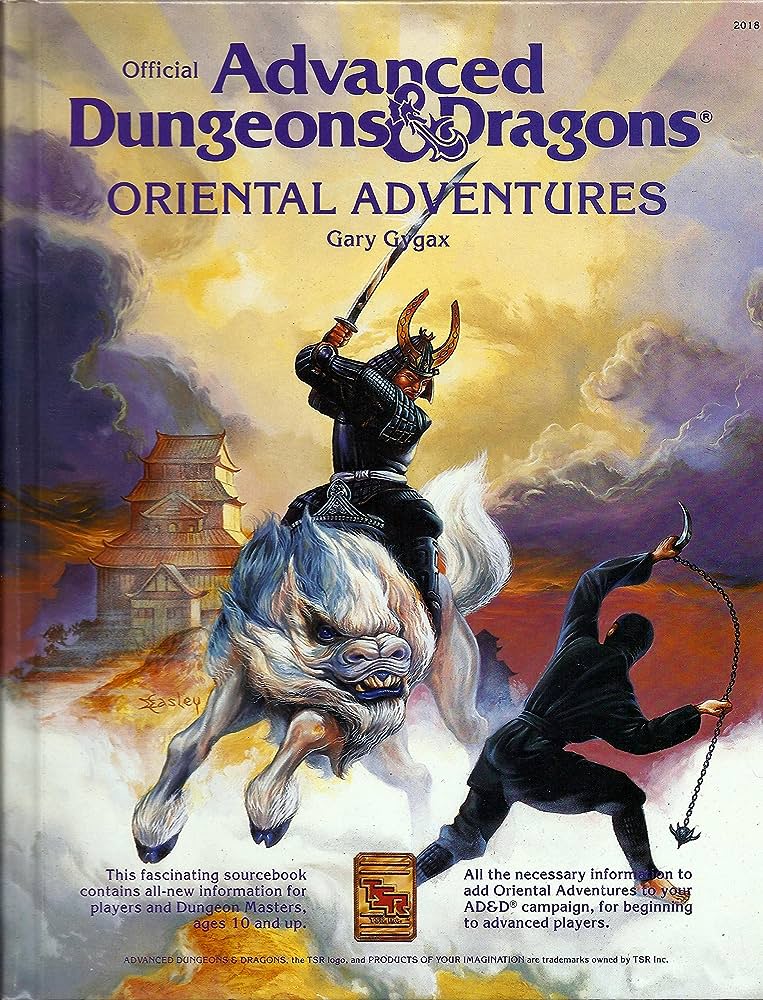
AD&D’s 1st edition Oriental Adventures is an older attempt at Eastern RPGs, but I figured I’d give everything a shot. I’d say the book is not quite playable by itself. It gets pretty close, but the PHB, DMG, and Monster Manual are probably still needed to really make Oriental Adventures a functional game.
A few things are immediately obvious when reading the book. It’s clearly adapting Japanese fantasy, not Chinese. Unfortunately, many of the systems on my list blur the line between the two countries, so… get used to that. Oriental Adventures also has almost no art in the book. There’s maybe a dozen illustrations in a 150 page book.
The book is decently organized, but was clearly written by multiple people without a style standard. This is most obvious in the class section where each class has a different way of telling you how they gain abilities as they level up. There isn’t much internal organization, but what is there is helpful. Short and to the point chapters make the book easy to digest.
I’ve tried AD&D 1st edition before and found it to be a unsatisfying experience. THAC0 is kind of a dumb idea. Multiattack progression tracked with fractions also feels ridiculous. All the specific subsystems pull you out of the main game and into a little subgame. Oriental Adventures sticks to that formula which was successful at the time of release but feels clunky compared to modern games. The book contains Eastern alternatives to most of the main classes. Wizards are now wu jen, thieves are yakuza, fighters are bushi, paladins are samurai or kensai. Races are a bit different since many D&D races are part of Western folklore. The choices are human, korobokuru (dwarves), hengeyokai (animal shapeshifters), and spirit folk (aasimars). It’s a decent amount of customization, but feels old and dusty compared to modern D&D games.
Most of the rules do not set the system far enough away from vanilla AD&D for it to feel Chinese. It’s all flavor instead of substance. The rules do support a feudal system by encouraging and discouraging player actions with ability requirements for character classes and races, oaths for character classes, and the honor system. Your character choices are limited by your stats. Hengeyokai are a strong race, so you need at least a 12 in strength to play as one. Wu jen are smart so you need a 13 in intelligence. This creates a sense of fate for what you character can be. A character with low stats might be forced to be a yakuza because of the hand that life dealt them. Perhaps not the fantasy that most people look for in games, but more on that later.
Continuing the thread of character building, many classes are also required to take oaths of some kind. For example, samurai are sworn to a damiyo and a spellcaster’s power comes from self-denial due to Buddhism. This system of oaths is expanded with the honor subsystem. Each character has an honor score that they are trying to increase by performing different actions in the game. Many of these actions are shared such as defeating monsters or fulfilling a debt, but others are specific to different classes and races. Your character’s honor also has a relation to family/clan honor, so what’s good for you is good for them. The benefit of high honor during play is that people like you more.
Honor has an additional effect when your character dies. The player takes the honor they gained during play and divides it by 10. This quotient creates a pool that can be added to the ability scores of the player’s new character. So if you gained 30 honor points during play with one character, your next character could add 3 to their strength stat when you’re rolling them up. The designers probably viewed this as a way to compensate for starting a new character at level 1.
A broader look at the game confirms that it’s more like a pen-and-paper rogue-like than most other RPGs. Your character’s family is randomly generated and its encouraged that when you die you play as your character’s sibling or relative. Events are randomly generated by the DM with a separate table for yearly, monthly, and daily events. Your characters respond to these events and gain honor so you can be more powerful the next go-around. The game doesn’t seem to want the DM to be designing dungeons to explore in the same way the base game does. In fact, since the DM is doing so much random generation if you run the system as-is, it almost feels like a DMless system. That said, there are a number of monsters for the DM to use that are well-made with good Eastern MSG flavor. Additionally, the back of the book lists monsters to use from previous AD&D 1st edition books that work well with the Eastern theme.
There are a number of interesting subsystems that deserve mentioning. The skills are a wide variety, some more useful than others. Barbarians can build fires, wu jen can read maps, and ninjas have a specific height they can pole vault that is tied to their level. There’s a surprisingly deep system for designing your own martial arts style for your character complete with moves that you can create or master from other dojos you encounter. The martial arts system is fascinating enough that I think it should’ve gotten its own game instead of being slapped on to this supplement as a six page afterthought.
Does AD&D Oriental Adventures pass my test for wanting to run a Chinese themed campaign with it? Unfortunately, no. I’ve played 1st edition before and haven’t liked it and this book didn’t do enough to draw me in to try again. It checked some of my boxes, but only in a roundabout way. The zodiac is present with the animal choices for the hengeyokai race. The five element system exists for the wu jen, but feels like an afterthought since most of the spells are the same as they are for the base Western themed game. The flavor of Eastern culturalism is definitely there, but from a Japanese feudal perspective instead of Chinese. Ultimately its not something I want to move forward with trying, but I’m glad I read the book if only for the martial arts section.
What is the book good for? It seems to be designed for running a rogue-like game where the PCs are concerned more with furthering their clan’s political goals within a feudal society instead of adventuring into dungeons to kill monsters and get treasure. I think the most fun way to play would be where all the PCs are from the same extended family and can benefit each other by increasing their honor. With higher honor they can get stronger characters and eventually make a play for the shogunate. Oddly, the rules could just as easily work in a Western themed feudal system if you preferred that. I think that’s what Oriental Adventures is meant to do, but even in that case, I’d question whether its the best system for that use case. Legend of the Five Rings might work better for Eastern feudalism and Pendragon might work better for Western.
If you’re interested, AD&D 1st edition Oriental Adventures is available on DriveThruRPG: https://www.drivethrurpg.com/product/17334/Oriental-Adventures-1e

 GoCorral
Leave a comment