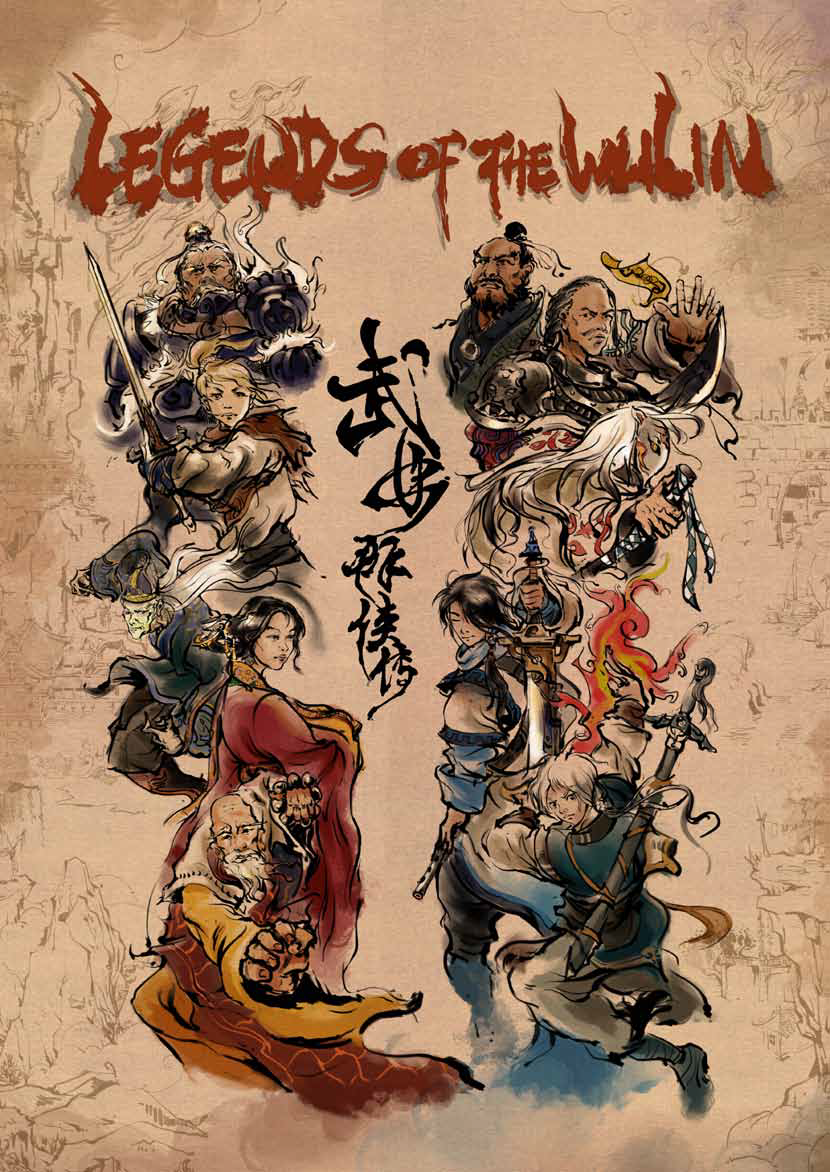
Legends of Wulin is a partial successor to Weapons of the Gods. While the previous rule set tried to emulate Wuxia stories set in mythical times, Legends of Wulin tries to be a bit more grounded. It’s sort of a second edition of Weapons of the Gods. Originally I was going to review Weapons of the Gods as well, but seeing how the authors’ second attempt at making an RPG system went… well, you’ll see.
The book is terribly organized and definitely could use some work. The authors apparently have a personal grudge against tables and refused to use them. It’s quite difficult to understand the rules, because the authors never present any concepts alongside others. There’s plenty of play examples which are helpful, but tables are also very important and mysteriously absent.
There’s lots of great black and white art. There’s a lot of world building, but no maps or organization to ease reference of the material the authors wrote. The lore is sprinkled into different sections of the rules themselves. If I want to learn more about the Crane School, I’d have to read about them in Crane Technique section, not the Wuxia schools section. Editing was also imperfect so there are occasional contradictions both in the lore and the rules themselves.
Legends of Wulin‘s central mechanic is a great way of symbolizing chi moving and flowing through your character’s body.
In Legends of Wulin there are five different ranks that define a person’s martial arts prowess. Normal people are 5th rank. Your PC has some training so they start off at the 4th rank. Power increases as you move up through the ranks with 1st being the best. So kind of like levels in any other RPG, but in reverse order just to be difficult. Rank defines your base stats of Lake, River, Joss, and Chi. Each stat goes up by one when a character’s rank increases.
Lake is the most important stat as it decides how many dice the character rolls when they use a skill. 4th rank characters start with a Lake of 6, giving them 6 dice to roll. The dice are all d10s. The result is not based off the total number, but determined in a bit more complicated fashion. Your result has a Tens digit and a Ones digit. Both are decided by the most frequent number that shows up in the roll of 6 dice. Take an example roll of 3, 5, 6, 6, 7, 10. 6 is the most common result. I rolled two 6s, so my Tens digit is 2 and the Ones digit is 6. My result is 26. I’d then add my skill bonuses on top of that result.
The game has example difficulties for tasks: Trivial 10
Moderate 20
Hard 30
Memorable 40
Fantastic 60
Legendary 80
Impossible 100
My unmodified 26 result is sufficient for a Moderate task. Probably 36 after modification which is good enough for a Hard task.
Let’s say it modified to a 36 and the task was Moderate. I didn’t need a 36, all I need is a 20. That’s where the River comes in. I can Float my two 6s into the River to store them for a later roll. Then if I have a Hard difficulty task later in the same scene I can Flow the two 6s out to achieve the task. I could even combine the 6s in my River with more 6s that I rolled with my Lake to achieve an even higher difficulty task.
With a River size of 2 at 4th rank, I’m allowed to store two sets of dice. Each stored set needs to be at least two dice. I have my set of two 6s. On another roll I could get two more 6s and store those as my second set. Or I might get three 4s and store those as my second set. I can also replace any set with a new one I’ve rolled from my Lake.
Joss is the action point of Legends of Wulin. Using a point of Joss increases your Lake by 1 for a roll or decreases your opponent’s Lake by 1 for a roll.
So during an encounter your power flows in and out of your River, hopefully providing more and more power until your collect enough of the same dice for an explosive finish.
So the basic mechanic is great. What about character creation? Unfortunately, kind of garbage. You pick skills at character creation from the list of: Awareness, Confidence Crafting, Finesse, Hardiness, Inspire, Learning, Medicine, Might, Perform, Politics, Ride, Stealth, Survival, Tactics, and Wu Wei. Characters start with about ten skills and gain points to acquire more skills or techniques throughout gameplay.
There’s no good list of what techniques you can get. It’s all buried within an enormous lore dump. Techniques are used during play by expending saved rolls in your River, using your Chi points, or using Joss.
There’s no real description of how you proceed through scenes using these skills. The DM defines difficulties for tasks and you complete them. There’s a barebones description of how to proceed through combat but other scenes are left poorly described.
My overall impression is that the basic mechanic of the Lake and River is a good idea. The rest of the book is a mess. The organization that exists is bad at informing players and DMs in how to play the game, build characters, or craft adventures. I could probably understand it if I read through the book again with a careful eye, but that would present a different problem. I would know how to play, but explaining it to my players would be difficult because the book provides no useful tools for quickly teaching the game to others.
Basic mechanic is great. Organization is terrible. Ancient China feels is quite good. The five elements are included in the techniques and Chi usage. Zodiac is also present as weapon styles, so that’s a plus. The organization is really what kills this book. It makes me really appreciate the thought that goes into making the information easily understandable in other big RPG systems like D&D. Since its too hard to understand, I’ll be skipping this system and not using it for play.


 GoCorral
Leave a comment