One of my jobs is working with introns in C. elegans and the other is working on rice genetics.
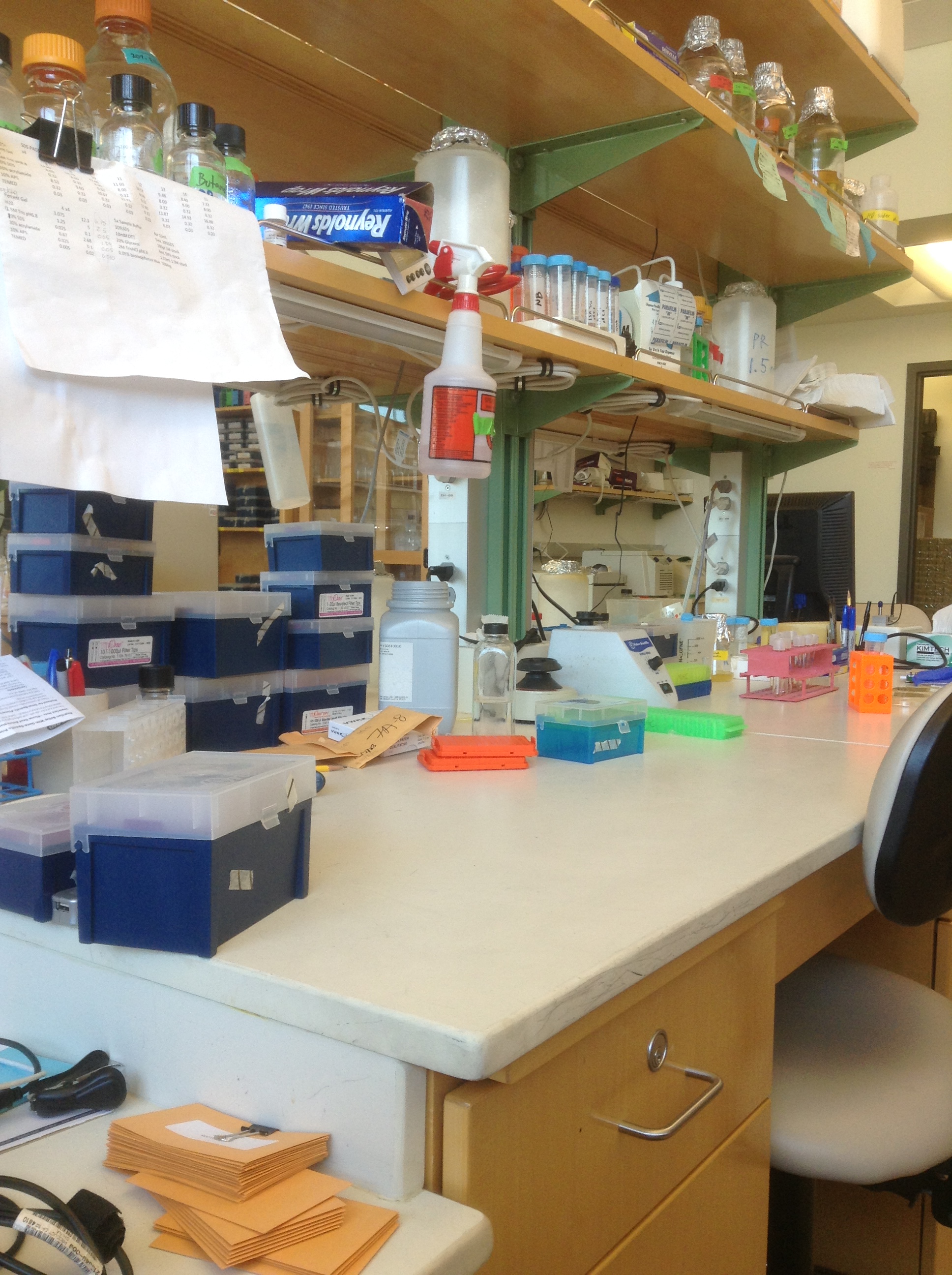
Above is a picture of my lab bench in the rice genetics lab where I do most of my work.
The rice are kept in three separate greenhouses spread around the western fringes of the college campus. The furthest greenhouse is a little over a mile from the lab.
The technology and staff at the greenhouse complex essentially takes care of the rice for me. They’re checked on once a week by someone in the lab.
About once a month we collect leaves from the rice plants.
I grind the leaves up and extract the DNA from them.
The DNA then gets sent to the Joint Genome Institute to be sequenced.
Sequencing is when the genetic code is read in its entirety to see each letter within it.
The entirety of an organism’s genetic code is called the organism’s genome.
JGI reads the rice genome, then uploads it to the internet for researchers around the world to use.
The rice genome has already been sequenced, so why are we doing it again?
The first time the rice genome was sequenced there were a lot of errors in it. Rereading the sequence now will hopefully rectify those errors.
There’s another project going on at the same time as that though.
I am not isolating DNA from “vanilla” rice, but over 2500 different mutant varieties that were created in my lab.
The sequencing will find a bunch of little errors within the rice genome.
Researchers who are interested in specific errors can then ask my lab to send them some rice seed of that particular mutant variety.
Those researchers get what they want easily and my lab gets a little bit of money for selling the seed.
The mutant varieties don’t “taint” the overall sequence because they only contain errors in a few places. The consensus sequence between them will remain the same.
I’m just a little part in that sequencing project that’s taken almost a decade at this point. I won’t be the one to finish it either, but I’m moving the ball closer to the finish line!
-Mister Ed






 GoCorral
Leave a comment